
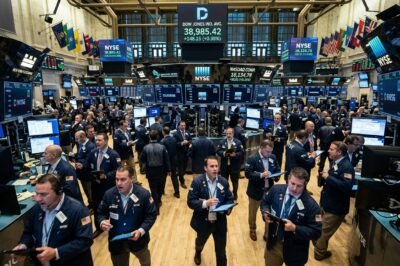
The global financial landscape woke up to a complex dichotomy this Monday morning as the Dow Jones Industrial Average clawed its way toward fresh record highs while the tech-heavy Nasdaq Composite struggled to maintain its footing. This divergence serves as a poignant reminder of the delicate balancing act investors must perform as the third-quarter earnings season shifts into a higher gear. With the bond market closed in observance of the federal holiday, the usual signals from the Treasury yield curve were absent, leaving equity traders to navigate the choppy waters of corporate sentiment and macroeconomic forecasts without their traditional compass. As we embark on what many analysts are calling the most pivotal week of the quarter, the tension between value-oriented blue chips and growth-focused technology stocks has never been more palpable. Market participants are bracing for a deluge of data from the world’s largest corporations, hoping for clarity on consumer spending, AI infrastructure return on investment, and the lingering effects of the Federal Reserve’s recent pivot. Today’s early action sets a cautious yet opportunistic tone for the days ahead, as the Dow gains momentum from a diverse array of industrial and financial leaders, while the Nasdaq feels the weight of valuation concerns and a temporary lull in tech-driven enthusiasm. This unique environment, characterized by a lack of fixed-income data, forces a singular focus on equity fundamentals and the micro-narratives driving the 30 companies that comprise the Dow.
The Blue-Chip Ascent: Analyzing the Dow’s Upward Momentum
The Dow Jones Industrial Average (DJIA) has shown remarkable resilience in the face of broader market uncertainty, recently pushing into territory that reflects a renewed confidence in the traditional sectors of the American economy. Unlike its tech-heavy counterparts, the Dow is buoyed by companies that represent the backbone of domestic commerce, including financial services, healthcare, and heavy industry. On a day when the bond market is shuttered, these value-oriented stocks often become the focal point for investors seeking stability. The recent performance of banking giants, which kicked off the earnings season with better-than-expected results, has provided a sturdy floor for the index. Analysts point to the robust net interest income and strong balance sheets of these institutions as evidence that the high-interest-rate environment has not yet significantly dampened the profitability of the financial sector. Furthermore, the Dow’s price-weighted nature means that high-priced shares in sectors like healthcare are exerting a positive pull on the index, reflecting a defensive rotation by fund managers who are wary of the volatility often found in high-growth tech sectors.
As we delve deeper into the components driving the Dow, it becomes clear that the index is benefiting from a ‘catch-up’ trade. For much of the first half of the year, the market’s gains were concentrated in a handful of artificial intelligence stocks, leaving many industrial and consumer staples companies trading at attractive valuations. Now, as the narrative shifts toward a potential ‘soft landing’ for the economy, these laggards are seeing significant inflows. Strong performances from companies like UnitedHealth Group and Goldman Sachs have been instrumental in pushing the Dow to its current levels. The broader market sentiment suggests that while the AI story is far from over, there is a growing appetite for companies that can demonstrate consistent cash flow and dividend growth in a fluctuating economic climate. This rotation into value is not just a temporary trend but a reflection of a market that is becoming more discerning about where it allocates capital during the final quarter of the year.
Tech Sector Turbulence and the Nasdaq’s Retreat
While the Dow enjoyed its climb, the Nasdaq Composite faced a more challenging opening to the week, characterized by a slight pullback that highlights the ongoing sensitivity of growth stocks to valuation pressures. The tech-heavy index, which has been the primary engine of market growth throughout 2024, is currently grappling with the high expectations set by investors. As the market enters a heavy earnings week for the Magnificent Seven and other tech titans, there is a sense of ‘priced-for-perfection’ surrounding many of these names. The slip in the Nasdaq today can be attributed to a combination of profit-taking and strategic repositioning. Investors are closely watching the semiconductor space, particularly companies like Nvidia and AMD, for signs of whether the massive investments in AI infrastructure are beginning to translate into sustainable revenue growth for the broader software and services ecosystem. Any hint of a slowdown in capital expenditure from the cloud giants could lead to further volatility in the tech sector.
Moreover, the Nasdaq’s performance is being influenced by the upcoming earnings reports from influential players like Tesla and Netflix. These companies often serve as bellwethers for consumer discretionary spending and the health of the digital economy. The current retreat in the index reflects a cautious wait-and-see approach. There is also the matter of international factors; supply chain shifts and geopolitical tensions continue to cast a shadow over global tech operations. Unlike the Dow, the Nasdaq is highly sensitive to the global regulatory environment and international trade policies. As companies navigate the complexities of global expansion while managing domestic expectations, the Nasdaq remains a more volatile barometer of investor sentiment. Today’s slight decline is a reminder that the path to higher valuations for tech companies is rarely a straight line, especially when the macroeconomic backdrop remains clouded by questions about the duration of the current interest rate cycle.
The Significance of the Bond Market Holiday
The closure of the U.S. bond market for the federal holiday adds a unique layer of complexity to today’s trading activity. Typically, the equity and bond markets operate in a symbiotic relationship, with Treasury yields providing critical signals regarding inflation expectations and the future path of interest rates. Without the 10-year Treasury yield to act as a benchmark, equity traders are operating in a data vacuum of sorts. This often leads to lower trading volumes and can sometimes result in exaggerated price movements in the stock market as liquidity is reduced. The absence of bond trading means that there is no real-time adjustment of discount rates, which are fundamental to the valuation of growth stocks. Consequently, the Nasdaq’s movement today might be more reflective of pure sentiment rather than a reaction to changes in the cost of capital.
Historically, days when the stock market is open but the bond market is closed tend to be quieter, but they also allow for a more concentrated focus on corporate news. For the Dow, this lack of noise from the fixed-income sector has allowed the positive momentum from recent earnings to take center stage. For the Nasdaq, however, the lack of yield data can be a source of anxiety, as investors cannot hedge their positions or adjust their outlooks based on interest rate fluctuations. This decoupling of the two markets is temporary, but it underscores how much modern equity trading relies on the signals generated by the credit markets. When the bond market reopens tomorrow, we can expect a flurry of activity as traders reconcile the stock market’s moves with the reality of current yields, potentially leading to a more synchronized or volatile market reaction.
Anticipating the Q3 Earnings Deluge
The current week marks one of the busiest periods of the third-quarter earnings season, with a significant number of S&P 500 companies scheduled to report their financial results. This ‘earnings gauntlet’ will provide the most comprehensive look yet at the health of corporate America following the Federal Reserve’s first rate cut in years. Investors are looking for more than just earnings beats; they are searching for forward-looking guidance that accounts for a cooling labor market and shifting consumer behavior. The big banks have already set a high bar, reporting resilient consumer spending and a pickup in investment banking activity. However, the focus is now shifting toward the industrial, tech, and consumer discretionary sectors. Every report this week will be scrutinized for clues on margin pressures, as companies deal with the dual challenges of sticky labor costs and a gradual loss of pricing power.
Key Sectors to Watch
- Financials: Continued reports from regional banks will highlight the health of small business lending and the impact of the interest rate environment on local economies.
- Technology: Software giants will provide updates on the adoption rates of AI-integrated platforms and the strength of corporate IT spending.
- Consumer Discretionary: Retail and automotive reports will offer a window into the consumer’s willingness to spend on big-ticket items amidst economic uncertainty.
- Energy: With oil prices fluctuating due to global tensions, energy companies’ reports will be critical for understanding the sector’s dividend sustainability and capex plans.
The stakes for these earnings reports are incredibly high. Because the market has performed so well leading up to this point, there is very little room for error. A miss in guidance, even if a company beats on the top and bottom lines, could lead to sharp sell-offs. Conversely, companies that can demonstrate a clear path to growth despite the macroeconomic headwinds will likely see their stock prices rewarded. This week will effectively determine whether the current market rally has the fundamental backing to continue through the end of the year or if we are due for a period of consolidation as expectations are reset.
Macro Factors and the Fed’s Next Move
Beyond individual corporate performance, the broader macroeconomic narrative continues to play a decisive role in market movements. The Federal Reserve’s recent decision to lower interest rates was a significant turning point, but the market is still debating the pace and depth of future cuts. Recent economic data has been a mixed bag: the labor market remains relatively tight, yet there are signs of cooling in certain sectors. Inflation, while trending toward the Fed’s 2% target, remains a concern for some investors who fear that a premature easing of policy could reignite price pressures. The absence of bond market activity today means that the usual ‘Fed speak’ and reaction to economic indicators are temporarily muted, but the underlying tension remains. Investors are looking ahead to the next round of CPI and PPI data to confirm the disinflationary trend.
Furthermore, the geopolitical environment cannot be ignored. Tensions in the Middle East and the ongoing conflict in Ukraine continue to impact commodity prices and global trade routes. For the Dow’s multinational giants, these factors are critical, as they affect everything from input costs to international sales. The Nasdaq’s components, many of which rely on complex global supply chains for hardware, are equally sensitive to these shifts. As we move closer to the end of the year, the combination of domestic political uncertainty and international volatility creates a backdrop where market participants must remain agile. The Fed’s ability to navigate a ‘soft landing’ depends heavily on factors outside its direct control, making every piece of economic data and every corporate guidance update a vital piece of the puzzle for investors trying to map out the future.
Conclusion: Strategizing for a High-Volatility Week
As the first day of this pivotal week draws to a close with the Dow and Nasdaq moving in opposite directions, the primary takeaway for investors is the importance of diversification and fundamental analysis. The divergence between indices underscores that the ‘rising tide lifts all boats’ phase of the market may be transitioning into a more selective environment where sector rotation and stock-specific factors carry more weight. The closed bond market today provided a brief reprieve from the daily obsession with yields, but it also highlighted how critical those signals are for establishing a clear market direction. Looking forward, the remainder of the week will be defined by the quality of corporate earnings and the clarity provided by management teams regarding their 2025 outlooks. Investors should prepare for increased volatility as the market processes a high volume of data in a short period.
Ultimately, the long-term implications of this week’s activity will depend on whether corporate earnings can justify current valuations. If the tech sector can prove that AI is driving tangible gains and the industrial sector can show resilience in the face of economic cooling, the path to year-end highs for all indices remains open. However, any significant cracks in the consumer story or a stall in tech innovation could lead to a broader market re-evaluation. For now, the Dow’s record-setting pace provides a glimmer of optimism, suggesting that the broader economy remains on solid ground even as the high-growth segments of the market take a necessary breather. As we move into tomorrow and the bond market returns, the full picture of investor sentiment will become clearer, setting the stage for what promises to be one of the most consequential weeks of the year for global finance.




































Leave a Reply