
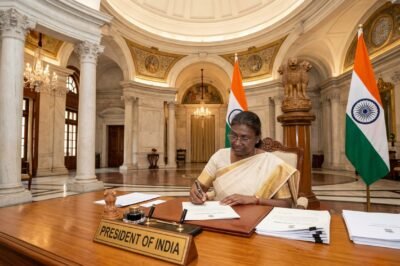
In a significant constitutional exercise that underscores the dynamic nature of India’s federal structure, President Droupadi Murmu has formally announced the appointment of new Governors for six diverse states across the nation. This high-profile administrative reshuffle involves the induction of four fresh faces into the gubernatorial fold and the strategic relocation of two seasoned incumbents. This move, emanating from the Rashtrapati Bhavan, is not merely a routine procedural update but a calculated step aimed at recalibrating the administrative synergy between the Union and the States. As the ceremonial head of the Republic, President Murmu’s warrants of appointment signal a transition in leadership that could have far-reaching implications for regional governance, political stability, and the implementation of central policies. The timing of these appointments is particularly noteworthy, occurring in the wake of a general election and preceding crucial state assembly polls, suggesting a deliberate attempt to place experienced hands in key Raj Bhavans to navigate the complex interplay of regional aspirations and national priorities.
The role of a Governor in the Indian political landscape is often a subject of intense academic and political debate. Functioning as the bridge between the Center and the State, a Governor is tasked with upholding the Constitution while ensuring that the state administration operates within the legal framework. With these new appointments, the President has balanced veteran political experience with regional representation. The four new appointees bring decades of public service to their new roles, having served in various capacities ranging from legislative speakers to union ministers. Meanwhile, the transfer of two existing Governors reflects a strategic redeployment to states where their specific expertise or demographic appeal might be more effectively utilized. This comprehensive overhaul serves as a reminder of the President’s prerogative under Articles 155 and 156 of the Constitution, reaffirming the executive’s commitment to maintaining a robust and responsive federal apparatus.
The Profiles of the Newly Appointed Governors
Among the most prominent new appointments is that of Haribhau Bagde, a veteran leader who has been assigned the prestigious Raj Bhavan in Rajasthan. Bagde, formerly the Speaker of the Maharashtra Legislative Assembly, brings a wealth of parliamentary experience to a state that is often a focal point of North Indian politics. His deep understanding of legislative procedures and his reputation for maintaining decorum in the house are expected to be significant assets in Rajasthan, where the governor often plays a crucial role in mediating legislative complexities. His appointment is seen as a move to bring a disciplined, veteran perspective to a state that serves as a cornerstone of the Hindi heartland.
In the southern state of Telangana, the President has appointed Jishnu Dev Varma as the Governor. Varma, who served as the Deputy Chief Minister of Tripura, marks a significant choice for a state that has seen a change in its political guard recently. As a member of the erstwhile royal family of Tripura, Varma brings a unique blend of traditional authority and modern administrative experience. His appointment to Telangana is particularly interesting given the state’s vibrant political climate and the ongoing transition under a new state government. His role will be pivotal in ensuring a smooth working relationship between the Bharat Rashtra Samithi-led or Congress-led dynamics and the central administration.
Om Prakash Mathur, a seasoned organizational strategist with a long-standing career in the Bharatiya Janata Party, has been appointed as the Governor of Sikkim. Mathur has been a key figure in national politics for decades, often credited with managing successful electoral campaigns in various states. His move to the sensitive border state of Sikkim is seen as a strategic placement of a trusted and experienced leader in a region of high geopolitical importance. Similarly, Ramen Deka, a former Member of Parliament from Assam, has been appointed as the Governor of Chhattisgarh. Deka’s deep roots in the Northeast and his extensive experience in national-level policy discussions will be vital in a state like Chhattisgarh, which faces unique challenges related to tribal welfare and internal security.
The Strategic Relocation: Transfers and Their Significance
The reshuffle also included the transfer of two prominent governors, a move that often indicates a change in administrative priorities or a need for experienced hands in more complex territories. C.P. Radhakrishnan, who was previously serving as the Governor of Jharkhand with additional charge of Telangana, has been moved to Maharashtra. This is perhaps the most high-stakes transfer in the current list. Maharashtra, being India’s economic powerhouse and a state currently navigating a highly volatile political landscape with multiple competing factions, requires a Governor with proven administrative acumen and the ability to remain neutral amidst political storms. Radhakrishnan’s previous experience in Jharkhand, a state known for its political complexities, makes him a fit candidate for the Raj Bhavan in Mumbai.
The second major transfer involves C.H. Vijayashankar, who has been appointed as the Governor of Meghalaya. Vijayashankar, a veteran politician from Karnataka, brings his vast experience in agricultural and rural development to the Northeastern state. Meghalaya, with its unique Sixth Schedule protections and distinct tribal governance structures, requires a Governor who can empathize with local traditions while facilitating development goals. Vijayashankar’s shift to the Northeast is indicative of the Union Government’s focus on the “Act East” policy, ensuring that the governors in these regions are capable of bridging the cultural and administrative gap between the center and the remote hilly states.
The Constitutional Mandate and the Governor’s Role
To understand the depth of these appointments, one must look at the constitutional framework that governs the office of the Governor. According to Article 153, there shall be a Governor for each state, and under Article 154, the executive power of the state is vested in the Governor. While the Governor typically acts on the aid and advice of the Council of Ministers headed by the Chief Minister, they possess significant discretionary powers under Article 163. These include the power to reserve bills for the President’s consideration, the discretion to invite a leader to form a government in a hung assembly, and the responsibility of reporting to the President in case of a breakdown of constitutional machinery under Article 356.
The recent appointments by President Murmu emphasize the need for individuals who can exercise these discretionary powers with maturity and impartiality. In states where the ruling party is different from the party at the Center, the Governor often finds themselves in the spotlight. By appointing seasoned veterans like Om Prakash Mathur and Santosh Kumar Gangwar (who was also recently named for Jharkhand), the President ensures that the individuals in these roles are well-versed in the nuances of the Indian Constitution. This reduces the likelihood of friction and enhances the efficiency of the federal system, allowing for smoother cooperation on national development projects and security concerns.
Political Implications and Regional Representation
From a political perspective, these appointments serve several purposes. First, they allow the ruling dispensation to utilize the experience of veteran leaders who may no longer be active in electoral politics but possess invaluable institutional knowledge. By placing them in Raj Bhavans, the government ensures that their expertise continues to benefit the nation. Second, there is a clear focus on regional balance. By appointing leaders from Maharashtra to Rajasthan, or from Tripura to Telangana, the administration promotes a sense of national integration. It allows leaders to understand the challenges of different geographies, fostering a more holistic approach to national governance.
Furthermore, these appointments are often interpreted as a signal to the political cadre. They demonstrate that long years of service and loyalty to the constitutional process are rewarded with high-ranking ceremonial offices. For states like Jharkhand and Maharashtra, which are heading into election cycles, having a stable and experienced Governor is essential to ensure that the constitutional process is followed strictly during transitions of power. The strategic placement of Ramen Deka in Chhattisgarh also highlights a focus on the tribal belt, ensuring that the constitutional protections afforded to these communities are monitored by a Governor with a deep understanding of grassroots issues.
Administrative Synergy and Future Governance
Beyond the politics and the legalities, the appointment of new Governors is about improving administrative synergy. A Governor acts as the Chancellor of state universities, plays a role in the appointment of high-ranking state officials, and oversees the administration of scheduled areas. In the Northeast, specifically, the Governor has special responsibilities regarding the administration of tribal districts. The new appointees will need to hit the ground running, engaging with state cabinets to expedite central schemes like the Jal Jeevan Mission, PM Awas Yojana, and various infrastructure projects that require state-center coordination.
The impact of a proactive Governor can be seen in the rapid resolution of land acquisition hurdles or in the mediation of interstate water disputes. By refreshing the lineup of Governors, President Murmu is effectively resetting the administrative clock in these six states. This provides an opportunity for fresh dialogue between the Raj Bhavans and the respective Chief Ministers’ offices. In an era where cooperative federalism is the stated goal of the national leadership, the role of the Governor becomes that of a facilitator rather than a hurdle, ensuring that the wheels of governance turn smoothly across state borders.
Conclusion: The Future of Federalism and Gubernatorial Impact
In conclusion, the appointment of new governors for Rajasthan, Telangana, Sikkim, Chhattisgarh, Meghalaya, and Maharashtra by President Droupadi Murmu represents a vital moment in India’s ongoing democratic journey. By selecting a mix of seasoned legislators, former ministers, and strategic organizers, the President has fortified the constitutional bridge that connects the Union with the States. These individuals carry the heavy responsibility of ensuring that the spirit of the Constitution is upheld in every corner of the country, from the peaks of the Himalayas in Sikkim to the Deccan plateau in Telangana.
As these new Governors take their oaths, the focus will shift to how they manage the delicate balance of power within their respective states. Their success will be measured by their ability to foster a collaborative environment where state aspirations align with national progress. In the long term, these appointments will be remembered for how they shaped the federal dialogue, handled political transitions, and contributed to the overall stability of the Indian Union. The strategic reshuffle is a testament to the resilience of the Indian constitutional framework, which allows for regular renewal and recalibration to meet the evolving needs of its diverse population.



































Leave a Reply