
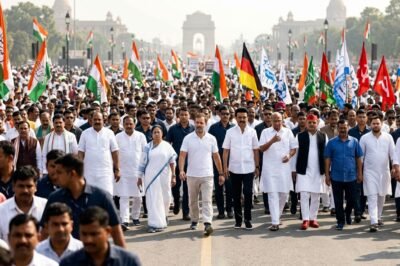
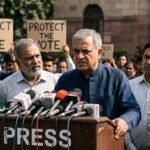
The streets of New Delhi witnessed a historic surge of political defiance as Rahul Gandhi, flanked by a sea of top leaders from the INDIA bloc, spearheaded a massive march toward the Supreme Court. This was not merely a walk through the capital’s arterial roads; it was a choreographed statement of resistance against what the opposition terms as the erosion of democratic institutions. As the sun beat down on the thousands of supporters waving flags of diverse political colors, the atmosphere was thick with the rhetoric of ‘Save the Constitution.’ For Rahul Gandhi, this moment represents a culmination of his recent efforts to transition from a legacy politician to a grassroots mobilizer. The march serves as a critical juncture in Indian politics, signaling that the disparate elements of the opposition have found a common grievance powerful enough to bridge their ideological divides. The visual of the country’s most powerful opposition figures walking shoulder-to-shoulder towards the temple of justice sends a resonant message to both the domestic electorate and the international community regarding the state of Indian democracy today.
The current political climate in India has been characterized by a deepening chasm between the ruling Bharatiya Janata Party (BJP) and a newly unified opposition front. The INDIA bloc, an acronym for the Indian National Developmental Inclusive Alliance, represents a strategic pivot aimed at consolidating the anti-incumbency vote. This march to the Supreme Court follows weeks of disruptions in Parliament, where the opposition has consistently raised issues ranging from the use of central investigative agencies against political rivals to the demand for a Joint Parliamentary Committee (JPC) on various financial allegations. The BBC’s reporting on these events highlights the scale of the unrest, noting that the protests have moved beyond the halls of the Lok Sabha and Rajya Sabha and into the public consciousness. This evolution from legislative debate to street-level mobilization indicates a significant shift in the opposition’s strategy to engage the public directly.
The Symbolism of the Supreme Court Destination
The choice of the Supreme Court as the terminus for this march is deeply symbolic and strategically calculated. In the Indian democratic framework, the judiciary is often seen as the last line of defense against executive overreach. By marching toward the apex court, the INDIA bloc is visually appealing to the highest legal authority in the land to intervene in what they perceive as a systemic dismantling of democratic norms. This move is intended to underscore the gravity of their concerns, moving the debate from a purely political arena into a constitutional one. The leaders seek to remind the public that the judiciary remains a pillar of hope for maintaining the checks and balances necessary for a functioning democracy.
The march also highlights the opposition’s frustration with the legislative process. When debates are stalled and members are suspended, the street and the court become the primary theaters of action. This strategic shift suggests that the INDIA bloc is looking for judicial validation of their claims, hoping that the court’s oversight will force a degree of transparency that they believe is currently lacking in government operations. Justice and accountability are the primary themes being broadcasted by the marching leaders, who argue that the executive branch has become too dominant, overshadowing the voices of elected representatives in Parliament.
Strategic Consolidation of the INDIA Bloc
For decades, the Indian opposition was fragmented, with regional parties often at odds with the Indian National Congress. However, the recent march demonstrates a remarkable level of coordination. Leaders from the TMC, AAP, DMK, and various Left parties joined Rahul Gandhi, showcasing a united front that many analysts previously thought impossible. This unity is built on the shared perception of an existential threat to their political survival. By aligning their interests, these parties hope to prevent the splitting of the anti-BJP vote, which has historically been a major factor in the ruling party’s electoral victories.
The role of Rahul Gandhi in this alliance has evolved significantly. Once criticized for being a reluctant leader, his recent ‘Bharat Jodo Yatras’ have seemingly provided him with the momentum needed to act as a glue for the INDIA bloc. The march to the Supreme Court is an extension of this newly found political vigor. It signals that the Congress is willing to share the stage with regional heavyweights, focusing on a collective identity rather than a singular party banner. This inclusive approach is vital for the bloc’s long-term sustainability. Key aspects of this consolidation include:
- Increased coordination among state-level leaders on national issues.
- Shared logistical resources for organizing mass protests across the country.
- A unified messaging strategy focused on the protection of constitutional values.
Key Grievances: From Economic Woes to Institutional Integrity
While the march is framed as a struggle for the Constitution, the underlying grievances are multifaceted and touch upon the daily lives of millions of Indians. Inflation, rural distress, and a burgeoning unemployment crisis are the sparks that have fueled the public’s participation in these protests. The INDIA bloc has successfully linked these daily hardships to the larger narrative of government mismanagement and crony capitalism. The economic plight of the common man is being used as a powerful mobilization tool against the incumbent administration, suggesting that the government’s policies have favored the elite over the working class.
Furthermore, the opposition is raising alarms about the alleged misuse of the Enforcement Directorate (ED) and the Central Bureau of Investigation (CBI). They argue that these institutions are being weaponized to target opposition leaders and suppress dissent. By taking these issues to the Supreme Court, they are demanding a legal framework that prevents the executive from using state machinery for partisan ends, a plea that resonates with a significant portion of the electorate that feels marginalized. This highlights the growing concern over the separation of powers in India’s current political landscape and the need for institutional autonomy to be restored to ensure fair play in the political arena.
The Government’s Counter-Narrative and Response
The ruling party has dismissed the march as a ‘theatric’ attempt by a ‘frustrated’ opposition to gain relevance. The BJP maintains that the INDIA bloc lacks a coherent vision for the country and is merely united by a desire to protect its leaders from corruption investigations. They argue that the democratic institutions are stronger than ever and that the opposition’s march is an attempt to pressure the judiciary and delegitimize the electoral mandate of the current government. This counter-narrative seeks to portray the opposition as obstructionist and anti-development, focusing on the legal troubles of individual leaders rather than the systemic issues they raise.
This clash of narratives is defining the pre-election atmosphere. The government emphasizes India’s rising global stature, economic growth, and infrastructure development, while the opposition focuses on the internal decay of democratic values and civil liberties. The intensity of the protests indicates that neither side is willing to back down, leading to a polarized political environment that will likely persist until the next general elections. The administration insists that legal processes are being followed strictly and that the opposition is trying to subvert the rule of law via street politics and emotional manipulation of the public.
Media Coverage and the Role of International Outlets
The BBC’s coverage of the march is significant because it brings international attention to India’s domestic political struggles. In an era of globalized news, the perception of India as a stable and vibrant democracy is crucial for its diplomatic and economic interests. When international outlets report on mass protests led by the primary opposition, it adds a layer of external pressure on the government to ensure that democratic standards are upheld. It places India’s domestic policy and treatment of dissent under a global microscope, which can have implications for trade deals and international partnerships.
Rahul Gandhi and other leaders are acutely aware of this global audience. Their speeches often reference international democratic norms and human rights, positioning their struggle as part of a global fight against rising authoritarianism. The BBC report serves to amplify this message, ensuring that the march is not just a local event but a topic of discussion in world capitals. This international visibility influences how global investors, policy-makers, and think-tanks view the Indian political landscape. The narrative of democratic backsliding is one the opposition is keen to project internationally to garner moral support and pressure the government to adhere to traditional democratic practices.
Future Implications: A New Era of Indian Opposition?
The march to the Supreme Court marks a point of no return for the INDIA bloc. Having taken such a visible and high-stakes stand, they must now maintain this momentum or risk being seen as a one-trick pony. The success of this movement will be measured by its ability to translate street protests into electoral gains in the upcoming state and national elections. If the bloc can remain unified and continue to articulate a clear alternative vision that addresses both economic and constitutional concerns, they pose a formidable challenge to the status quo. The road to the 2024 elections is now paved with the promise of more such mass mobilizations and a highly charged political atmosphere.
Conversely, the government’s ability to navigate this period of heightened dissent will test its political acumen and its commitment to democratic dialogue. The legal battles that will inevitably follow in the Supreme Court will be watched closely for their impact on the upcoming elections and the precedent they set for the future of Indian law. Ultimately, the march led by Rahul Gandhi is a testament to the enduring vibrancy—and the current volatility—of Indian democracy. It sets the stage for a high-stakes confrontation that will determine the direction of the world’s largest democracy for years to come. The judicial response to this political pressure and the public’s eventual verdict at the polls will be the defining moments in India’s modern political history.
































Leave a Reply