
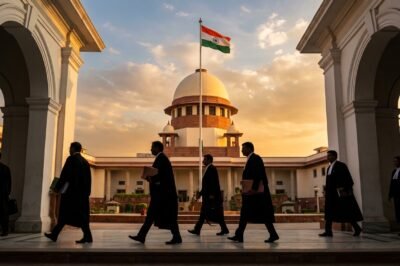
The Indian legal landscape recently witnessed an unprecedented surge of institutional solidarity as the Supreme Court Bar Association (SCBA) and the Supreme Court Advocates-on-Record Association (SCAORA) joined forces to issue a scathing condemnation of the coordinated calls for the resignation of Justice Surya Kant. This development marks a pivotal moment in the ongoing tension between judicial discretion and public sentiment, particularly in an era where social media platforms often transform into parallel courts of public opinion. The controversy, which stems from oral observations made during a high-profile hearing, has ignited a national debate on whether the bench should be subject to the whims of digital activism. The joint statements issued by these premier legal bodies serve not only as a defense of a single judge but as a robust fortification of the entire judicial pillar, which they argue is being systematically undermined by motivated interests. This hook-driven narrative explores how the legal fraternity is drawing a line in the sand, insisting that while judgments are open to critique, the personhood and tenure of the judges must remain sacrosanct to ensure the impartial administration of justice.
The Catalyst: Understanding the Friction Between Bench and Public Discourse
The genesis of this institutional friction lies in the intense proceedings regarding the Nupur Sharma case, where Justice Surya Kant, along with Justice J.B. Pardiwala, made certain oral observations that were perceived by a section of the public as overly harsh or beyond the scope of the legal petition. In the hyper-connected world of modern India, these remarks were instantly transcribed, shared, and analyzed by thousands, leading to a polarized atmosphere where hashtags demanding resignation began to trend. The legal community, however, views these developments with extreme trepidation. They argue that oral observations are a vital part of the Socratic method used in Indian courts to test the strength of an argument and should not be equated with a final, written judgment. The SCBA and SCAORA have pointed out that focusing on snippets of conversation during a hearing ignores the complexity of the legal process and unfairly targets individuals who are performing a difficult constitutional duty.
Furthermore, the escalation from disagreement to a demand for resignation represents a dangerous shift in political and social discourse. Historically, the Indian judiciary has been protected by a certain level of institutional reverence, but the democratization of opinion through technology has stripped away this traditional insulation. The legal bodies contend that if judges are forced to look over their shoulders at trending topics before making an observation, the very independence of the judiciary is at stake. They highlight that the pressure exerted by organized groups can lead to a ‘chilling effect,’ where judges might hesitate to ask difficult questions or make necessary comments for fear of personal reprisal or professional sabotage. This section of the breakdown emphasizes that the condemnation by the bar associations is a calculated move to preserve the sanctity of the courtroom environment from external bullying.
The SCBA Resolution: A Fortress Around the Bench
The Supreme Court Bar Association, which represents the elite of the Indian legal profession, was swift in its response. In a detailed resolution, the SCBA Executive Committee expressed its ‘deep concern’ over the ‘unwarranted and orchestrated’ attacks on Justice Surya Kant. They emphasized that the independence of the judiciary is a basic feature of the Indian Constitution, and any attempt to intimidate judges through public outcry is a direct assault on the rule of law. The resolution was not merely a gesture of professional courtesy but a legal manifesto asserting that the bar stands as a shield between the bench and the mob. By using words like ‘orchestrated,’ the SCBA hinted at the possibility of a coordinated campaign designed to undermine the authority of the court, suggesting that these are not spontaneous outbursts of citizen anger but calculated political maneuvers.
Strongly worded and uncompromising, the SCBA’s stance also touched upon the necessity of maintaining decorum in public criticism. While the association acknowledged that every citizen has a right to criticize a judgment, they drew a sharp distinction between criticizing the ‘legal reasoning’ and attacking the ‘person’ or the ‘office’ of the judge. The resolution called upon all stakeholders, including the media and political entities, to exercise restraint. It argued that the culture of demanding resignations for every controversial statement made in court would lead to judicial paralysis. This robust defense by the SCBA highlights the internal belief that the bar and the bench are two sides of the same coin, and an injury to one is an injury to the entire system of justice delivery.
SCAORA’s Intervention and the Unity of the Legal Fraternity
The Supreme Court Advocates-on-Record Association (SCAORA) added significant weight to the condemnation by issuing its own separate but aligned statement. SCAORA members, who are the only practitioners authorized to file cases in the Supreme Court, occupy a unique position in the hierarchy of the Indian legal system. Their involvement signifies that the concern is not limited to senior advocates but permeates every level of the Supreme Court’s functioning. SCAORA’s statement focused on the ‘dignity and integrity’ of the institution, arguing that the targeted attacks on Justice Surya Kant were ‘beyond the limits of fair criticism.’ They pointed out that such trends are detrimental to the administration of justice as they try to influence the judicial process through extra-judicial means.
The unity between SCBA and SCAORA is particularly noteworthy because it reflects a consensus within the legal community that transcends individual ideologies. This collective front serves as a powerful deterrent against future campaigns. By speaking in one voice, the legal fraternity is sending a clear message to the executive branch and the public: the internal mechanisms of the judiciary are robust enough to handle internal disagreements, and external interference will be met with stiff resistance. This section explores how the synergy between these two bodies provides a dual layer of protection, ensuring that the ‘last bastion of democracy’ does not crumble under the weight of populist pressure. The SCAORA statement also urged the government to take note of the rising tide of digital harassment faced by judges, suggesting that legislative or administrative safeguards might be necessary to protect the judiciary in the digital age.
The Perils of ‘Trial by Media’ and Digital Trolling
A significant portion of the discourse surrounding this event focuses on the phenomenon of ‘trial by media.’ The SCBA and SCAORA have both alluded to the fact that news cycles and social media algorithms often favor sensationalism over legal nuance. When a judge makes an observation, it is often taken out of context to serve a specific narrative, leading to a distorted public perception. This distortion is then weaponized by trolls to launch personal attacks, often involving the judge’s family or past career. The associations have argued that this environment makes it nearly impossible for judges to function without fear or favor. They highlight that the constitutional oath taken by a judge is to uphold the law without fear, but the current climate of digital vitriol creates a psychological burden that was never envisioned by the framers of the Constitution.
Moreover, the impact of such trolling extends beyond the individual judge. It affects the public’s trust in the institution. If the populace is led to believe that a judge is biased or unfit based on a 30-second clip or a viral tweet, the legitimacy of the entire court’s orders is called into question. The legal bodies are essentially arguing that the current trend of demanding resignations is a form of ‘contempt of court’ in the court of public opinion. They stress that the judicial process is slow, deliberate, and based on evidence, whereas the digital process is instantaneous and based on emotion. Reconciling these two worlds is the greatest challenge facing the Indian legal system today, and the condemnation of the attacks on Justice Surya Kant is a primary step in addressing this imbalance.
Constitutional Safeguards vs. Populist Demands
It is crucial to understand the legal impossibility of the demands being made by the critics. Under the Indian Constitution, specifically Article 124, the removal of a Supreme Court judge is an extraordinarily rigorous process. It requires a motion signed by a minimum of 100 members of the Lok Sabha or 50 members of the Rajya Sabha, followed by an investigation by a committee and a two-thirds majority vote in both houses of Parliament on grounds of ‘proved misbehavior or incapacity.’ There is no provision for a judge to resign due to public outcry or social media trends. The SCBA and SCAORA have underscored this point to educate the public on the fact that these ‘resignation calls’ are legally moot and serve only to harass and defame.
By highlighting the constitutional framework, the legal bodies are reminding the public that judges are not elected officials who serve at the pleasure of a constituency. They are appointed professionals whose job is to interpret the law, often against the tide of popular opinion. This distinction is vital for a functional democracy where the rights of minorities or unpopular individuals must be protected from the ‘tyranny of the majority.’ The defense of Justice Surya Kant is, therefore, a defense of the constitutional design that insulates judges from political and social volatility. The associations argue that if the door is opened even slightly to populist removals, the judiciary will become a puppet of whoever controls the loudest megaphone.
Future Implications: Protecting the Last Bastion
The long-term implications of this confrontation between the bar and the digital public are profound. If the SCBA and SCAORA had remained silent, it would have signaled a vulnerability within the legal institution. By standing firm, they have set a precedent for how the judiciary will respond to the ‘new normal’ of digital activism. However, this also highlights a need for the judiciary to perhaps evolve in its communication strategy. While judges cannot and should not engage with the public directly, the way court proceedings are reported and transcribed may need a more structured approach, such as official live-streaming or real-time transcripts, to prevent the spread of misinformation. The current controversy has shown that silence is no longer an option when the integrity of a judge is being assassinated in the digital town square.
In conclusion, the condemnation of the calls for Justice Surya Kant’s resignation is a watershed moment for Indian democracy. It serves as a stark reminder that the rule of law is a fragile construct that requires constant vigilance from those who practice it. The SCBA and SCAORA have performed their duty as the guardians of the court, ensuring that the scales of justice are not tipped by the weight of trending hashtags. Moving forward, the focus must shift toward creating a healthier dialogue between the judiciary and the public, where criticism is rooted in legal scholarship rather than personal animosity. The survival of the Indian judicial system as an independent and fearless entity depends on its ability to withstand these modern storms, and the current display of solidarity is a promising sign that the ‘last bastion’ remains fortified against the winds of populism.




































Leave a Reply