
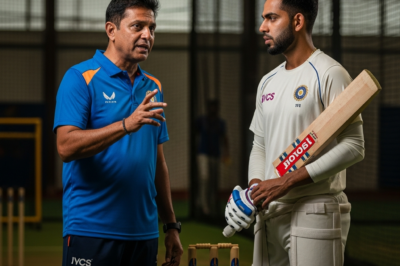
The landscape of Indian cricket is perpetually evolving, but rarely does a talent emerge with the sheer audacity and promise of Vaibhav Sooryavanshi. At just 13 years of age, the Bihar-born prodigy has already etched his name into the annals of history, becoming the youngest player ever to be signed by an Indian Premier League (IPL) franchise. However, while the world is currently mesmerized by his batting pyrotechnics—most notably his blistering century against the Australian Under-19 team—former Indian spinner and current Rajasthan Royals spin coach Sunil Joshi has identified a second dimension to the youngster’s game that could redefine his career trajectory. In a recent revelation that has sent ripples through the cricketing community, Joshi announced his intent to personally mentor and develop Sooryavanshi’s bowling, aiming to transform him into a genuine, high-impact all-rounder.
The Meteoric Rise of Vaibhav Sooryavanshi
To understand the significance of Sunil Joshi’s intervention, one must first appreciate the rapid ascent of Vaibhav Sooryavanshi. Making his first-class debut for Bihar at the age of 12, Sooryavanshi shattered records that had stood for decades. His inclusion in the India Under-19 squad was not merely a selection based on age, but a recognition of a technical maturity that far exceeds his biological years. During the Youth Test against Australia U-19 in Chennai, he hammered a 58-ball century, an innings characterized by fearless stroke play and an innate ability to find gaps in the field. This performance was the primary catalyst for the intense bidding war witnessed at the IPL 2025 auction, where Rajasthan Royals eventually secured his services for a staggering INR 1.10 crore.
However, the modern game, particularly the T20 format, demands more than specialized skills. The value of a player who can contribute with both bat and ball is exponential. Sunil Joshi, a veteran of 15 Tests and 69 ODIs for India, and a man who has seen the evolution of spin bowling from the front row as a national selector, recognizes this shift. By focusing on Sooryavanshi’s bowling, Joshi is not just looking to add a few overs to the boy’s repertoire; he is looking to build a strategic asset for the future of Indian cricket.
Sunil Joshi’s Vision: The Art of the Left-Arm Spinner
Sunil Joshi’s expertise in left-arm orthodox spin is legendary. In his playing days, he was known for his subtle variations in flight, his ability to extract bounce from a length, and his tactical discipline. When he speaks about developing a young bowler, the cricketing world listens. Joshi has observed that Sooryavanshi possesses a natural rhythm and a clean action that can be molded into a potent weapon. “I’ll work with him,” Joshi stated emphatically, highlighting that while batting remains the teenager’s primary strength, the foundational attributes for becoming a reliable spinner are already present.
The developmental plan involves more than just net sessions. Joshi intends to focus on the ‘scientific’ aspects of spin: the revolutions on the ball, the point of release, and the psychological warfare involved in setting up a batsman. For a player as young as Sooryavanshi, the goal is to ensure that bowling does not become a secondary thought. By integrating bowling drills into his daily routine early on, Joshi aims to create a muscle memory that will allow the youngster to bowl long spells without losing accuracy or pace. This holistic approach is designed to ensure that if the batting fails on a given day, the player can still influence the outcome of the match through his bowling.
The Technical Overhaul: Flight, Loop, and Variation
Developing a bowler from a part-time status to a frontline option requires a deep dive into technicalities. Under Joshi’s tutelage, Sooryavanshi will likely undergo a rigorous assessment of his bowling mechanics. One of the key areas will be the ‘load-up’ and the ‘follow-through.’ For young spinners, maintaining a consistent release point under the pressure of the IPL is a significant challenge. Joshi’s experience will be crucial in teaching Vaibhav how to use the crease, how to bowl to defensive fields, and how to bait the batsman into a false stroke.
Furthermore, in the context of the IPL, where the boundaries are short and the bats are heavy, a spinner must possess variations. The arm-ball, the slider, and the ability to change pace without a visible change in action are the hallmarks of elite left-arm spinners like Ravindra Jadeja or Axar Patel. Joshi’s roadmap includes introducing these variations gradually so as not to disrupt Sooryavanshi’s natural action. The focus will be on ‘control’ first and ‘magic’ later. If Sooryavanshi can develop the ability to hold an end tight, he becomes a captain’s dream, especially in the middle overs where the game is often won or lost.
The Rajasthan Royals Ecosystem: A Breeding Ground for Talent
The choice of Rajasthan Royals as a destination for Sooryavanshi is serendipitous. The franchise has a long-standing reputation for scouting and nurturing young talent, dating back to the Shane Warne era in 2008. With a high-performance center that rivals the best in the world, the Royals provide the perfect infrastructure for Joshi to execute his developmental plans. The presence of other seasoned professionals in the squad also means that Sooryavanshi will be surrounded by a wealth of knowledge.
Within the RR camp, the focus is not just on immediate results but on the long-term sustainability of the player’s career. The management understands that at 13, Vaibhav is still growing physically. Therefore, the workload management handled by the medical and coaching staff—including Joshi—will be paramount. Developing his bowling must be balanced with his batting load to prevent injuries, particularly stress fractures or shoulder issues common in young cricketers. This collaborative environment ensures that the ‘project’ of turning him into an all-rounder is handled with the highest level of professional care.
The Strategic Impact on Indian Cricket’s Future
Why does Sunil Joshi’s plan matter for the larger picture of Indian cricket? For years, the Indian national team has searched for the elusive ‘genuine all-rounder’ who can bat in the top six and bowl a full quota of overs. While Jadeja and Axar have filled this void brilliantly, the pipeline for the next generation needs to be filled. By starting at age 13, Sooryavanshi has a developmental window of five to seven years before he is expected to reach his peak. If Joshi’s intervention is successful, India could have a world-class all-rounder ready for international duty by the time he is 19 or 20.
Moreover, this sets a precedent for how young talents are managed in India. Instead of pigeonholing players into specific roles based on their initial success, coaches are now looking at the ‘ceiling’ of a player’s potential. Joshi’s proactive stance suggests a shift towards a more versatile player profile in domestic cricket, where youngsters are encouraged to be multi-skilled from the grassroots level. This adaptability is what will keep Indian cricket competitive in an era of relentless scheduling and multiple formats.
Conclusion: A Journey of a Thousand Miles
The journey from a promising debutant to a finished product is fraught with challenges, yet with a mentor like Sunil Joshi, Vaibhav Sooryavanshi has been given the best possible start. Joshi’s commitment to ‘work with him’ is a promise of guidance, discipline, and technical excellence. As the IPL 2025 season approaches, the spotlight will inevitably be on Sooryavanshi’s batting, but keen observers will be looking for those few overs of left-arm spin, watching for the subtle signs of Joshi’s influence. If this partnership flourishes, we may not just be witnessing the rise of a batting superstar, but the birth of a cricketing icon who can dominate the game with both the willow and the leather. The road ahead is long, but the blueprint is now in place for a transformation that could define a generation.







































Leave a Reply