
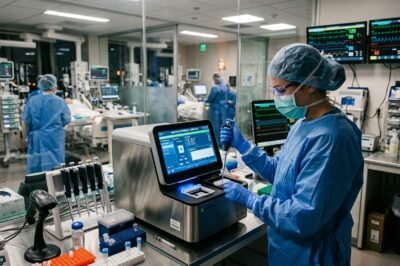
The landscape of modern intensive care is defined by a relentless race against time. For patients suffering from severe pneumonia in the Intensive Care Unit (ICU), every hour that passes without targeted treatment increases the risk of organ failure, septic shock, and mortality. Traditionally, clinicians have relied on empirical therapy—a broad-spectrum ‘best guess’ approach to antibiotic administration—while waiting for the results of traditional laboratory cultures. These cultures, though reliable, often require 48 to 72 hours to yield definitive results. This delay forces a precarious balancing act between over-prescribing broad-spectrum drugs, which fuels the global crisis of antibiotic resistance, and under-treating a potentially lethal pathogen. However, recent findings published in the European Medical Journal (EMJ) highlight a transformative shift: rapid diagnostic testing is now capable of slashing the time to appropriate antibiotic therapy by hours, or even days. This breakthrough not only promises better patient outcomes but also marks a significant milestone in the field of antibiotic stewardship and precision medicine. By integrating rapid molecular diagnostics directly into the ICU workflow, healthcare providers are finally narrowing the gap between infection and precision intervention, ensuring that the right patient receives the right drug at the right time.
## The Critical Challenge of Ventilator-Associated Pneumonia (VAP)
Pneumonia remains one of the most common and deadly infections acquired within the ICU, particularly among patients requiring mechanical ventilation. Known as Ventilator-Associated Pneumonia (VAP), this condition carries a high morbidity rate and significantly extends hospital stays. The challenge lies in the complexity of the ICU environment, where patients are often already immunocompromised or suffering from multiple comorbidities. Diagnosing the specific causative agent—whether it be Staphylococcus aureus, Pseudomonas aeruginosa, or multi-drug resistant Gram-negative bacteria—is paramount. Without rapid identification, doctors often resort to the ‘kitchen sink’ approach, using powerful carbapenems or glycopeptides that may not be necessary, or worse, may not cover the specific strain causing the infection. Statistics indicate that for every hour of delay in appropriate therapy during septic shock, mortality increases by nearly 7.6%. This urgency creates a desperate need for diagnostic tools that transcend the slow pace of traditional microbiology.
## How Rapid Molecular Testing Changes the Paradigm
The technological engine behind this shift is the emergence of multiplex PCR (Polymerase Chain Reaction) assays and other rapid molecular platforms. Unlike traditional cultures that require the growth of bacterial colonies on agar plates, rapid tests look for the genetic signatures of pathogens directly from clinical samples like bronchoalveolar lavage (BAL) fluid or endotracheal aspirates. These systems can simultaneously detect dozens of different bacteria, viruses, and, crucially, antibiotic resistance genes within 60 to 90 minutes. By identifying genes like mecA (methicillin resistance) or blaKPC (carbapenemase production) early, clinicians can avoid ineffective drugs immediately. The EMJ report emphasizes that these platforms allow for ‘de-escalation’—switching from broad-spectrum to narrow-spectrum drugs—much faster than previously possible. This precision prevents the destruction of a patient’s natural microbiome and reduces the selective pressure that drives the evolution of superbugs.
## Significant Reductions in Time-to-Treatment
The data provided in the EMJ analysis is compelling. In various clinical trials and real-world applications, the implementation of rapid testing has been shown to reduce the time to ‘optimal’ therapy by an average of 20 to 30 hours. In some cases, the difference is even more dramatic, moving the dial from three days down to four hours. This reduction is not merely a logistical success; it is a clinical triumph. When a patient in the ICU shows signs of deteriorating respiratory function, the ability to confirm a specific pathogen before the next nursing shift begins allows for a total recalibration of the care plan. Furthermore, the high negative predictive value of these tests is just as important as their positive results. If a rapid test can confidently rule out the presence of MRSA or Legionella within two hours, the clinician can safely withhold toxic and expensive specialized antibiotics that would otherwise have been administered ‘just in case.’
## Impact on Antibiotic Stewardship and Public Health
Beyond the individual patient, the acceleration of appropriate therapy has profound implications for antibiotic stewardship programs (ASP). Hospitals worldwide are struggling to curb the rise of antimicrobial resistance (AMR), which the WHO has declared one of the top ten global public health threats. By using rapid testing to guide therapy, ICUs can significantly reduce the ‘days of therapy’ (DOT) for broad-spectrum agents. The EMJ study highlights that rapid diagnostics facilitate a 25% to 40% faster transition to targeted therapy. This reduction in the use of broad-spectrum agents helps preserve the efficacy of our most potent antibiotics for future generations. Moreover, it reduces the risk of secondary infections such as Clostridioides difficile, which often occur when a patient’s healthy gut flora is wiped out by unnecessarily aggressive antibiotic regimens. The integration of technology and stewardship represents the future of sustainable healthcare.
## Clinical Outcomes and Resource Management
The economic and operational benefits of rapid testing in the ICU are equally noteworthy. While the initial cost of molecular diagnostic kits is higher than traditional culture plates, the total cost of care often decreases. Faster identification leads to shorter durations of mechanical ventilation and reduced lengths of stay in the ICU—two of the most expensive components of hospital care. By stabilizing patients faster and preventing the complications of inappropriate antibiotic use, hospitals can improve bed turnover and resource allocation. More importantly, the psychological impact on the care team cannot be overlooked. Providing ICU physicians with actionable data in real-time reduces the cognitive load and moral injury associated with ‘blind’ prescribing in high-stakes environments. The EMJ findings suggest that the integration of these tests leads to a more confident and streamlined clinical decision-making process.
## Implementation Barriers and the Path Forward
Despite the clear advantages, the widespread adoption of rapid testing faces hurdles. The primary barrier is the initial financial investment and the need for 24/7 laboratory staffing to process these tests as they arrive. There is also a ‘trust gap’ where some clinicians are hesitant to stop broad-spectrum antibiotics based solely on a molecular result before the traditional culture confirms it. Addressing these barriers requires a multi-disciplinary approach, involving hospital administration, laboratory directors, and infectious disease specialists. Education is key; clinicians must understand the high sensitivity and specificity of modern PCR panels. As the technology continues to evolve, we can expect to see even more portable, point-of-care devices that can be used directly at the bedside, further reducing the ‘vein-to-result’ time. The transition to a diagnostic-led treatment model is no longer a luxury—it is a necessity for modern critical care.
## Conclusion: The Future of Precision Critical Care
The findings highlighted by the EMJ regarding rapid testing in ICU pneumonia represent a fundamental shift in how we approach infectious diseases. We are moving away from the era of ‘one size fits all’ empirical medicine toward an era of hyper-personalized, data-driven care. The ability to cut the time to appropriate antibiotics is a lifeline for the most vulnerable patients in the healthcare system. As we refine these tools and integrate them into standard protocols, we will not only save lives but also protect the very medicines that make modern surgery and intensive care possible. The era of waiting three days for an answer is coming to an end; the era of the two-hour diagnosis is here, and it is set to redefine the standards of the ICU forever.





































Leave a Reply