
India’s craft traditions are more than expressions of beauty. They carry stories of communities, regional identities, artistic knowledge, cultural memory and generations of human creativity. Every woven textile, painted surface, embroidered motif and handcrafted sculpture reflects a living heritage that has travelled across centuries while continuing to inspire new forms of artistic expression.
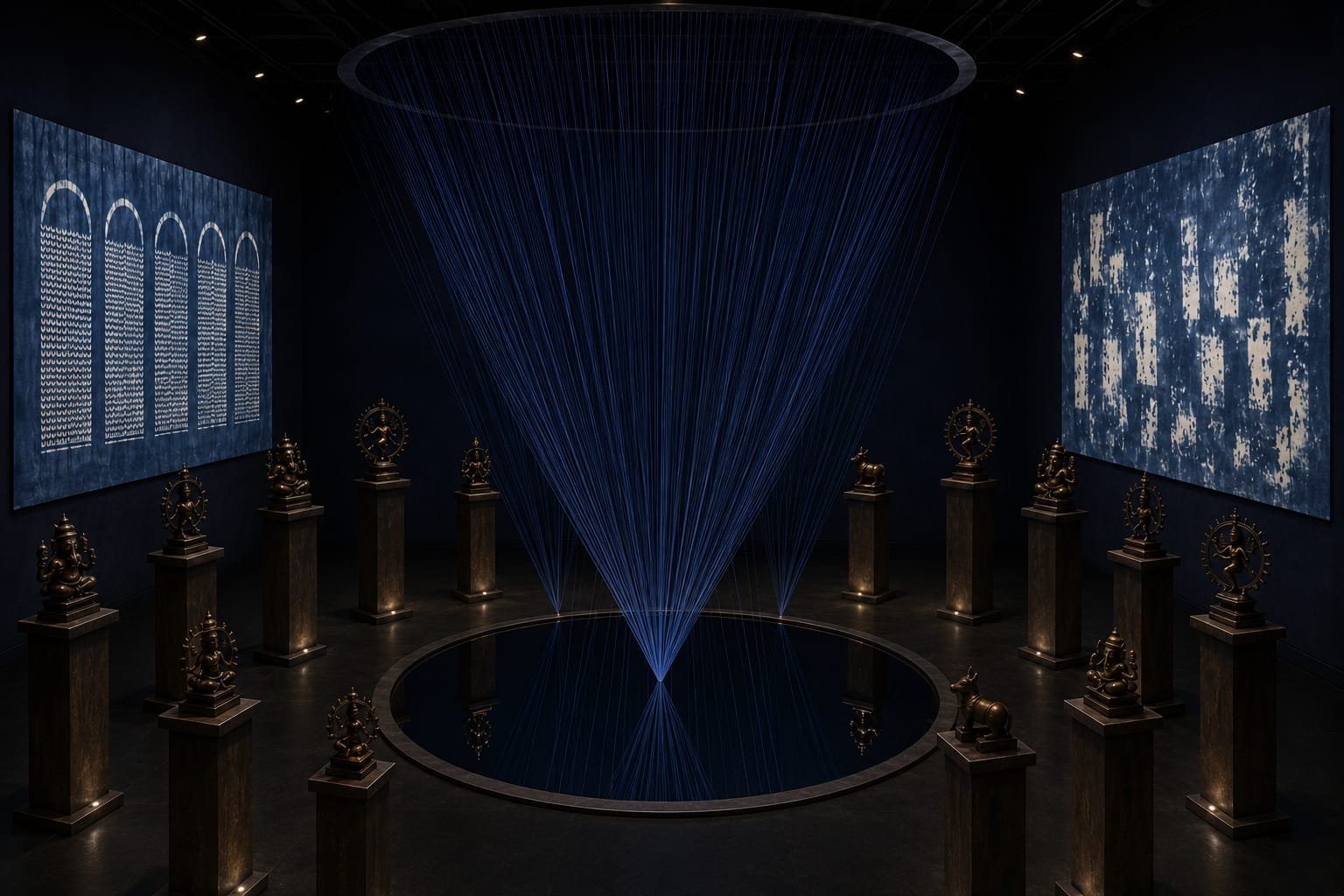
It is this continuing dialogue between Indian tradition and modernity that forms the foundation of the forthcoming exhibition, “Adiyogi Shiva in Vastu Shilpa: Tradition and Modernity,” at the National Crafts Museum & Hastkala Academy (NCM&HKA), Pragati Maidan, New Delhi.
The exhibition brings together traditional Indian craft, historic artistic vocabulary and contemporary textile art to explore one of India’s most enduring cultural symbols Adiyogi Shiva. Through textiles, sculpture, natural dyes, Khadi, indigo resist-dyeing and regional craft traditions, the exhibition seeks to demonstrate how cultural heritage can remain rooted in history while continuing to evolve through contemporary creativity.
A Living Museum of Indian Craft Heritage
The National Crafts Museum & Hastkala Academy occupies an important place in the preservation and presentation of India’s extraordinary handcrafted heritage. Its collections represent traditional skills, regional aesthetics, craft techniques, materials and artistic practices developed and refined across generations. For students, researchers, designers, scholars, artisans and visitors, museum collections provide an opportunity to study the visual and material language of Indian craftsmanship. Traditional textiles reveal regional identities, embroidery preserves inherited knowledge, sculptural objects reflect spiritual imagination and craft techniques offer insights into the social, cultural and economic lives of communities. In this sense, a craft museum is not simply a place where historic objects are preserved. It is also a space where the past can inspire the future. The museum’s exhibitions play a vital role in creating this connection. By placing traditional objects within new curatorial frameworks, exhibitions can encourage audiences to revisit familiar artistic traditions and discover their relevance in the contemporary world.
Adiyogi Shiva: An Eternal Symbol Reimagined
At the heart of the exhibition is the timeless image of Adiyogi Shiva, a powerful symbol within Indian cultural imagination. Conceived under the leadership of Ms. Nidhi, Curator & Deputy Director (Design & Documentation), NCM&HKA, the exhibition brings traditional representations of Shiva into dialogue with contemporary artistic expression. The project juxtaposes the museum’s traditional craft collection with contemporary indigo-dyed artworks on Khadi created by textile exponent Ms. Sangeeta Gupta.mRather than presenting tradition and modernity as opposing ideas, the exhibition explores how the two can exist within a continuous creative journey. Traditional knowledge can inspire contemporary experimentation. Ancient symbolism can find new visual languages. Historic craft techniques can continue to influence modern artists and designers. This relationship between preservation, innovation and cultural continuity lies at the centre of Adiyogi Shiva in Vastu Shilpa: Tradition and Modernity.
Traditional Indian Crafts and the Imagination of Adiyogi
The exhibition’s first section focuses on traditional representations of Adiyogi Shiva through decorated textiles and three-dimensional craft traditions. Visitors can encounter a rich visual vocabulary represented through traditions such as:
- Sajni Kantha
- Kalamkari
- Pichwai
- Ajrakh
- Appliqué
- Bronze sculpture
- Other traditional sculptural forms
Each tradition brings its own material, technique, colour palette, composition and symbolic vocabulary to the interpretation of Shiva. Kalamkari, with its painted and block-printed storytelling traditions, represents one of India’s celebrated textile art forms. Pichwai carries a rich tradition of devotional imagery and visual symbolism. Ajrakh is renowned for its intricate patterns and complex dyeing processes, while Kantha embroidery transforms fabric into a surface of storytelling and inherited memory. When brought together, these traditions demonstrate the remarkable diversity of Indian textile art, Indian handicrafts and regional artistic expression. Despite differences in geography and technique, the works are connected by a shared cultural imagination surrounding Shiva. Across India’s artistic traditions, Shiva has been associated with creation, transformation, transcendence, cosmic consciousness and eternal energy. These ideas have provided generations of artisans with an exceptionally rich source of inspiration.
When Khadi Meets Natural Indigo
The second section of the exhibition moves from historic craft traditions into contemporary artistic expression.
Here, the visual and symbolic language of Shiva is reinterpreted through large-scale textile artworks created on hand-spun Khadi using indigo resist-dyeing techniques.
The combination of Khadi and natural indigo creates a distinctive contemporary medium.
Khadi brings texture, history and associations with Indian hand-spun and handwoven traditions. Indigo contributes depth, intensity and a strong visual identity shaped by one of the world’s oldest natural dye traditions.
Together, these materials become a bridge between craft heritage and contemporary textile design.
The artworks by Sangeeta Gupta do not merely reproduce traditional images of Shiva. Instead, they seek to reinterpret and reconfigure the symbolism of Adiyogi for a contemporary visual context.
The result is a transition from inherited craft traditions to modern artistic experimentation while maintaining a connection with India’s cultural memory.
Vastu Shilpa as an Evolving Continuum
One of the exhibition’s central ideas is the understanding of Vastu Shilpa as a living and evolving continuum rather than a heritage tradition frozen in time.
Indian artistic traditions have historically adapted to changing materials, technologies, cultural influences and creative environments.
Preservation, therefore, does not always mean keeping a tradition unchanged.
A living tradition can preserve its cultural essence while allowing new generations to reinterpret its techniques, forms and symbols.
A historic embroidered textile and a contemporary indigo artwork may be separated by time and artistic vocabulary, yet both can communicate cultural memory.
This is where traditional craft and contemporary design meet.
The exhibition highlights the importance of allowing heritage to remain dynamic. Traditional knowledge can become a source for experimentation. Craft techniques can inspire new design practices. Cultural symbols can continue to find meaning among younger generations.
Shiva Beyond Religious Representation
Within India’s cultural and artistic imagination, Shiva is a multidimensional symbol.
Adiyogi represents ideas associated with transformation, cosmic energy, transcendence, consciousness and eternal bliss.
This layered symbolism has allowed artists, craftspeople and designers to approach the figure of Shiva through many different visual languages.
Textiles, embroidery, painting, sculpture, natural dyes and handcrafted materials have all provided platforms for artistic interpretations of Shiva.
The diversity of these interpretations demonstrates the adaptability of Indian craft traditions.
A regional textile tradition may communicate Shiva through colour and pattern. A sculptural form may focus on spiritual or cosmic symbolism. A contemporary textile artist may use abstraction, graphic forms or material experimentation.
The image may change, but the cultural conversation continues.
A Bridge Between India’s Past and Future
One of the exhibition’s strongest ideas is the deliberate meeting of two creative worlds.
On one side are preserved examples of India’s traditional craft heritage.
On the other are contemporary works that reinterpret an ancient cultural symbol through Khadi, natural indigo and modern textile art.
Between these two worlds lies a creative bridge.
That bridge represents the continuing journey of Indian craftsmanship—from ancestral knowledge to contemporary experimentation, from regional traditions to modern artistic practice and from museum preservation to new creative possibilities.
For students and younger visitors, this idea carries particular importance.
Heritage is not simply something that belongs to history.
It can become a foundation for new ideas.
Traditional crafts can inspire contemporary fashion, textile design, interior design, visual communication, sustainable materials research, fine art and innovative handcrafted practices.
The past can become a creative resource for the future.
Indian Craft as Cultural Memory
Every handcrafted object represents more than its material form.
A textile can preserve the knowledge of weaving and dyeing communities. An embroidered surface can carry generations of artistic skill. A sculpture can reflect regional spiritual traditions and aesthetic values.
Together, these objects form a vast archive of cultural memory.
Museums, artisans, researchers, designers, educational institutions and cultural organisations all have a role to play in ensuring that this knowledge remains accessible to future generations.
By bringing traditional craft objects into conversation with contemporary artistic practices, Adiyogi Shiva in Vastu Shilpa: Tradition and Modernity highlights the continuing relevance of Indian heritage.
The exhibition suggests that safeguarding traditional knowledge and encouraging innovation are not contradictory goals.
In fact, innovation can help traditions remain visible, meaningful and connected to contemporary audiences.
Celebrating the Living Spirit of Indian Handicrafts
The forthcoming exhibition is envisioned as more than a display of beautiful objects.
It is an exploration of the relationship between Indian craft heritage, contemporary art, textile traditions, cultural memory, Khadi, natural indigo and artistic innovation.
Through the curatorial vision behind the exhibition, India’s artistic heritage is presented as something living rather than static.
It survives through artisans.
It evolves through designers.
It travels through textiles.
It is renewed through materials and techniques.
And it continues through the imagination of each generation.
The exhibition ultimately celebrates a simple but powerful idea: tradition provides the roots, while creativity gives it new branches.
In the enduring image of Adiyogi Shiva, the exhibition finds a fitting metaphor for this journey an ancient symbol continually renewed through changing artistic languages and contemporary imagination.
The exhibition is expected to commence on Tuesday and continue until 21 September 2026, offering visitors an opportunity to experience a unique confluence of traditional Indian craft heritage and contemporary artistic expression.
Craft lovers, students, researchers, artists, designers and the wider public are encouraged to engage with the exhibition and the creative communities behind it.
Every visitor, conversation and moment of appreciation can contribute to greater recognition for artists, artisans and India’s extraordinary craft traditions.
“Adiyogi Shiva in Vastu Shilpa: Tradition and Modernity” is ultimately an invitation to witness how Indian heritage moves across time—not by remaining unchanged, but by continuing to transform.




































Leave a Reply