
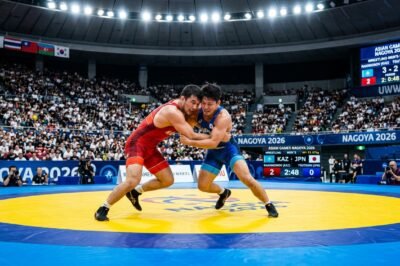
The 20th edition of the Asian Games, hosted in the Aichi-Nagoya region, has reached a fever pitch as the wrestling competition enters its third crucial day. Wrestling has always been a cornerstone of the Asian Games, representing a blend of ancient tradition and modern athletic excellence. On this momentous Day 3, the atmosphere inside the arena is electric, filled with the scent of mats and the roar of a crowd that understands the historical weight of every takedown and turn. As the global wrestling community turns its eyes toward Japan, the stakes could not be higher for the athletes involved. This is not merely a regional tournament; it is a proving ground for the world’s best, sanctioned by United World Wrestling (UWW) and serving as a critical barometer for the upcoming Olympic cycle. The third day is traditionally where the cream rises to the top, featuring the quarter-finals through to the gold medal matches in some of the most competitive weight classes in the sport.
Among the constellations of stars taking to the mat today, three names stand out as icons of the sport: the virtually invincible Yui Susaki of Japan, the surging Indian prodigy Sujeet Kalkal, and the Iranian heavyweight sensation Amir Hossein Zare. Each athlete brings a unique narrative to the circle. For Susaki, it is about maintaining a legacy of perfection on home soil. For Sujeet, it is an opportunity to cement his status as the successor to India’s storied wrestling lineage. For Zare, it is about asserting dominance in a category that demands both Herculean strength and tactical brilliance. As United World Wrestling oversees the proceedings, the technical precision and officiating standards are at an all-time high, ensuring that every point scored is a testament to the sheer grit and preparation of these modern-day gladiators. The following analysis dives deep into the technicalities, the stakes, and the drama unfolding on Day 3 of the 2026 Asian Games wrestling championship.
The Dominance of Yui Susaki: A Technical Masterclass in the 50kg Category
Yui Susaki enters Day 3 not just as a favorite, but as a living legend of the wrestling world. Having dominated the 50kg freestyle category for years, her presence in Nagoya is a significant draw for the home crowd. Susaki is known for her incredible defensive capabilities; it is a rare sight to see any opponent score even a single technical point against her. Her wrestling style is a perfect blend of agility, low-center-of-gravity stability, and an almost psychic ability to anticipate her opponent’s moves. On Day 3, as she moves through the elimination rounds, the focus remains on her technical execution of the leg-lace and her rapid-fire transitions from a sprawl to a counter-attack.
The pressure of performing at home cannot be understated. However, Susaki has historically thrived under the spotlight. Her preparation for the 2026 Asian Games involved rigorous camps in the Japanese highlands, focusing on stamina and explosiveness. For the United World Wrestling observers, Susaki represents the gold standard of the 50kg division. Her matches today are expected to be clinics in tactical positioning. Every time she steps onto the mat, she isn’t just wrestling for a medal; she is wrestling against her own past records, seeking to maintain her aura of invincibility. Competitors from Mongolia and China, who have traditionally challenged Japanese dominance, will need to bring an unprecedented level of aggression to even disrupt her rhythm. Susaki’s performance today will likely set the tone for the Japanese wrestling contingent, which looks to sweep the women’s freestyle categories.
Sujeet Kalkal: India’s Great Hope in the 65kg Freestyle
In the 65kg freestyle division, all eyes from the subcontinent are on Sujeet Kalkal. As a rising star who has successfully transitioned from the junior ranks to the elite senior level, Sujeet carries the aspirations of a nation with a rich wrestling heritage. The 65kg category is widely regarded as one of the most shark-infested waters in international wrestling, featuring technical wizards and explosive athletes alike. Sujeet’s journey on Day 3 is a litmus test for his tactical maturity. He is known for his relentless pace and his ability to tire out opponents in the second period, a strategy that requires immense aerobic capacity and mental fortitude. Sujeet’s technical repertoire, particularly his high-crotch single leg and his ability to finish takedowns cleanly, will be vital against the seasoned veterans he faces today.
The narrative surrounding Sujeet is also one of redemption and evolution. After missing out on previous podiums by narrow margins, his camp has focused heavily on his defensive posture and ‘parterre’ wrestling. On Day 3, the level of competition spikes, potentially pitting him against top seeds from Iran and Uzbekistan. These matches are often decided by a single scramble or a last-second push-out. For Sujeet, the Asian Games represent a stepping stone toward global superstardom. United World Wrestling rankings show that Sujeet has been climbing steadily, and a gold medal here would catapult him into the top tier of world wrestling. The Indian coaching staff has emphasized the importance of staying calm under pressure, especially when the crowd is favoring the local Japanese wrestlers or the powerhouse Iranian athletes.
The Heavyweight King: Amir Hossein Zare and the Iranian Legacy
When it comes to the 125kg heavyweight division, few names command as much respect as Amir Hossein Zare. Representing Iran, a country where wrestling is more than a sport—it is a cultural pillar—Zare brings a combination of size and speed that is rare in the heaviest weight class. Day 3 sees Zare entering the fray with the intent of reclaiming his dominance over the Asian continent. His wrestling is characterized by a high-tempo style that is unusual for heavyweights, often outworking his opponents through sheer volume of attacks. Zare’s presence on the mat is intimidating, but his success comes from his intelligence; he knows exactly when to conserve energy and when to unleash his explosive power for a decisive takedown.
The heavyweight category at the 2026 Asian Games is particularly competitive, with strong entries from Kazakhstan and Kyrgyzstan. Zare’s rivalry with other elite heavyweights has become a staple of UWW events, and the Day 3 brackets are expected to lead toward a titanic final. The Iranian fans, always vocal and passionate, have traveled in large numbers to support their hero. Zare’s performance is not just about his personal glory; it is about maintaining Iran’s status as a powerhouse in freestyle wrestling. Every match he wrestles today will be a lesson in how a heavyweight can move with the grace of a lightweight while maintaining the crushing power of a giant. His ability to control the center of the mat and force his opponents into passivity warnings is a key part of his tactical arsenal that spectators should watch closely.
United World Wrestling (UWW) Standards and Tournament Structure
The role of United World Wrestling in the 2026 Asian Games is paramount. As the international governing body, UWW ensures that the competition adheres to the highest standards of fairness and technical excellence. The officiating on Day 3 is under intense scrutiny, as the stakes involve not just medals but also crucial ranking points that determine seeding for future world championships. The UWW has introduced several minor rule tweaks over the past year to encourage more active wrestling and penalize passivity, and these are being strictly enforced in Nagoya. This makes for a more dynamic viewing experience, as athletes are forced to engage rather than stall.
Key Aspects of UWW Oversight:
- Video Review System: The challenge system allows coaches to request a video review of specific actions, ensuring that high-stakes matches are not decided by human error.
- Anti-Doping Protocols: Rigorous testing is in place to maintain the integrity of the sport, with UWW working alongside international agencies.
- Mat Quality and Safety: The Aichi-Nagoya organizers have provided state-of-the-art facilities that meet all UWW safety specifications to prevent injuries during high-impact throws.
The structure of Day 3 is designed to maximize athlete recovery while keeping the momentum of the tournament. With the morning sessions dedicated to qualification and the evening sessions reserved for the medal bouts, the athletes must manage their weight and energy levels throughout the day. This ‘tournament management’ is a skill in itself, often separating the champions from the runners-up. The UWW officials on-site also coordinate with the Asian Wrestling Council to ensure that the unique needs of the Asian federations are met while following global protocols.
Technological Advancements and Training Protocols for 2026
The wrestling displayed on Day 3 is the result of years of technological and scientific advancement in training. National federations have increasingly turned to data analytics to study their opponents. For instance, the Japanese team is known to use motion-capture technology to analyze the biomechanics of Yui Susaki’s movements, optimizing every millisecond of her reaction time. Similarly, the Indian contingent has integrated sports psychologists and specialized nutritionists into their traveling party, ensuring that athletes like Sujeet Kalkal are at their peak mental and physical state when they step onto the mat. These advancements have narrowed the gap between traditional powerhouses and rising nations.
Furthermore, the 2026 games have seen a rise in the use of wearable technology during training sessions. Heart rate monitors, GPS trackers for mat coverage, and recovery-focused tools like cryotherapy are now standard. This level of professionalization has elevated the quality of wrestling on Day 3 to unprecedented heights. When we see Zare or Susaki execute a move, it is the culmination of thousands of hours of data-driven practice. The tactical depth of the sport has increased, with coaches now able to provide real-time feedback based on statistical trends observed in the earlier rounds of the tournament. This scientific approach ensures that the 2026 Asian Games will be remembered as a turning point in the professionalization of amateur wrestling.
Future Implications: From Nagoya to the Global Olympic Stage
As the curtains close on the Day 3 wrestling action at the 2026 Asian Games, the implications extend far beyond the podium. This tournament serves as a critical bridge to the 2028 Olympic Games. For athletes like Susaki, a dominant performance here solidifies her status as the gold medal favorite for the next Olympics. For Sujeet Kalkal, a strong showing provides the confidence and the ranking points necessary to secure a favorable draw on the world stage. The Asian Games provide a unique competitive environment that mimics the pressure of the Olympics, making it an invaluable experience for younger athletes who are looking to make their mark.
Moreover, the success of the wrestling event in Nagoya reinforces the sport’s popularity in Asia, potentially leading to more investment in grassroots programs across the continent. United World Wrestling will take the data and the outcomes from these games to refine their global strategies for promoting the sport. The regional rivalries—Japan vs. Iran, India vs. Uzbekistan—have been further cemented, promising exciting matchups for years to come. Ultimately, Day 3 of the 2026 Asian Games has demonstrated that wrestling remains a vibrant, evolving, and deeply respected discipline that continues to produce world-class icons who inspire the next generation of athletes across the globe.







































Leave a Reply