
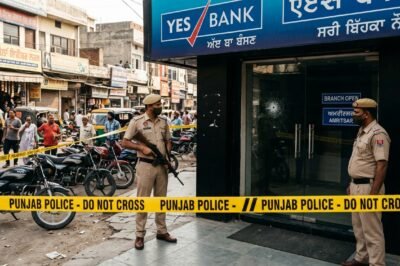
In a shocking escalation of workplace violence that has sent ripples of fear through the financial sector, a loan manager at a YES Bank branch in Amritsar was shot in broad daylight following a heated dispute over a banking transaction. The incident, which unfolded within the supposedly secure confines of a prominent private sector bank, serves as a grim reminder of the volatility currently underlying customer-service relations in the high-pressure world of retail banking. Witnesses describe a scene of absolute chaos as the mundane atmosphere of digital ledger entries and currency counting was shattered by the deafening sound of a gunshot. This was not a heist or a premeditated robbery gone wrong; it was a targeted act of aggression stemming from a disagreement over a financial transaction, highlighting a terrifying new reality for frontline bank employees who find themselves at the mercy of disgruntled clients. As the victim was rushed to a local hospital, the incident has sparked an intense debate regarding the adequacy of security protocols in Indian banking institutions and the increasing vulnerability of white-collar professionals in the line of duty.
The Anatomy of the Amritsar Branch Shooting
The details emerging from the YES Bank branch in Amritsar paint a harrowing picture of how a routine professional interaction can devolve into a life-threatening tragedy. According to preliminary police reports and eyewitness accounts, the suspect entered the bank with the intent to settle a dispute regarding a loan or a specific transaction that had been causing friction for some time. The loan manager, whose primary responsibility involved navigating the complexities of credit approvals and recovery, was approached at his desk. What began as a verbal argument quickly intensified. Within minutes, the suspect reportedly brandished a firearm and discharged it at the manager, striking him and causing him to collapse in view of both colleagues and terrified customers.
The immediate aftermath was one of panic and confusion. Bank staff scrambled for cover while security personnel, often armed only with basic tools or outdated weaponry, struggled to contain the situation. The suspect managed to flee the scene before a full lockdown could be implemented, leaving behind a trail of physical and psychological trauma. Local law enforcement was notified immediately, and the branch was cordoned off for forensic examination. This event is not merely an isolated crime but a symptomatic indicator of how interpersonal disputes are increasingly being settled through extreme violence, even in environments traditionally viewed as safe and professional.
The Core of the Dispute: Banking Transactions and Customer Frustration
At the heart of this violent outburst lies a disagreement over a banking transaction—a broad term that covers everything from loan interest rates and hidden charges to frozen accounts and documentation hurdles. In the current economic climate, the pressure on both bank employees to meet targets and customers to manage their debts has reached a boiling point. Loan managers are often the faces of institutional policies that customers find opaque or unfair. When a loan is rejected or a penalty is levied, the manager becomes the lightning rod for the customer’s frustration. In this specific case, the dispute likely involved a significant financial stake, pushing the suspect beyond the limits of rational behavior.
Furthermore, the digitalization of banking has, ironically, made face-to-face interactions more volatile. With many processes now automated, customers only visit the branch when something goes wrong or when they feel stuck in a bureaucratic loop. By the time they reach a manager’s desk, their frustration is already peaking. Without proper conflict resolution training for staff and a lack of clear communication channels for aggrieved clients, these interactions can easily turn hostile. The Amritsar incident highlights the desperate need for banks to re-evaluate how they handle high-stakes disputes and whether their current grievance redressal mechanisms are effective enough to prevent such escalations.
Security Lapses in Private Banking Institutions
One of the most pressing questions arising from the Amritsar shooting is how a customer was able to enter a high-traffic urban bank branch with a concealed firearm. Modern private banks like YES Bank are expected to have robust security measures, including metal detectors, armed guards, and constant surveillance. However, the reality on the ground often tells a different story. In many branches, security guards are primarily task-led—opening doors, managing queues, or assisting with ATM issues—rather than focusing on active threat detection. The presence of a metal detector is often ceremonial, with alarms ignored or sensitivity levels lowered to avoid inconveniencing customers.
This lapse in security protocol creates a dangerous loophole. While banks invest heavily in cybersecurity to protect digital assets, physical security for the human capital working within the walls often remains stagnant. The Amritsar incident exposes the vulnerability of ‘open-plan’ offices where managers are easily accessible to the public without any physical barriers. Moving forward, banking institutions must consider more stringent entry checks, similar to those found in airports or high-security government buildings, and perhaps even the installation of bullet-resistant glass partitions for high-risk departments like loan recovery and cash management.
The Psychological Toll on Banking Professionals
Beyond the physical injury to the loan manager, the incident has had a devastating impact on the morale and mental health of banking professionals across the country. The banking sector in India is already known for its grueling hours and high-stress environments. Adding the fear of physical assault to this mix creates an unsustainable workplace culture. Employees are now questioning their safety while performing standard duties. The trauma experienced by the staff members who witnessed the shooting cannot be understated; many will require long-term psychological support to overcome the PTSD associated with workplace violence.
There is also the ‘chilling effect’ on the performance of loan managers. If managers fear that enforcing bank policy or rejecting a risky loan could result in a violent retaliation, they may become hesitant to perform their duties effectively. This compromise in professional integrity could have wider implications for the banking sector’s health and its ability to manage credit risk. Organizations must prioritize employee well-being by providing comprehensive insurance, mental health counseling, and a visible commitment to prosecuting anyone who threatens or harms their staff.
Legal Implications and the Police Investigation
The Punjab Police have registered a case under relevant sections of the Bharatiya Nyaya Sanhita (formerly the IPC), including attempted murder and violations of the Arms Act. Investigative teams are currently scanning CCTV footage from inside the bank and surrounding areas to trace the suspect’s escape route. In cases like this, the legal system must act swiftly to send a clear message that violence against public or private service providers will not be tolerated. The investigation will also look into the origin of the firearm used, checking if it was a licensed weapon or an illegal ‘country-made’ pistol, which are unfortunately prevalent in certain regions.
The role of the bank in this legal process is also critical. As an employer, YES Bank has a duty of care toward its employees. Legal experts suggest that if a lack of adequate security is proven to have contributed to the incident, the institution could face liability. The outcome of this case will likely set a precedent for how future incidents of workplace violence in the financial sector are handled. It is imperative that the prosecution builds a watertight case to ensure that justice is served for the victim and to act as a deterrent for others who might consider taking the law into their own hands over financial grievances.
Conclusion: Rethinking the Safety of India’s Financial Hubs
The shooting of a loan manager inside a YES Bank branch in Amritsar is a watershed moment for the Indian banking industry. It serves as a stark warning that the traditional sanctity of the bank branch as a safe space is under threat. To prevent such tragedies in the future, a multi-pronged approach is required. Banks must invest in sophisticated security infrastructure that includes active screening of all entrants, while simultaneously improving their customer service and dispute resolution protocols to de-escalate tensions before they reach a breaking point. Furthermore, the government and law enforcement must work together to ensure that banking professionals are protected under specific workplace safety regulations. As we move towards an increasingly digital yet emotionally charged financial landscape, the safety of the people who keep the wheels of the economy turning must be paramount. Failure to address these vulnerabilities will not only lead to more tragedies but will also undermine the trust that is the very foundation of the banking system.






































Leave a Reply