
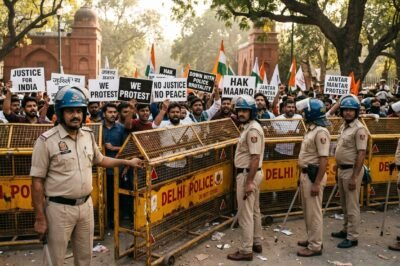
The heart of the national capital turned into a theater of political friction as Jantar Mantar, the traditional bastion of Indian dissent, witnessed a dramatic escalation in the ongoing tensions between civil society and the state. At the center of this storm are the Anti-CEC protests, a movement that has gained significant momentum following recent legislative changes impacting the appointment process of the Chief Election Commissioner and other Election Commissioners. The latest development, where leaders from the Citizens for Justice and Peace (CJP) including prominent activists such as Das and Ranka were booked for unauthorized entry, marks a pivotal moment in the discourse over public assembly rights. This move by the Delhi Police has not only intensified the friction on the ground but has also ignited a fierce debate regarding the shrinking space for democratic protest in the high-security zones of New Delhi. As the news of the FIR spread through social media and news cycles, it sent shockwaves through the activist community, framing the struggle not just as a policy critique, but as a direct confrontation with the administrative apparatus governing the capital. The following analysis delves into the intricate layers of these protests, the legal challenges faced by activist leaders, and the broader implications for the sanctity of India’s democratic and electoral institutions.
The Genesis of the Anti-CEC Movement and Legislative Friction
To understand the current turmoil at Jantar Mantar, one must look back at the legislative shift that triggered the unrest. The controversy revolves around the Chief Election Commissioner and other Election Commissioners (Appointment, Conditions of Service and Term of Office) Act, 2023. This legislation altered the selection committee’s composition, replacing the Chief Justice of India with a Union Cabinet Minister nominated by the Prime Minister. Civil society groups, including the CJP, argue that this move grants the executive undue influence over the Election Commission, potentially compromising the impartiality of India’s electoral process.
The protests are a culmination of months of simmering discontent. Activists claim that the independence of the ECI is the bedrock of a free and fair democracy. By removing the judicial oversight in the selection process, they argue that the government has effectively bypassed the spirit of the Supreme Court’s March 2023 judgment, which had initially included the CJI in the panel to ensure neutrality. The movement has seen a coalition of various NGOs, student bodies, and veteran activists coming together to demand a reversal of this legislative change, leading to the high-stakes demonstrations currently unfolding in the capital.
The Legal Clampdown: Booking of Das and Ranka
The escalation reached a boiling point when the Delhi Police filed an FIR against CJP leaders Das and Ranka. The charges specifically mention ‘unauthorised entry’ into the designated protest site during a time when prohibitory orders under Section 144 were allegedly in place. According to police sources, the leaders bypassed several security cordons and failed to provide the necessary permissions required for a gathering of that scale. The police maintain that their actions were a necessary measure to maintain public order in a sensitive zone that houses various government offices and diplomatic residences.
However, the legal representatives of the CJP leaders have challenged this narrative. They argue that Jantar Mantar is a globally recognized site for peaceful assembly and that the imposition of restrictive orders is often used selectively to stifle voices critical of the administration. The booking of Das and Ranka is seen by many as a deterrent aimed at discouraging other high-profile activists from joining the fray. This legal battle is expected to play out in the courts, focusing on the balance between state-imposed security restrictions and the fundamental right to protest enshrined in Article 19 of the Indian Constitution.
Jantar Mantar: A Restricted Hub of Dissent
Jantar Mantar has long served as the ‘Hyde Park’ of India, where voices from across the country converge to seek the ear of the government. In recent years, however, the area has seen increasingly stringent regulations. The Delhi Police have frequently invoked Section 144 of the CrPC (now BNSS), citing traffic management and security concerns. This has turned the site into a tightly controlled environment where every banner and every megaphone is subject to administrative scrutiny. The recent incident involving CJP leaders highlights the growing difficulty activists face in navigating these bureaucratic hurdles.
Statistics show a marked increase in the number of FIRs filed against protesters in the New Delhi district over the last three years. Critics point out that while some gatherings are permitted with minimal interference, those directed at core institutional changes—like the ECI selection process—face much higher levels of policing. The physical space for protest has been physically narrowed by barricades, water cannons, and a heavy deployment of paramilitary forces, making the act of ‘unauthorised entry’ a frequent legal snare for those who refuse to adhere to the rigid, and often delayed, permission process.
Institutional Integrity and the Global Perception
The Anti-CEC protests have garnered international attention, with human rights organizations and democratic watchdogs monitoring the situation closely. The core of the grievance—the autonomy of the Election Commission—is a matter of global democratic standards. When leaders of organizations like CJP are booked for protesting these changes, it raises questions about the health of India’s democratic infrastructure. International observers often look at the treatment of peaceful protesters as a barometer for a country’s commitment to civil liberties.
Domestically, the controversy has forced a wedge between the ruling party and the opposition. Opposition parties have been quick to capitalize on the arrests, framing them as an assault on the ‘Constitution of India.’ They argue that the ECI must not only be fair but must also be seen to be fair. The removal of the CJI from the selection process, followed by the criminalization of those who protest it, creates a perception of institutional capture that activists say is hard to ignore. The CJP leaders have vowed to continue their struggle, stating that their legal troubles are a small price to pay for the defense of electoral transparency.
Civil Society’s Resilient Response
Despite the police action, the spirit of the protest remains undeterred. The CJP, an organization known for its long-standing legal and social battles, has issued statements reaffirming its commitment to the cause. They have called for a nationwide ‘Save Democracy’ day, urging citizens to voice their concerns over the ECI appointments. The booking of Das and Ranka has, in many ways, acted as a catalyst, mobilizing a wider demographic of young professionals and students who see the ECI’s independence as crucial for their future.
The response from the ground suggests a shift in strategy. Protesters are now utilizing digital platforms to circumvent the physical restrictions at Jantar Mantar. Viral videos of the police action, live streams of the arrests, and detailed explainers on the 2023 Act have ensured that the movement remains in the public eye even when physical access to the protest site is blocked. The resilience shown by the leaders, who are now facing potential legal trials, has turned the focus back onto the ‘why’ of the protest rather than just the ‘how’ of the police intervention.
Future Implications: Dissent in the Shadow of the Law
The booking of CJP leaders Das and Ranka for their actions at Jantar Mantar is likely to have long-term implications for how civil society interacts with the state. Firstly, it sets a precedent for the use of ‘unauthorised entry’ charges to manage political demonstrations in the capital. If the courts uphold these charges, it could lead to even more restrictive measures for future protests, potentially rendering Jantar Mantar a protest site in name only. This would force dissent into more decentralized and perhaps more volatile forms of expression across the city.
Secondly, the outcome of this legal battle will influence the broader movement against the new ECI appointment rules. If the activists can successfully argue that their entry was a legitimate exercise of their rights, it will embolden the movement and put the government on the defensive. Conversely, a prolonged legal ordeal for Das and Ranka may serve as a cautionary tale for other civil society organizations. Ultimately, the struggle at Jantar Mantar is a microcosm of the larger tension between administrative control and democratic freedom in modern India. The eyes of the nation will remain on the judiciary to see how it navigates this complex intersection of law, security, and the fundamental right to disagree.





































Leave a Reply