
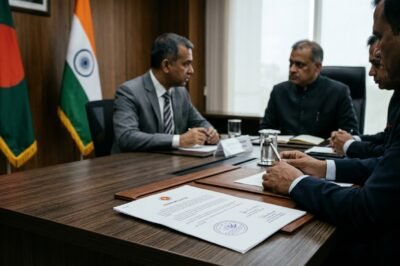
The geopolitical landscape of South Asia is currently witnessing a historic and complex diplomatic maneuver as the Bangladesh Foreign Ministry confirms it is formally examining a request for a new passport from the ousted Prime Minister, Sheikh Hasina. This development follows the dramatic collapse of her fifteen-year administration in August 2024, an event precipitated by a massive student-led uprising that fundamentally altered the nation’s political trajectory. Currently residing in India under high-security exile, the former Premier finds herself in a precarious legal limbo. The revocation of her diplomatic passport shortly after her departure left her without valid travel documentation, making this new application not merely a bureaucratic process but a significant political flashpoint. The interim government, led by Nobel laureate Muhammad Yunus, now faces the daunting task of balancing domestic demands for justice with the intricate protocols of international diplomacy and the fundamental rights of a citizen, even one facing grave allegations. As the Foreign Ministry deliberates, the world watches to see how this decision will impact the future of accountability and regional stability.
The Background: From Absolute Power to Exile
Sheikh Hasina’s departure from Dhaka on August 5, 2024, marked the end of an era defined by rapid economic growth and increasing accusations of authoritarianism. The protests, which began over civil service job quotas, evolved into a nationwide movement demanding her resignation following a violent crackdown that resulted in hundreds of deaths. Upon her arrival in India, the interim administration in Bangladesh moved swiftly to cancel the diplomatic passports of Hasina and several members of her cabinet, effectively stripping them of their sovereign immunity and ease of international movement. This move was seen as a precursor to legal proceedings, as numerous cases involving allegations of crimes against humanity were filed in domestic courts.
The request for a new regular passport signifies a strategic move by the former Prime Minister to regularize her status. Without a valid passport, her ability to seek asylum in a third country or move freely within international borders is severely restricted. For the Bangladeshi authorities, the application presents a legal paradox: while every citizen has a right to a passport, the law also allows the state to withhold travel documents from individuals facing active criminal investigations or those whose presence is required by the judiciary. The Foreign Ministry’s statement that they are “examining” the request suggests a cautious approach intended to avoid procedural errors that could be exploited in international legal forums.
Legal Framework and the Passport Order of 1973
The issuance and revocation of passports in Bangladesh are governed by the Bangladesh Passport Order of 1973. Under this legislative framework, the government possesses the discretionary power to refuse a passport if it deems that the applicant’s departure from the country would be detrimental to the public interest or if the applicant is involved in legal proceedings related to criminal offenses. Given that Sheikh Hasina is the primary accused in over a hundred cases, including those pertaining to murder and forced disappearances, the legal grounds for denial are substantial. However, any decision made by the Ministry of Foreign Affairs and the Department of Immigration and Passports must be legally sound to withstand potential challenges in the High Court.
Furthermore, the interim government is under immense pressure from civil society and student leaders to ensure that the former leader is brought back to face trial. Issuing a new passport could be interpreted by the public as a sign of leniency or a clandestine agreement to facilitate her permanent relocation to a third country, thereby evading justice. Conversely, a flat denial without due process could be framed by her legal team as a violation of fundamental human rights, potentially garnering sympathy or intervention from international human rights organizations. The Ministry must therefore navigate a narrow path where legal rigor meets political necessity.
Diplomatic Strains Between Dhaka and New Delhi
The passport issue is inextricably linked to the broader diplomatic relationship between Bangladesh and India. Sheikh Hasina has long been a key ally for New Delhi, and her presence in India has placed the Indian government in a delicate position. While India has provided her with temporary refuge on humanitarian grounds, the lack of a valid passport complicates her long-term residency. If Bangladesh refuses to issue a document, it places the burden on India to decide whether to provide her with a travel document or continue her stay under an exceptional legal status, which could further strain ties with the new administration in Dhaka.
Reports indicate that the interim government in Bangladesh has already communicated its desire for the extradition of Sheikh Hasina to stand trial. The existence of a bilateral extradition treaty signed in 2013 (and amended in 2016) provides a mechanism for this, but the process is fraught with hurdles. India may invoke the clause that allows for the refusal of extradition if the charges are deemed “political in nature.” By examining the passport request, Bangladesh is effectively testing the diplomatic waters, signaling to both India and the international community that it intends to follow formal legal channels rather than emotive political rhetoric.
Market and Economic Implications of Political Stability
The outcome of this administrative decision has surprising implications for Bangladesh’s economic stability and investor confidence. Investors, both domestic and foreign, are closely monitoring how the interim government handles the legacy of the previous regime. A transparent, rule-of-law-based approach to the Sheikh Hasina passport issue would signal a move toward institutional maturity and judicial independence. Such a signal is crucial for a country seeking to stabilize its economy after months of unrest, high inflation, and a significant dip in foreign exchange reserves.
Furthermore, the textile and garment industry, which forms the backbone of the Bangladeshi economy, relies heavily on international goodwill and stability. Any perception of prolonged political vendetta or administrative chaos could deter global brands from placing long-term orders. Therefore, the Foreign Ministry’s handling of this high-profile case is seen as a litmus test for the country’s transition toward a more democratic and predictable governance model. The business community is advocating for a swift resolution to such political distractions so the nation can focus on critical financial reforms and infrastructure development.
The Role of International Community and Human Rights
The international community, including the United Nations and Western powers, has called for a fair and transparent legal process regarding the events of July and August 2024. The passport application is being viewed through the lens of international law. If the Bangladeshi government denies the passport, they must provide a detailed justification that aligns with international standards of due process. Many international observers are wary of “victor’s justice” and are urging the interim government to ensure that any legal actions taken against former officials are beyond reproach.
This scrutiny puts additional pressure on the Foreign Ministry to ensure that the examination of the passport request is not seen as an arbitrary act of retribution. If Hasina is eventually granted a passport, it might be under specific conditions that limit its use or require her to appear before a court of law. Such a compromise could satisfy international legal standards while still holding her accountable within the domestic legal system. The balance between domestic demands for retribution and international expectations of procedural fairness remains one of the most difficult challenges for the current leadership.





































Leave a Reply