
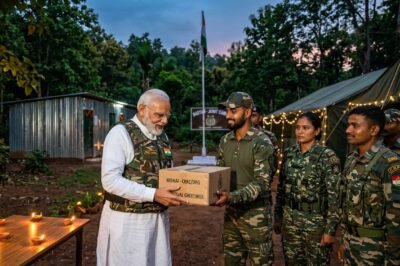
In a move that blends cultural tradition with high-stakes geopolitical signaling, Prime Minister Narendra Modi has chosen the rugged heartlands of Bastar, Chhattisgarh, to celebrate Deepavali with India’s security forces. This decision is not merely a festive gesture but a profound statement of victory over internal strife in a region that was once synonymous with the ‘Red Corridor’ and served as the primary bastion for Maoist insurgency. By choosing Bastar, the Prime Minister is casting the literal and metaphorical light of Deepavali upon a territory that, for decades, existed in the shadows of crossfire, landmines, and administrative absence. This visit underscores the federal government’s narrative of a ‘Viksit Bharat’ (Developed India) reaching the last mile, signaling to the nation that the era of Left-Wing Extremism (LWE) is entering its final, terminal chapter. As the Prime Minister shares sweets with the jawans of the Central Armed Police Forces (CAPF) and the state’s specialized units, the act serves as a morale booster for the men and women who have reclaimed this land inch by inch, transforming a ‘den of Maoists’ into a frontier of hope and infrastructure development.
The Tradition of Valor: A Decade of Festive Frontier Diplomacy
Since assuming office in 2014, Prime Minister Modi has institutionalized the practice of spending Deepavali with the armed forces, a tradition that takes him away from the capital’s power corridors to the biting cold of Siachen, the scorching sands of Jaisalmer, or the dense jungles of the Northeast. This year’s choice of Bastar is particularly poignant given the region’s history. By standing with the soldiers in Chhattisgarh, the Prime Minister is reinforcing a direct emotional bond between the leadership and the grassroots protectors of the sovereignty. This practice has evolved into a masterclass in political communication, emphasizing that the commander-in-chief is a ‘Pradhan Sevak’ who values the sacrifice of the rank-and-file above personal comfort. It is an exercise in humanizing the massive security apparatus and acknowledging the psychological toll of long-term deployment in conflict zones.
Strategically, these visits serve as a platform for the Prime Minister to articulate India’s security doctrine. In Bastar, the message is clear: the state has re-established its monopoly on the legitimate use of force, and the transition from ‘security first’ to ‘development first’ is well underway. For the soldiers stationed in remote outposts like Sukma, Bijapur, or Dantewada, the presence of the Prime Minister is a validation of their silent toil. It transforms their grueling jungle warfare duties into a national mission recognized at the highest level, fostering a sense of belonging and national purpose that is often lost in the bureaucratic layers of the Ministry of Home Affairs.
Decoding the Bastar Metamorphosis: From Red Corridor to Development Hub
Bastar’s transformation over the last decade is nothing short of a sociological and security miracle. Statistics from the Ministry of Home Affairs indicate a nearly 70% drop in LWE-related violence compared to the peaks of the late 2000s. The ‘Bastar Den’ once functioned as a parallel state where the writ of the Maoist ‘Janatana Sarkar’ ran supreme. Today, the geography of fear has been replaced by the geography of connectivity. The Prime Minister’s visit highlights the success of the ‘Security-Development’ dual-track strategy. Security forces no longer just conduct search-and-destroy missions; they act as the protective shield under which schools, hospitals, and roads are constructed in areas like Abujhmad, which were previously ‘no-go zones’ for civil administration.
The ‘Samadhan’ strategy, introduced by the current administration, has been pivotal. It emphasizes Smart leadership, Aggressive strategy, Motivation and training, Actionable intelligence, Dashboard-based KPIs, Harnessing technology, Action plan for each theater, and No access to financing for Maoists. The results are visible in the surrender of top-tier Maoist commanders and the destruction of the insurgent logistics chain. Bastar is no longer a ‘black hole’ on the map; it is a region where the national flag flies atop newly inaugurated administrative blocks, signifying the retreat of the sickle-and-hammer ideology that once promised revolution but delivered only stagnation.
Socio-Economic Implications: The Ripple Effect of Stability
The stabilization of Bastar has direct economic implications for Chhattisgarh and India at large. Bastar is rich in mineral resources, including high-grade iron ore and tin. For years, Maoist activity stifled the industrial potential of the region, leading to billions in lost revenue and employment opportunities. With the security situation under control, major public sector undertakings and private players are revisiting their investment portfolios in the region. The expansion of the NMDC iron ore mines and the proposed industrial clusters are set to turn the youth of Bastar from potential insurgent recruits into skilled industrial laborers. The Prime Minister’s visit acts as a ‘Green Signal’ to the markets that the region is open for business and safe for investment.
Furthermore, the government’s focus on Minor Forest Produce (MFP) and the establishment of ‘Van Dhan Kendras’ have empowered the local tribal population. By integrating Bastar into the national supply chain for organic products and handicrafts, the administration is dismantling the Maoist narrative that the Indian state is an ‘exploitative outsider.’ When PM Modi celebrates Deepavali with the forces, he is also celebrating the resilience of the Bastariya people who have chosen the ballot over the bullet and the market over the forest hideout. This economic integration is the most potent weapon against the resurgence of any radical ideology.
Tactical Shifts and the Role of Specialized Units
The victory in Bastar is largely credited to the evolution of specialized forces such as the District Reserve Guard (DRG), which consists largely of local tribal youth, and the ‘Bastariya Battalion’ of the CRPF. These units have provided the ‘home ground advantage’ that the state previously lacked. By celebrating with these specific forces, the Prime Minister acknowledges the importance of local intelligence and cultural affinity in counter-insurgency operations. The DRG, in particular, has been the ‘spearhead’ in breaking the Maoist back by utilizing their innate knowledge of the terrain and local dialects to outmaneuver the insurgents.
Modernization of the police force has also played a crucial role. The use of high-altitude long-endurance (HALE) drones, fortified police stations, and secure communication networks has tipped the scales in favor of the state. During his visit, the Prime Minister is expected to witness some of these technological advancements that have minimized collateral damage and maximized the precision of security operations. This modernization is a key pillar of the ‘Atmanirbhar Bharat’ initiative, as much of the surveillance and protective gear is now being manufactured domestically, reducing reliance on foreign imports for internal security needs.
Political Messaging and the National Narrative
Politically, the visit is a masterstroke in reinforcing the image of a strong, decisive leadership that does not shy away from conflict zones. It contrasts sharply with previous administrations that were often accused of a ‘soft’ approach to internal security. By standing in Bastar, the Prime Minister is reminding the electorate that the ‘Red Menace,’ which his predecessor Dr. Manmohan Singh once called the ‘greatest internal security threat,’ is being systematically dismantled. This narrative is crucial as the country moves towards future electoral cycles, positioning the current government as the sole guarantor of national integrity and internal peace.
The visit also resonates with the ‘Nationalist’ core of the Prime Minister’s supporter base. It bridges the gap between the urban middle class and the rural tribal belts, weaving a story of a unified India. The imagery of the Prime Minister feeding sweets to a tribal jawan or a female commando in the heart of the jungle is a powerful visual that transcends language barriers. It reinforces the idea that the ‘Deepavali’ of the nation is incomplete without the inclusion of those who guard its most volatile frontiers. This is political communication at its most evocative, turning a traditional festival into a celebration of national triumph.
Market Implications: Infrastructure and Connectivity
From a financial perspective, the pacification of Bastar paves the way for massive infrastructure projects. The Jagdalpur-Raipur highway and the expansion of rail connectivity are top priorities. Infrastructure stocks and construction firms stand to benefit as the ‘Special Central Assistance’ (SCA) funds are poured into building bridges and roads that bypass traditional Maoist ambush points. The telecom sector is also a major beneficiary; the ‘Mobile Tower Phase-II’ project in LWE-affected areas has already seen the installation of thousands of towers, bringing 4G and 5G connectivity to the deepest reaches of the Bastar forest. This digital inclusion is the final nail in the coffin for an insurgency that relied on isolation and misinformation.
Real estate in surrounding towns like Jagdalpur is seeing a surge in value as they transition from military hubs to commercial centers. The potential for eco-tourism in the Kanger Valley National Park and the Chitrakote Falls is immense, provided the security umbrella remains firm. The Prime Minister’s visit serves as an unofficial endorsement of this safety, likely triggering a boost in domestic tourism to a region that is as culturally rich as it is geographically stunning.
Conclusion: The Future of Internal Security and Integration
In conclusion, Prime Minister Modi’s Deepavali in Bastar is a landmark event that signifies more than just a seasonal greeting. It is the victory lap of a decade-long strategy to reclaim India’s internal sovereignty. The future implications are clear: the government will continue its ‘zero tolerance’ policy toward armed rebellion while simultaneously accelerating the integration of tribal communities into the mainstream economy. The ‘Bastar Model’—a blend of localized security, heavy infrastructure investment, and direct political engagement—will likely be the blueprint for addressing other peripheral conflicts in the country.
As the lamps are lit in the outposts of Chhattisgarh, they signal the end of an era of darkness and the beginning of a new chapter where Bastar is defined not by its insurgency, but by its industry, culture, and contribution to the Indian story. The challenges of landmines and sleeper cells may remain, but the psychological war has been won. The Prime Minister’s presence in this ‘once-den’ of Maoists is the ultimate proof that in the battle between the bullet and the lamp, the light has finally prevailed.





































Leave a Reply