
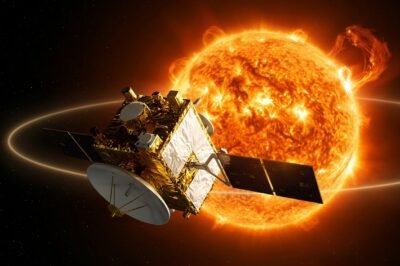
The Sun, our closest star and the engine of the solar system, has long remained a cryptic celestial giant, often unpredictable and potentially hazardous to the fragile technological lattice of modern Earth. On the heels of the triumphant Chandrayaan-3 lunar landing, the Indian Space Research Organisation (ISRO) has pivoted its gaze toward the solar horizon with the Aditya-L1 mission. This ambitious voyage to the Lagrange Point 1 (L1) has recently yielded scientific gold, unlocking intricate secrets of the Sun’s behavior that were previously shrouded in mystery. As the world becomes increasingly dependent on satellite networks, global positioning systems, and interconnected power grids, the ability to forecast solar storms—the violent outbursts of energy from the Sun—is no longer a matter of academic curiosity but a cornerstone of global security and economic stability. By capturing high-resolution data on coronal mass ejections and solar flares, Aditya-L1 is positioning India at the forefront of heliophysics, providing the global community with a sophisticated early warning system that could save trillions of dollars in infrastructure damage and ensure the continuity of our digital way of life. This recent breakthrough marks a significant milestone in humanity’s quest to master space weather forecasting.
The Strategic Significance of the Lagrange Point 1
The Aditya-L1 spacecraft is not just another satellite; it is a sentinel placed at a unique gravitational sweet spot known as the Lagrange Point 1 (L1), located approximately 1.5 million kilometers from Earth. This position allows the observatory to remain in a fixed orientation relative to both the Earth and the Sun, providing an uninterrupted, 24/7 view of the solar disc. Unlike Earth-orbiting satellites that face frequent eclipses and occultations, Aditya-L1 enjoys a continuous line of sight, which is crucial for monitoring transient solar events that can occur in a matter of seconds. This constant surveillance is the foundation of the mission’s ability to provide real-time data on solar activity.
By maintaining this strategic position, ISRO has effectively created a permanent ‘weather station’ in deep space. The L1 point is vital because it sits outside the Earth’s magnetosphere, allowing the spacecraft to measure the solar wind and magnetic fields in their pristine state before they are influenced by our planet’s magnetic environment. This raw data is essential for scientists to understand the fundamental physics of the Sun and to build more accurate models of how solar energy travels through the interplanetary medium. The successful insertion into this halo orbit was a feat of complex celestial mechanics, demonstrating India’s growing maturity in deep-space navigation and mission management.
Unraveling the Mystery of the Solar Corona and Heating Paradox
One of the primary scientific objectives of Aditya-L1 is to solve the long-standing ‘coronal heating paradox.’ For decades, solar physicists have been puzzled by why the Sun’s outer atmosphere, the corona, is millions of degrees hotter than its surface, the photosphere. The surface of the Sun sits at about 5,500 degrees Celsius, yet the corona reaches temperatures exceeding 1 to 2 million degrees. Understanding the mechanisms behind this extreme temperature gradient is key to predicting how energy is released during solar storms. Aditya-L1’s Visible Emission Line Coronagraph (VELC) is designed specifically to study this region with unprecedented precision.
The latest data from the mission suggests that small-scale magnetic reconnections and ‘nanoflares’ may play a far more significant role in heating the corona than previously estimated. By capturing high-resolution images of the solar atmosphere in multiple wavelengths, the SUIT (Solar Ultra-violet Imaging Telescope) payload has provided a closer look at the transition region where this dramatic temperature spike occurs. These findings are revolutionary, as they provide the empirical evidence needed to refine theoretical models. If scientists can understand how the corona stores and releases energy, they can better predict the onset of Coronal Mass Ejections (CMEs), which are the primary drivers of space weather disruptions on Earth.
Coronal Mass Ejections and the Threat to Modern Infrastructure
Coronal Mass Ejections (CMEs) are massive bursts of solar wind and magnetic fields rising above the solar corona or being released into space. When these giant clouds of plasma reach Earth, they can trigger geomagnetic storms that have devastating effects on our technological civilization. The potential for a ‘Carrington Event’—a massive solar storm similar to the one in 1859 that set telegraph wires on fire—is a constant threat in the modern era. Today, a storm of that magnitude could potentially knock out power grids, destroy sensitive satellite electronics, and disrupt global communication for months, leading to economic losses in the trillions of dollars.
Aditya-L1’s recent discoveries help in identifying the ‘pre-cursor’ signs of these CMEs. By monitoring the solar magnetic field’s configuration and the accumulation of magnetic stress in active regions, the spacecraft can provide early warnings hours or even days before a CME hits Earth. This lead time is critical for satellite operators to put their assets into ‘safe mode’ and for power grid managers to balance loads to prevent catastrophic transformer failures. The ability to distinguish between ‘geo-effective’ storms (those that will hit Earth) and those that will pass harmlessly into space is a major leap forward in operational space weather forecasting, reducing the number of false alarms and unnecessary shutdowns.
The Role of Advanced Instrumentation: SUIT and VELC
The success of Aditya-L1 rests on its suite of seven cutting-edge instruments, but the SUIT and VELC payloads are the stars of the show. The Solar Ultra-violet Imaging Telescope (SUIT) provides near-continuous observations of the Sun in the 200-400 nm wavelength range. This allows researchers to see different layers of the solar atmosphere simultaneously, mapping the flow of energy from the photosphere to the corona. The images produced are some of the clearest ever taken in these wavelengths, revealing the complex ‘loop’ structures and sunspots that act as the birthplaces of solar flares. These visual insights are coupled with magnetic data to create a 3D understanding of solar eruptions.
Complementing SUIT is the Visible Emission Line Coronagraph (VELC), which uses an internal occulter to block out the bright solar disc, creating an artificial eclipse. This allows the instrument to see the much fainter corona. VELC is unique because it can observe very close to the solar limb, an area that is often difficult for other space-based coronagraphs to capture. By analyzing the spectroscopic data from VELC, scientists can measure the velocity and density of the solar plasma as it is ejected. This data is the ‘smoking gun’ that tells us how fast a solar storm is traveling and how much energy it carries, which are the two most important variables in calculating the impact on Earth’s magnetosphere.
Global Market Implications and the Growing Space Economy
The implications of Aditya-L1’s discoveries extend far beyond the realm of pure science; they have significant economic and commercial ramifications. The global space economy is currently valued at over $500 billion and is projected to grow to $1.8 trillion by 2035. This economy relies heavily on the safety of orbital assets. Insurance companies that cover multi-million dollar satellite launches are increasingly looking at space weather risks as a primary factor in their premiums. The high-fidelity data provided by Aditya-L1 can help lower these risks by providing better forecasting tools, ultimately making space ventures more commercially viable and insurable.
Furthermore, the mission showcases ISRO’s ability to deliver world-class scientific results at a fraction of the cost of other space agencies. This cost-efficiency is attracting international partnerships and commercial contracts for satellite launches and data services. By contributing to the global pool of space weather data, India is strengthening its diplomatic ties and its position as a responsible space-faring nation. Industries such as aviation, which rely on trans-polar flights and are susceptible to radiation during solar storms, also stand to benefit from the enhanced forecasting capabilities, ensuring safer and more efficient global travel routes.
Conclusion: A New Era of Solar Guardianship
The Aditya-L1 mission represents a defining moment in India’s scientific journey, transitioning from a nation that explores space to one that protects the planet from space-based threats. The recent discoveries regarding the Sun’s magnetic dynamics and coronal heating are just the beginning of what promises to be a five-year mission of profound discovery. As we move closer to the peak of the current solar cycle (Solar Cycle 25), the data from Aditya-L1 will become increasingly vital. We are no longer passive observers of the Sun; we are now active monitors, capable of peering into the heart of solar tempests before they strike. This leap in understanding ensures that while the Sun remains a powerful and sometimes violent neighbor, its secrets are no longer hidden, allowing humanity to thrive in an increasingly tech-dependent world under the watchful eye of our solar sentinel. The legacy of Aditya-L1 will be a safer, more resilient Earth, better prepared for the cosmic weather of the future.






































Leave a Reply