
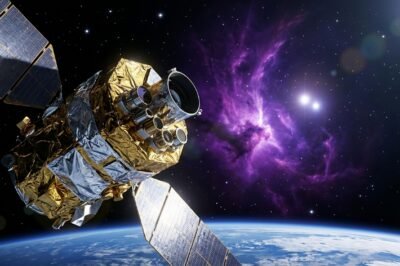
The cosmos is a place of perpetual motion, but much of its most energetic activity remains hidden from the naked eye. While stars twinkle with a serene luminescence in the night sky, the reality of the universe is far more chaotic, defined by cataclysmic explosions, the collision of massive stellar remnants, and the voracious appetite of supermassive black holes. To capture these fleeting, violent moments, NASA has officially greenlit the UltraViolet Explorer (UVEX) mission. This next-generation space telescope is poised to revolutionize our understanding of the high-energy universe by peering into the ultraviolet spectrum—a window that has been largely closed since the decommissioning of previous missions. By observing the universe in UV light, UVEX will act as a cosmic detective, tracing the origins of elements, the lifecycle of galaxies, and the immediate aftermath of the most powerful explosions known to science. This mission represents a critical leap forward, providing the sensitivity and wide-field capabilities necessary to document a universe that is constantly in flux, ensuring that no sudden flash of cosmic brilliance goes unnoticed. The selection of UVEX underscores a strategic pivot toward multi-messenger astronomy, where electromagnetic data is combined with gravitational wave detections to provide a holistic view of cosmic phenomena. As we stand on the precipice of this new observational era, UVEX promises to deliver not just images, but a fundamental shift in our comprehension of how the most extreme environments in space influence the evolution of the cosmos.
Unveiling the Mission Profile and Scientific Objectives
NASA’s UltraViolet Explorer (UVEX) is a Medium-Class Explorer (MIDEX) mission, a category of space missions designed to provide frequent flight opportunities for world-class scientific investigations within a relatively modest budget. Set for launch in approximately 2030, UVEX will be managed by the Explorers Program Office at NASA’s Goddard Space Flight Center. The mission is led by Principal Investigator Fiona Harrison, a distinguished professor at the California Institute of Technology (Caltech). The primary objective of UVEX is to perform a deep, all-sky survey in the ultraviolet spectrum, filling a massive void in our current astronomical toolkit. Since the retirement of the Galaxy Evolution Explorer (GALEX) in 2013, astronomers have lacked a high-sensitivity wide-field UV surveyor, forcing them to rely on older data or targeted observations from telescopes like Hubble, which have a very narrow field of view.
The UVEX mission is designed to provide at least 50 to 100 times the sensitivity of GALEX, allowing it to see further back in time and detect much fainter objects. This sensitivity is achieved through advanced mirror coatings and detector technology that have been refined over the last decade. By conducting a multi-year survey, UVEX will create a dynamic map of the sky, documenting how ultraviolet sources change over time. This temporal aspect is crucial for identifying ‘transients’—objects that appear suddenly and fade away. The data collected by UVEX will be shared globally, enabling a vast array of studies ranging from the atmosphere of nearby stars to the properties of the most distant quasars. The mission’s design emphasizes rapid data processing and dissemination, ensuring that ground-based telescopes can be alerted quickly to follow up on interesting events.
A New Window into Cosmic Cataclysms and Transients
One of the most exciting aspects of UVEX is its ability to catch ‘cosmic violence’ in the act. When a massive star reaches the end of its life and explodes as a supernova, it releases a tremendous burst of ultraviolet radiation. This ‘shock breakout’ occurs in the first minutes to hours following the explosion, carrying vital information about the size and composition of the progenitor star. Currently, most telescopes detect supernovae days after they happen, by which time the initial UV signature has faded. UVEX’s wide-field capability means it will be scanning large swathes of the sky repeatedly, significantly increasing the probability of capturing these early-stage explosions. This data will allow astrophysicists to build better models of stellar death and the chemical enrichment of the universe, as supernovae are the primary source of heavy elements like oxygen and iron.
Beyond supernovae, UVEX will investigate Tidal Disruption Events (TDEs), which occur when a star wanders too close to a supermassive black hole and is torn apart by tidal forces. As the stellar debris is consumed by the black hole, it emits a brilliant flare of ultraviolet light. By studying these flares, UVEX will help scientists estimate the masses of black holes in distant galaxies and understand how they interact with their surroundings. The mission will also be instrumental in studying the accretion disks around white dwarfs and neutron stars, providing insights into the physics of matter under extreme density and gravity. These high-energy events are the fundamental laboratories of the universe, testing the laws of physics in ways that are impossible to replicate on Earth.
Mapping the Galactic Neighborhood with Unprecedented Sensitivity
While UVEX is designed to look deep into the distant universe, it also has a significant mission closer to home. It will conduct the first deep, high-resolution ultraviolet survey of the entire Milky Way galaxy. Our galaxy is filled with hot, young stars and diffuse interstellar gas that glows in the ultraviolet. Previous surveys lacked the resolution to distinguish individual stars in crowded regions of the galactic plane. UVEX will solve this by providing sharp images that reveal the distribution of hot stars and the structures of star-forming regions. This map will serve as a ‘census’ of the stellar population in our neighborhood, helping astronomers understand the history of star formation in the Milky Way and how it compares to other galaxies.
Furthermore, UVEX will study the ‘interstellar medium’—the gas and dust that exists between stars. Ultraviolet light is particularly sensitive to the presence of certain ions and molecules, making it an ideal tool for mapping the chemical composition and temperature of this gas. By understanding how gas flows in and out of galaxies and how it is recycled into new generations of stars, scientists can better explain the lifecycle of galactic systems. This component of the mission will also have implications for exoplanetary science. The ultraviolet radiation from a host star can significantly impact the atmosphere and habitability of its planets. By characterizing the UV output of millions of stars, UVEX will provide the context necessary to interpret the data from missions like the James Webb Space Telescope (JWST) as they search for biosignatures on alien worlds.
Technological Innovation: The Engineering Behind the Lens
Building a telescope that can survive the harsh environment of space while maintaining high sensitivity in the ultraviolet is a monumental engineering challenge. Ultraviolet light is notoriously difficult to reflect; most common mirror materials absorb it rather than reflecting it. To overcome this, UVEX will utilize specialized coatings that maximize reflectivity in the far and near-ultraviolet bands. The telescope’s primary mirror is designed to provide a wide field of view, covering several square degrees of the sky in a single exposure. This is a significant improvement over the Hubble Space Telescope, which, while powerful, sees only a tiny fraction of the sky at any given time. UVEX is effectively a ‘wide-angle lens’ for the high-energy universe, whereas Hubble is a ‘telephoto lens’.
The detectors on UVEX are also state-of-the-art. They are designed to be extremely ‘blind’ to visible light, which prevents the telescope from being overwhelmed by the brightness of cooler, more common stars. This ‘solar-blind’ technology allows UVEX to focus exclusively on the high-energy processes it was built to observe. Additionally, the spacecraft must be highly agile. To study transients effectively, UVEX needs to be able to reorient itself quickly and communicate data back to Earth in near real-time. The integration of high-speed onboard processing and advanced communications arrays ensures that the mission can function as a rapid-response unit, bridging the gap between discovery and follow-up. This technological suite represents the culmination of decades of research in UV optics and detector physics.
The Multi-Messenger Era: Synergy with Gravitational Wave Detectors
One of the primary drivers for the UVEX mission is the rise of multi-messenger astronomy. In 2017, the scientific world was rocked by the detection of gravitational waves from the merger of two neutron stars (GW170817), followed shortly by observations of light across the entire electromagnetic spectrum. This event confirmed that such mergers are the source of heavy elements like gold and platinum. However, finding the ‘optical counterpart’—the visible light from the merger—is incredibly difficult because gravitational wave detectors can only narrow down the location to a relatively large area of the sky. This is where UVEX comes in. Its wide field of view is perfectly suited to scanning these large areas to find the ultraviolet ‘kilonova’ produced by the merger.
Ultraviolet light is predicted to be the first electromagnetic signal to emerge from a neutron star merger, appearing even before visible light. By detecting this UV signal within hours of a gravitational wave event, UVEX will provide the precise coordinates needed for other telescopes, like JWST or large ground-based observatories, to begin detailed spectroscopic observations. This synergy between ‘hearing’ the universe through gravitational waves and ‘seeing’ it through ultraviolet light will unlock the secrets of the most dense matter in the cosmos. It will help us understand the internal structure of neutron stars and the precise mechanism by which they forge the elements that make up our world. UVEX is the missing piece of the puzzle in this new era of collaborative, multi-disciplinary science.
Economic and Strategic Significance for the Global Space Sector
The selection of the UVEX mission also carries significant implications for the aerospace industry and the broader economy. With a cost cap of approximately $300 million (excluding the launch vehicle and mission operations), the project represents a major investment in high-tech manufacturing and research. The development of UVEX will involve a consortium of academic institutions and private aerospace contractors, fostering innovation in optical coatings, detector manufacturing, and satellite bus design. These technological advancements often have ‘spin-off’ applications in fields such as medical imaging, semiconductor manufacturing, and environmental monitoring, where sensitive UV detection is also highly valued.
Moreover, missions like UVEX bolster the strategic position of the United States in the global space race. By continuing to lead in the field of space-based astrophysics, NASA maintains a pipeline of skilled engineers and scientists and strengthens international collaborations. As private companies like SpaceX and Blue Origin lower the cost of access to space, the demand for sophisticated scientific payloads like UVEX will only grow. The mission also serves as an educational beacon, inspiring the next generation of STEM professionals. The data from UVEX will provide fodder for thousands of doctoral theses and research papers for decades to come, ensuring that the return on investment extends far beyond the initial launch costs. In an era where space is increasingly seen as a commercial frontier, UVEX reminds us of the enduring value of pure scientific exploration.
Conclusion: Lighting Up the Darkened Corners of Modern Astrophysics
NASA’s UVEX telescope is more than just another instrument in orbit; it is a sentinel designed to monitor the most extreme and fleeting moments of the universe. By filling the critical ‘ultraviolet gap,’ it will provide the context necessary to understand how stars are born, how they die, and how their violent ends contribute to the ongoing evolution of galaxies. From mapping the intricate structures of our own Milky Way to acting as a rapid-response scout for gravitational wave events, UVEX will touch upon almost every major question in modern astrophysics. It represents a commitment to exploring the invisible, the violent, and the transient, ensuring that our map of the cosmos is as complete as possible.
As we look toward the 2030s, the combination of UVEX, JWST, and upcoming missions like the Nancy Grace Roman Space Telescope will provide a multi-wavelength view of the universe that was once the stuff of science fiction. We are entering a golden age of discovery where the hidden mechanisms of the cosmos are finally being brought into the light. UVEX will be at the forefront of this journey, proving that even in the darkest, most violent corners of space, there is a story to be told—and we finally have the tools to read it. The mission stands as a testament to human curiosity and our relentless drive to understand the origins of everything we see in the night sky. Through the eyes of UVEX, the universe will never look the same again.







































Leave a Reply