
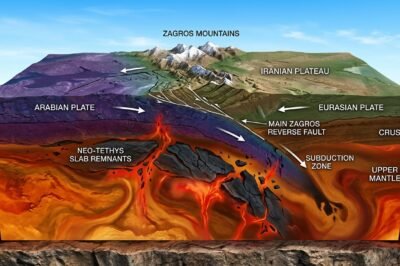
Deep within the bowels of the Earth, a cataclysmic event millions of years in the making is reaching a critical inflection point. Beneath the arid landscapes and towering mountain ranges of Iran, the remains of a long-lost sea, the Tethys Ocean, are being torn asunder by the relentless forces of plate tectonics. This geological phenomenon, which represents a massive structural failure of an oceanic plate trapped between colliding continents, is not merely a matter of scientific curiosity; it is a fundamental shift in the tectonic architecture of the Middle East. For eons, the Arabian plate has been migrating northward, pushing against the massive Eurasian plate. In this slow-motion collision, the ancient oceanic crust that once separated these landmasses didn’t just disappear; it was forced downward into the hot, viscous mantle in a process known as subduction. However, new research indicates that this subducted slab is now experiencing internal tearing, a process that is reshaping the subterranean landscape of the region and sending ripples through the scientific community. This discovery offers a rare window into the lifecycle of oceans and the violent birth of mountain ranges, providing a blueprint for understanding how the very ground we stand on is recycled over millions of years.
The Ghost of the Neo-Tethys: A Geological Legacy
To understand the current tearing beneath Iran, one must first look back nearly 200 million years to the era of the Neo-Tethys Ocean. This vast body of water once separated the supercontinent of Gondwana from Laurasia. As the Arabian plate broke away from Africa and began its trek toward Eurasia, the Neo-Tethys began to shrink. The process was not a simple closing of a door but a complex descent where the oceanic floor was shoved beneath the Iranian plateau. This subducted oceanic crust, often referred to as a “slab,” didn’t melt immediately. Instead, it remained as a cold, dense mass sinking into the Earth’s mantle.
Today, this slab is the focus of intense seismic study. Geologists have found that as the slab sinks, it encounters resistance from the deeper, more viscous layers of the mantle. The tension created by the weight of the sinking slab and the resistance it faces has reached a breaking point. Imagine a piece of cold taffy being pulled from both ends; eventually, it thins and snaps. This is essentially what is happening hundreds of kilometers below the Iranian surface. The remains of the Neo-Tethys are fragmenting, creating massive gaps in the subterranean structure that have profound implications for the surface above.
Seismic Tomography and the Discovery of the Tearing Slab
The discovery of this tectonic tearing was made possible by advancements in seismic tomography, a technique akin to a CT scan for the Earth. By analyzing the speed and trajectory of seismic waves generated by earthquakes, researchers can create three-dimensional models of the subsurface. Cold, dense materials like the ancient oceanic slab allow seismic waves to travel faster, while hotter, softer mantle material slows them down. The resulting images revealed a startling anomaly: the continuous sheet of subducted crust beneath the Zagros Mountains and the Iranian Plateau was no longer continuous. There are visible “tears” or windows where the slab has detached or thinned significantly.
These tears allow hotter mantle material to flow upward into the gaps, a process that can lead to localized uplift and changes in volcanic activity. This finding challenges the traditional view of subduction as a steady, uniform process. Instead, it reveals a chaotic and fragmented reality. The tearing is particularly evident in the transition zones where the rate of continental collision varies, suggesting that the geometry of the colliding plates plays a critical role in how the underlying slab disintegrates. This research provides the first clear evidence that the death of an ocean is just as dynamic and violent as its birth.
The Collision of Giants: Arabian and Eurasian Plate Dynamics
The collision between the Arabian and Eurasian plates is one of the most active tectonic boundaries in the world. This convergence is responsible for the formation of the Zagros Mountains, which stretch across Iran, Iraq, and southeastern Turkey. The rate of convergence is estimated at approximately 2 to 3 centimeters per year, which, in geological terms, is incredibly fast. As the Arabian plate continues to push northward, it compresses the Iranian crust, leading to the frequent and often devastating earthquakes that characterize the region.
However, the tearing of the subducted Tethys slab adds a new layer of complexity to this interaction. When the slab tears, it changes the way stress is distributed throughout the crust. Normally, a subducting slab acts as an anchor, pulling the rest of the plate down with it. If that anchor breaks or tears, the forces acting on the surface can shift suddenly. This can lead to changes in the rate of mountain building and may even influence the location and intensity of future seismic events. The internal “tearing apart” of the ancient ocean’s remains is effectively changing the rules of the game for the entire Middle Eastern tectonic regime.
Environmental and Topographic Impacts on the Iranian Plateau
The consequences of mantle tearing are not confined to the deep Earth; they manifest on the surface in significant ways. One of the most notable impacts is the topographic uplift of the Iranian Plateau. As the slab tears and hotter mantle material rises to fill the void, the crust above becomes more buoyant. This thermal buoyancy pushes the plateau higher, contributing to its high average elevation and rugged terrain. This process has a direct impact on regional climate patterns, as high-altitude plateaus can disrupt atmospheric flow and influence precipitation levels.
Furthermore, the tearing of the slab can influence the hydrothermal systems of the region. The proximity of hot mantle material to the upper crust can heat groundwater, leading to the formation of hot springs and potentially driving the movement of mineral-rich fluids. These fluids are often responsible for the deposition of valuable ore bodies, including copper and gold, which are prevalent in certain parts of the Tethys orogenic belt. Thus, the ancient ocean’s demise is a primary driver of both the physical beauty and the economic potential of the Iranian landscape.
Geopolitical and Strategic Implications of Tectonic Instability
From a strategic and economic perspective, the tectonic activity beneath Iran has far-reaching implications. The region is a vital corridor for global energy infrastructure, including pipelines and shipping routes. Understanding the seismic risks associated with the tearing slab is crucial for the long-term stability of these assets. Earthquakes in this region are not just natural disasters; they are events that can disrupt global markets and necessitate massive humanitarian responses. By mapping the tearing of the subducted slab, scientists can better predict which areas are most at risk for high-magnitude seismic events.
Moreover, the geological evolution of the region dictates the placement of critical infrastructure. Cities like Tehran are situated near major fault lines that are influenced by these deep-seated tectonic movements. A better understanding of how the Tethys remains are fragmenting allows urban planners and engineers to design more resilient structures. In a region where geopolitical tensions are often high, the added variable of geological instability makes the work of seismologists and geologists essential for national and regional security. The collision of continents is a force that transcends borders, requiring international cooperation in scientific research.
Conclusion: The Future of a Fragmenting Continent
As we look to the future, the tearing of the ancient Tethys slab beneath Iran serves as a reminder that the Earth is a dynamic and ever-changing system. The collision of the Arabian and Eurasian plates will continue for millions of years, eventually resulting in the complete closure of the Persian Gulf and the further rise of the Iranian mountains. However, the internal fragmentation of the subducted slab suggests that this process will not be a smooth transition. Instead, it will be marked by episodes of rapid uplift, shifting seismic patterns, and perhaps even new forms of volcanic activity.
The study of these ancient oceanic remains is more than just a trip through geological history; it is a vital effort to understand the current and future state of our planet. By deciphering the clues hidden hundreds of miles beneath the surface, scientists are providing the knowledge necessary to navigate the challenges of a geologically active world. The tearing apart of the Tethys Ocean’s remains is a testament to the power of plate tectonics and a warning that even the most massive structures on Earth are subject to the relentless forces of change. As continents continue to collide, the story of the lost ocean beneath Iran will remain a central chapter in the ongoing narrative of Earth’s evolution.






































Leave a Reply