
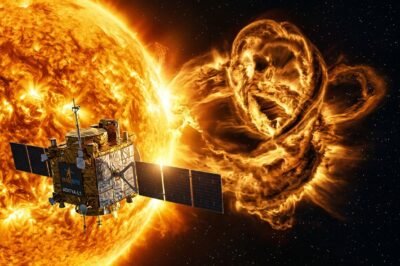
In a milestone that underscores India’s burgeoning dominance in the global space arena, the Aditya-L1 mission, the nation’s premier solar observatory, has successfully detected and analyzed the uneven expansion of solar eruptions, commonly known as Coronal Mass Ejections (CMEs). This groundbreaking observation, reported via News On AIR, marks a significant leap in our understanding of the Sun’s volatile atmosphere. For decades, the complexities of how solar plasma interacts with the vacuum of space have remained partially shrouded in mystery, with most models assuming a relatively uniform expansion. However, the latest data from the Visible Emission Line Coronagraph (VELC) and other onboard sensors suggests a far more chaotic and anisotropic reality. This discovery is not merely a scientific curiosity; it represents a fundamental shift in how we predict space weather, which has direct and often devastating implications for modern technological infrastructure on Earth and in orbit.
The Sun, a dynamic and turbulent star, is the primary driver of our solar system’s environment. While its steady light provides the energy for life, its periodic outbursts can pose existential threats to our digital civilization. Aditya-L1, positioned at the strategic Lagrange Point 1 (L1), approximately 1.5 million kilometers from Earth, offers an unhindered, continuous view of the Sun. This vantage point allows scientists to observe the solar corona without the atmospheric interference that plagues ground-based telescopes. The recent findings regarding the non-uniform expansion of CMEs provide the first high-resolution evidence of how magnetic fields and surrounding solar wind conditions warp the shape and velocity of these massive plasma bubbles as they hurtle through the inner heliosphere. As we move closer to the solar maximum of Cycle 25, understanding these irregularities is becoming a matter of global security.
The Scientific Significance of Anisotropic CME Expansion
For years, heliophysicists have worked with the ‘ice cream cone’ model or other simplified geometric representations to forecast the arrival of Coronal Mass Ejections. While these models provided a baseline, they often failed to account for the ‘pancaking’ effect or the lateral stretching that Aditya-L1 has now documented with unprecedented precision. The data indicates that CMEs do not expand symmetrically; instead, they are subject to internal magnetic pressures and external drag forces that cause them to bulge in specific directions. This uneven expansion means that the density and magnetic field strength within a CME are not distributed evenly, which significantly affects how it interacts with Earth’s magnetosphere.
By identifying these irregularities, ISRO scientists can now refine the ‘Time of Arrival’ (ToA) predictions. When a CME hits Earth, it can trigger geomagnetic storms. If the leading edge is more expanded or concentrated in a specific quadrant, the resulting impact can be far more intense than previously estimated. The Aditya-L1 mission’s ability to track these variations in real-time provides a critical buffer, allowing satellite operators and power grid managers to take preemptive measures. This discovery highlights the intricate interplay between the solar magnetic field and the plasma dynamics that define the heliosphere’s structure.
Technological Breakthroughs: The Role of VELC and SUIT
The success of this detection is largely attributed to the sophisticated suite of instruments carried by the Aditya-L1 spacecraft. The Visible Emission Line Coronagraph (VELC) is the primary payload, designed to study the solar corona’s dynamics from a very close proximity to the solar disk. Unlike other coronagraphs that have a large occulting gap, VELC is engineered to observe the inner corona, where the initial acceleration and expansion of CMEs occur. This is the crucial ‘cradle’ of solar eruptions, and observing the uneven expansion here provides the data necessary to model the CME’s evolution as it travels toward the outer planets.
Complementing VELC is the Solar Ultra-violet Imaging Telescope (SUIT), which monitors the solar disk in the near-ultraviolet range. By correlating the observations from SUIT with the expansion data from VELC, scientists can trace the origin of these eruptions back to specific active regions on the Sun. This multi-wavelength approach allows for a holistic view of solar events, from the initial magnetic reconnection on the surface to the grand-scale expansion of the plasma into interplanetary space. The precision of these instruments is a testament to India’s indigenous manufacturing capabilities in the high-tech aerospace sector.
Economic and Global Infrastructure Implications
The financial stakes involved in space weather forecasting are astronomical. We live in an era where global commerce, communication, and navigation rely heavily on a fragile network of satellites. A major CME, if poorly understood and unpredicted, could result in billions of dollars in losses. The uneven expansion observed by Aditya-L1 suggests that current risk assessment models may be underestimating the localized intensity of solar storms. For example, a CME that appears to be headed slightly off-center might actually have a lateral expansion that catches Earth’s orbital path, leading to unexpected satellite drag or electronic failures.
Furthermore, the global power grid remains vulnerable to Ground Induced Currents (GICs) caused by solar activity. By providing more accurate data on the structure of expanding CMEs, Aditya-L1 enables power utility companies to better manage transformer loads during periods of high solar activity. In a world increasingly dependent on renewable energy grids and interconnected digital systems, the ‘early warning’ system provided by ISRO’s solar mission is an essential component of global economic resilience. The ability to distinguish between a uniform CME and one with skewed expansion allows for a more surgical and less disruptive response to solar threats.
Strategic Positioning: Why Lagrange Point 1 is Vital
Aditya-L1’s location at the L1 point is no coincidence. It is a gravitationally stable position where the pull of the Sun and Earth balance the centrifugal force felt by the satellite. This allows the spacecraft to stay in a fixed position relative to the Earth and the Sun with minimal fuel consumption. More importantly, it provides a 24/7 view of the Sun without any eclipses or occultations. This continuity is what allowed the detection of the uneven expansion; solar eruptions are transient events that can evolve rapidly over minutes and hours. A ground-based telescope or a Low Earth Orbit (LEO) satellite would likely miss the subtle phases of expansion due to Earth’s rotation or orbital shadow.
From this strategic perch, Aditya-L1 acts as a sentinel. The data it transmits back to the Indian Space Science Data Centre (ISSDC) is shared with the global scientific community, reinforcing India’s role as a provider of critical ‘Global Commons’ data. This international collaboration is vital for creating a comprehensive map of the Sun’s influence on the solar system. The detection of anisotropic expansion is a prime example of how specific, high-quality data from a single mission can improve the accuracy of global heliophysics models used by NASA, ESA, and other space agencies.
Future Challenges and the Path to Solar Maximum
As we approach the peak of Solar Cycle 25, expected around 2025, the frequency and intensity of solar flares and CMEs will increase. The discovery of uneven expansion by Aditya-L1 is just the beginning of what promises to be a very active period of solar study. Scientists are now tasked with integrating this ‘anisotropy factor’ into existing predictive algorithms. This will require complex fluid dynamics simulations and a deeper dive into the plasma physics of the solar corona. The challenge lies in the sheer volume of data and the need for real-time processing to ensure that the findings are actionable for satellite operators.
Moreover, the success of Aditya-L1 opens the door for future missions. ISRO is already looking toward more advanced solar observatories that could potentially provide a multi-point perspective of the Sun. Imagine a fleet of ‘Adityas’ positioned at different Lagrange points, providing a 360-degree, three-dimensional view of solar eruptions. Such a network would eliminate all ‘blind spots’ in space weather forecasting, making our technological society truly resilient to the whims of our star. The current findings serve as a proof of concept for the high-level science that can be achieved with dedicated, cost-effective space missions.
Conclusion: A New Era in Heliophysics
The detection of uneven expansion in solar eruptions by Aditya-L1 is a landmark achievement that transcends national pride. It is a contribution to the collective knowledge of humanity, providing a clearer picture of the forces that govern our solar system. By revealing that CMEs do not expand uniformly, ISRO has challenged existing paradigms and paved the way for more sophisticated space weather forecasting. This discovery ensures that as we become more reliant on space-based technology, we are also becoming better equipped to protect it. The Aditya-L1 mission continues to prove that India is not just a participant in the space race, but a leader in the scientific exploration of our most vital celestial neighbor. The insights gained today will undoubtedly shape the safety protocols and technological innovations of tomorrow, ensuring a more secure future for our interconnected world.





































Leave a Reply