
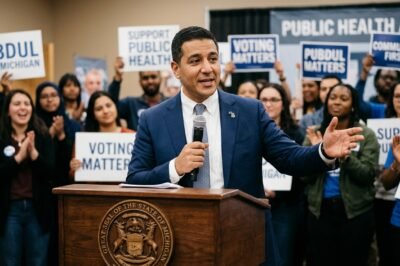
The political landscape of Michigan, and indeed the broader United States, has undergone a seismic shift that few could have predicted during the height of the 2016 electoral cycle. The ascent of Abdul El-Sayed from a public health professional to a history-making political figure represents more than just a victory for a single candidate; it is a profound rebuttal to an era defined by exclusionary rhetoric and the weaponization of identity. As he steps into his role with the title of senator, El-Sayed’s journey offers a masterclass in resilience, policy-driven campaigning, and the strategic navigation of a media environment that was often hostile to his very existence. This analysis delves into how a doctor-turned-politician managed to dismantle the walls of prejudice built during the Trump administration, proving that a message of universal healthcare and social equity can resonate even in the most polarized environments. By focusing on the ‘politics of addition’ rather than the ‘politics of subtraction,’ El-Sayed has effectively rewritten the playbook for minority candidates in the American Midwest, turning what many perceived as electoral liabilities into his greatest strengths.
The significance of this moment cannot be overstated. For years, the specter of Islamophobia was used as a potent tool to alienate Muslim-American candidates from the mainstream. However, El-Sayed’s victory signals a maturation of the American electorate, particularly in the Rust Belt, where economic anxiety often intersects with cultural tension. His ability to bridge these divides—connecting with urban voters in Detroit while addressing the concerns of rural laborers—highlights a shift toward class-based solidarity that transcends religious and ethnic lines. This detailed breakdown explores the mechanics of his campaign, the socio-political climate that sought to suppress his voice, and the ultimate triumph of a vision that prioritizes the collective well-being over individualistic division.
The Architect of a New Michigan: Background and Context
Abdul El-Sayed did not emerge from a traditional political vacuum. Before the headlines and the legislative sessions, he was the youngest health director of a major American city, tasked with rebuilding Detroit’s health department from the ground up. His tenure was marked by a relentless focus on the social determinants of health—lead poisoning, asthma rates in industrial zones, and the lack of basic medical access for the city’s most vulnerable. This period was foundational; it provided him with the ‘technocratic credibility’ that many critics tried to ignore. By the time he entered the political fray, he wasn’t just a candidate of color; he was an expert in the systems that were failing the people of Michigan.
His initial foray into the gubernatorial race in 2018 served as a precursor to his current success. Although he did not win that primary, he succeeded in building a massive grassroots infrastructure that outlasted the election cycle. This network was composed of young activists, environmentalists, and working-class families who felt neglected by the establishment. It was during this time that he faced the brunt of the ‘Trumpian’ influence in local politics—accusations of hidden agendas and ‘sharia’ conspiracies. Yet, instead of retreating into a defensive posture, El-Sayed doubled down on transparency, inviting critics into a dialogue about clean water and fair wages, effectively neutralizing hate with the hard realities of policy.
Navigating the Rhetoric of Division and Hate
The ‘Trump era’ introduced a brand of vitriol that specifically targeted individuals of El-Sayed’s background. The rhetoric often centered on the idea that someone named Abdul could never truly represent the ‘heartland’ of America. This was not merely social media noise; it was a coordinated political strategy designed to activate the most reactionary elements of the base. El-Sayed’s strategy was to frame these attacks as a distraction from the real issues. When opponents brought up his faith, he brought up the Flint water crisis. When they questioned his loyalty, he spoke about his loyalty to the patients he served as a physician. This pivot was crucial in maintaining the moral high ground and keeping the focus on the failures of the status quo.
Statistically, the impact of this hateful rhetoric often has a chilling effect on minority voter turnout and candidate recruitment. However, El-Sayed’s campaign saw a reverse trend. By standing firm, he galvanized a coalition that saw his struggle as their own. In districts where Trump had previously made significant gains, El-Sayed managed to narrow the gap by focusing on the ‘kitchen table issues’ that the divisive rhetoric ignored. This demonstrated a critical market implication for political campaigning: identity can be a bridge rather than a barrier when it is used to humanize the systemic failures of the economy. His success is a testament to the fact that voters are increasingly hungry for authenticity over polished, focus-grouped personas.
The Demographic Shift and the Power of Grassroots Mobilization
One of the most striking aspects of El-Sayed’s victory is the demographic data behind the votes. Michigan has seen a steady increase in its Arab-American and Muslim-American populations, but more importantly, it has seen a surge in ‘progressive-aligned’ voters across all ethnicities. El-Sayed’s team utilized sophisticated data analytics to identify non-voters—those who felt the system had nothing to offer them. By mobilizing this ‘missing middle,’ he created a buffer against the traditional swing-voter fluctuations that usually dictate Michigan politics. His campaign didn’t just win over Democrats; it brought new people into the democratic process entirely.
The mobilization effort was characterized by a decentralized structure. Thousands of volunteers organized small-scale meetups, translating complex policy papers into relatable narratives. This grassroots approach was essential in countering the high-spend ad campaigns of his opponents. While the opposition relied on traditional media buys and fear-based messaging, El-Sayed’s campaign was built on the ‘earned media’ of community trust. This shift reflects a broader trend in American politics where the cost of entry is being challenged by the power of digital connectivity and authentic community engagement. The financial implications for future campaigns are clear: the return on investment for grassroots organizing is beginning to outpace traditional television advertising in highly contested regions.
Policy Over Identity: A Strategic Pivot to Substance
While the media often focused on the historic nature of his candidacy, El-Sayed’s internal strategy was obsessively focused on policy. He championed a ‘Michigan Medicare for All’ plan and a ‘Green New Deal for Michigan,’ which at the time were considered radical. By providing detailed, white-paper-level specifics on how these programs would be funded and implemented, he forced his opponents to debate him on substance rather than platitudes. This moved the needle of the entire political discourse in the state. Even his detractors had to admit that he was the most prepared candidate on the stage, a factor that weighed heavily with undecided voters who were tired of ‘politics as usual.’
Economic and Market Implications of Progressive Wins
From a financial perspective, the rise of candidates like El-Sayed signals a potential shift in state-level spending and regulatory environments. Investors and market analysts are now looking at Michigan through a lens of increased social spending and tighter environmental regulations. While some business sectors may express concern over higher corporate taxes, others see the long-term benefits of a healthier, more educated workforce and modernized infrastructure. El-Sayed’s focus on the ‘public health of the economy’ suggests that social investments are not just moral imperatives but sound economic strategies. The stabilization of the healthcare market through public options, for instance, could reduce the burden on small businesses that currently struggle with rising insurance premiums.
The Global Context: A Message to the World
Al Jazeera’s coverage of this story highlights the global significance of El-Sayed’s win. In a world where right-wing populism is on the rise across Europe and the Middle East, the success of a Muslim-American leader in a major US state serves as a powerful counter-narrative. It reassures global observers that the American democratic experiment is still capable of self-correction. For international markets, this stability and the rejection of extreme xenophobia are positive indicators for long-term diplomatic and trade relations. It proves that the United States can still produce leaders who are capable of navigating multiculturalism within a democratic framework.
Conclusion: Future Implications and the Legacy of a Senator
The story of Abdul El-Sayed is far from over; it is merely entering a new, more influential chapter. As he takes his seat in the Senate, the implications for the 2024 presidential cycle and beyond are profound. He represents a bridge between the traditional Democratic establishment and the rising progressive wing of the party. His ability to win in a state like Michigan suggests that the ‘Blue Wall’ can be rebuilt, not by retreating to the center-right, but by leaning into bold, populist policies that address the root causes of inequality. For future candidates of color, El-Sayed has cleared a path that was once considered impassable. He has shown that while hate can be a powerful motivator in the short term, a vision based on dignity, health, and justice has a much more enduring shelf life.
Ultimately, the victory of Abdul El-Sayed is a victory for the concept of ‘belonging.’ It challenges the notion of who is allowed to lead and what an American leader looks like. As the political and financial sectors adjust to this new reality, the focus will remain on whether his legislative record can match the high expectations set by his historic campaign. If his past performance in Detroit is any indication, the Senate has just gained one of its most rigorous and dedicated public servants. The message to the world is clear: the history of hate can be overcome by a future of hope, provided that hope is backed by hard work and unyielding policy conviction.

































Leave a Reply