
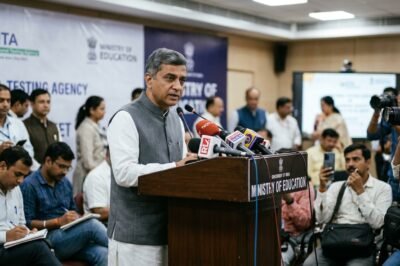
In a move that has sent shockwaves through the Indian academic community and ignited a firestorm of political debate, the Union Ministry of Education announced the cancellation of the University Grants Commission-National Eligibility Test (UGC-NET) just one day after it was conducted across the country. This unprecedented decision follows significant concerns regarding the integrity of the examination process, specifically pointing towards a potential paper leak that was flagged by the National Cyber Crime Threat Analytics Unit. For over 9 lakh candidates who appeared for the exam on June 18, 2024, the announcement is a devastating blow, coming at a time when the National Testing Agency (NTA) is already under intense scrutiny for alleged irregularities in the NEET-UG medical entrance results. By ordering a high-level investigation by the Central Bureau of Investigation (CBI), the government has signaled its intent to maintain the sanctity of national examinations, yet the move has raised fundamental questions about the reliability of centralized testing systems and the future of academic meritocracy in India. The cancellation marks one of the largest disruptions in the history of the UGC-NET, affecting thousands of aspiring assistant professors and research scholars who spent months, if not years, preparing for this single day.
The Scale of the UGC-NET Crisis and the NTA’s Performance
The National Testing Agency (NTA), which was established to conduct efficient, transparent, and international-standard tests, is now facing an existential crisis. The UGC-NET June 2024 session was unique as it returned to an OMR (Optical Mark Recognition) or pen-and-paper format for the first time in several years, moving away from the Computer-Based Test (CBT) model. This shift was intended to make the exam more accessible but may have inadvertently created vulnerabilities in the logistics and distribution chain of the question papers. Over 9,08,580 candidates sat for the exam across 1,205 centers in 317 cities, making the logistics of the operation immense. The decision to cancel the exam was not taken lightly; it was based on inputs from the Ministry of Home Affairs’ Indian Cyber Crime Coordination Centre (I4C), suggesting that the integrity of the exam in certain subjects might have been compromised.
Historically, the UGC-NET is the gateway for Indian nationals to determine their eligibility for the ‘Junior Research Fellowship and Assistant Professor’ and ‘Admission to PhD’ in Indian universities and colleges. With the cancellation, the entire academic cycle for the 2024-25 session faces a massive delay. Universities that were planning to use these scores for their doctoral admissions are now left in a state of limbo. The NTA’s inability to secure the paper, despite the high-stakes nature of the exam, points toward a systemic failure that goes beyond individual centers. The reliance on physical paper distribution in the OMR format has been criticized by experts as a step backward in an era where digital encryption and secure CBT platforms are the global standard.
Breakdown of the CBI Investigation and Legal Implications
The involvement of the Central Bureau of Investigation (CBI) elevates the situation from a mere administrative lapse to a potential criminal conspiracy. The Ministry of Education has explicitly stated that the matter has been handed over to the CBI for a thorough investigation into the source of the leak and the involvement of organized ‘solver gangs’ or coaching mafias. This move is seen as an attempt to restore public trust, but it also highlights the severity of the breach. The CBI will likely look into the entire chain of custody of the question papers, starting from the printing presses to the transport agencies and the local coordinators at the 1,205 examination centers. Previous investigations into paper leaks in India have often revealed deep-seated networks that exploit the desperation of students for financial gain, often involving insiders within the testing machinery.
Legally, this incident falls under the newly notified Public Examinations (Prevention of Unfair Means) Act, 2024. This stringent law was designed precisely to tackle such scenarios, providing for imprisonment up to 10 years and a fine of up to 1 crore rupees for those involved in organized paper leaks. The UGC-NET case will be one of the first major tests for this legislation. Legal experts suggest that the government’s proactive cancellation is a strategy to prevent future litigation that could have been filed by students if the results were announced despite the leak. However, the legal burden now shifts to the CBI to provide concrete evidence that can stand in court, ensuring that the masterminds behind the leak are brought to justice rather than just the foot soldiers.
Statistical Analysis: The Human and Financial Cost
To understand the gravity of the cancellation, one must look at the numbers. Out of the 11.21 lakh registered candidates, approximately 81 percent appeared for the exam. For these 9 lakh students, the financial burden is significant. On average, a candidate spends between 5,000 to 15,000 rupees on application fees, study materials, and travel logistics. Many candidates from rural areas travel hundreds of kilometers to reach urban exam centers, often staying in expensive temporary accommodations. The collective financial loss to the student community is estimated to be in the hundreds of crores. Moreover, the psychological toll is immeasurable. Years of preparation and the hope for a stable career in academia have been replaced by anxiety and uncertainty.
- Total Registered Candidates: 11.21 Lakhs
- Total Appeared Candidates: 9.08 Lakhs
- Total Cities Covered: 317
- Total Exam Centers: 1,205
- Economic Loss per Candidate: Estimated 5,000 – 15,000 INR
Beyond the individual, there is a macro-economic impact on the research ecosystem. The delay in the Junior Research Fellowship (JRF) awards means that research projects across Indian laboratories and humanities departments will face a talent crunch. The JRF provides a crucial monthly stipend that allows students from economically weaker backgrounds to pursue high-level research. A delay of even six months can lead to a ‘brain drain’ where talented students look for opportunities abroad or in the private sector instead of waiting for the government to fix its examination machinery.
The Political Firestorm and Institutional Accountability
The cancellation has provided significant ammunition to the opposition parties, who have been quick to link the UGC-NET failure with the ongoing NEET-UG controversy. The narrative of ‘leaks and scams’ has become a major political challenge for the ruling government and the Education Minister. Critics argue that the centralization of all major exams under the NTA has created a single point of failure. The demand for the resignation of top NTA officials and a complete overhaul of the agency has gained momentum on social media and in political circles. The controversy has also raised questions about the ‘outsourcing’ of exam invigilation and the lack of government oversight at the local level.
Institutional accountability is now the need of the hour. The Ministry of Education has promised a high-level committee to suggest reforms in the NTA, but experts believe that cosmetic changes will not suffice. There is a growing demand for a more decentralized approach where individual universities or states have more say in the conduct of their exams, reducing the scale of the operation and thereby reducing the incentive for large-scale paper leaks. The political fallout is likely to continue as the CBI progresses with its investigation, potentially revealing more uncomfortable truths about the security protocols—or the lack thereof—within the nation’s premier testing body.
Technological Solutions and Modernizing the Examination System
In the wake of this crisis, the debate around the OMR vs. CBT format has resurfaced. While OMR was seen as a way to scale the exam, it is inherently more susceptible to physical theft and leakage. Modernizing the examination system through technology is no longer an option but a necessity. This includes the use of blockchain for paper distribution, AI-monitored proctoring, and the generation of unique, randomized question sets for every candidate. If the NTA is to survive this crisis, it must adopt a ‘tech-first’ security model. Digital question papers that are only decrypted five minutes before the exam starts using biometric keys of the center head could potentially eliminate the risk of leaks during transit.
Furthermore, the use of Aadhaar-linked biometric verification at centers can stop the practice of ‘proxy candidates’ which is often the second half of the paper-leak business. The government must also invest in creating dedicated, government-owned testing centers rather than relying on private schools and colleges that may have lax security standards. The integration of End-to-End Encryption for the entire workflow—from question setting to result processing—is essential to prevent internal leaks. These technological upgrades will require significant investment, but compared to the cost of canceling national-level exams and the loss of institutional credibility, it is a small price to pay.
Future Implications: Restoring Trust in the Meritocracy
The cancellation of the UGC-NET is a watershed moment for Indian education. It marks a point where the state has acknowledged that its systems are under threat from sophisticated criminal networks. The primary future implication is the inevitable delay in the academic calendar, but the deeper implication is the erosion of trust among the youth. For a nation that prides itself on its ‘demographic dividend,’ a failing examination system is a national security risk. The government must act swiftly not just to re-conduct the exam, but to prove that the new process is unhackable. The upcoming session of the UGC-NET will be the most watched exam in India’s history, and any further slip-up could lead to a permanent loss of faith in the NTA.
The road ahead involves a two-pronged strategy: swift justice through the CBI probe and long-term structural reform of the NTA. The findings of the CBI will determine if the leak was an isolated incident at a specific center or a systemic breach at the headquarters. Until then, millions of students wait in anticipation, hoping that their hard work will not be overshadowed by the actions of a few criminals. The goal must be to create a system where the only factor that determines success is a student’s merit, not their access to leaked documents. Only then can the sanctity of the Indian education system be truly restored and the aspirations of the youth be protected from the dark underbelly of the paper-leak mafia.




































Leave a Reply