
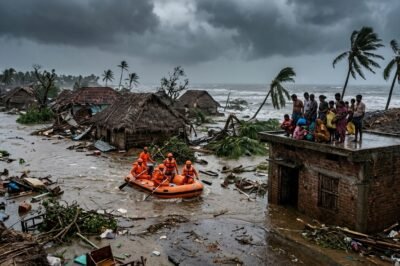
The relentless fury of the Bay of Bengal has once again manifested in the form of Cyclone Arnab, a severe cyclonic storm that made a devastating landfall along the coast of Andhra Pradesh in the early hours of Tuesday. As the clock struck 2:30 AM, the eye of the storm crossed the coastline near Machilipatnam, bringing with it a cataclysmic combination of sustained winds reaching 160 kilometers per hour and torrential downpours that turned streets into rivers within minutes. The immediate human cost has been tragic, with state authorities confirming at least five fatalities across the districts of Krishna and Guntur. These victims, caught in the crosshairs of nature’s indifference, were primarily residents of low-lying coastal hamlets whose precarious dwellings were no match for the storm surge that pushed seawater nearly two kilometers inland. For the millions residing along the volatile Eastern Seaboard, Arnab represents not just a seasonal weather event but a stark reminder of the escalating volatility of the regional climate. The atmospheric pressure dropped to record lows as the storm approached, creating a vacuum that sucked in moisture and energy, eventually releasing it with a ferocity that has left the state’s administrative machinery scrambling to maintain order amidst the chaos.
The Meteorological Genesis and Path of Destruction
Cyclone Arnab began its life as a modest low-pressure area near the Andaman Sea before rapidly intensifying into a Severe Cyclonic Storm (SCS) due to abnormally high sea surface temperatures. Meteorologists from the India Meteorological Department (IMD) had been tracking the system for over a week, noting its unusual trajectory which defied early computer models. Unlike previous storms that often recurve toward Odisha or West Bengal, Arnab maintained a steady, westward march, gaining strength from the warm waters of the central Bay of Bengal. The rapid intensification—a phenomenon becoming increasingly common in the era of global warming—left limited time for some local communities to fully reinforce their infrastructure. By the time it reached the inner continental shelf, Arnab had developed a well-defined eye and symmetric spiral bands that lashed the coast long before the center made landfall.
The landfall process itself lasted nearly four hours, during which the mechanical force of the wind uprooted thousands of electrical poles and centuries-old banyan trees. In the port city of Machilipatnam, the sound of the wind was described by survivors as a continuous, haunting roar that drowned out the crashing of waves. Precipitation levels were equally staggering, with some weather stations recording over 350mm of rain in a single 12-hour window. This volume of water has led to the breach of several minor irrigation tanks, further complicating the flooding situation in the hinterlands. The convergence of the storm surge with the high tide exacerbated the inundation, trapping hundreds of families on the rooftops of their concrete houses while those in thatched huts faced the grim reality of total structural failure.
Economic Impacts: Agriculture and the Blue Economy
The financial ramifications of Cyclone Arnab are expected to be profound, particularly for the agricultural sector which serves as the backbone of the Andhra Pradesh economy. Preliminary reports from the Department of Agriculture suggest that over 200,000 hectares of ready-to-harvest paddy crops have been submerged. The timing of the storm is particularly cruel, as farmers were mere days away from the commencement of the harvest season. For many small-scale cultivators, the loss of this crop translates to a complete wipeout of their annual income and the accumulation of insurmountable debt. Furthermore, the commercial banana and coconut plantations in the Konaseema region have seen widespread felling, with losses estimated in the hundreds of crores.
Beyond traditional farming, the ‘Blue Economy’ of the state has taken a massive hit. Andhra Pradesh is a global hub for aquaculture, specifically shrimp farming. The storm surge has led to the overflow of thousands of shrimp ponds, allowing the stock to escape into the sea and contaminated floodwaters. This not only represents a direct loss of inventory but also poses a long-term threat to the soil quality due to salinity ingress. The fishing community has also suffered, with hundreds of mechanized boats and traditional catamarans smashed against the jetties or lost to the receding tide. The disruption of cold storage chains due to the total collapse of the power grid means that even the salvaged catch is at risk of perishing, leading to a temporary spike in seafood prices across South India.
Infrastructural Collapse and the Energy Crisis
Infrastructure damage across the coastal districts is described as ‘unprecedented’ by state officials. The high-velocity winds have decimated the power distribution network, with high-tension transmission towers buckled like tin foil. As of this afternoon, over 1.5 million households remain without electricity, and the restoration process is expected to take at least a week given the flooded state of the sub-stations. Communication networks have also been severely crippled; cellular towers have either been physically damaged or have run out of battery backup, making it difficult for the disaster management teams to coordinate rescue efforts in real-time. This ‘digital blackout’ has added a layer of psychological distress to the affected population, who are unable to contact loved ones or access emergency information.
The transport sector is in a similar state of paralysis. National Highway 16, a critical artery connecting Chennai to Kolkata, saw multiple disruptions due to fallen trees and waterlogging. Railway authorities were forced to cancel or divert over fifty trains, leaving thousands of passengers stranded at various stations. The damage to rural roads is perhaps the most critical issue, as it hinders the movement of heavy machinery and relief supplies to the worst-hit villages. Engineering wings of the state government are currently conducting rapid assessments, but the sheer scale of the damage to bridges and culverts suggests that the rebuilding phase will require a multi-billion rupee investment and several months of sustained labor.
State Response and Human Relief Operations
In response to the crisis, the State Government of Andhra Pradesh, led by the Chief Minister, has mobilized the entirety of its administrative resources. Over 60,000 people were evacuated to 300 relief camps established in government schools and community halls prior to the landfall, a move that undoubtedly prevented a much higher death toll. The National Disaster Response Force (NDRF) and the State Disaster Response Force (SDRF) have deployed twenty teams equipped with inflatable boats, chainsaws, and medical kits. These teams are currently operating in the ‘Golden Hour’ of rescue, focusing on reaching isolated pockets in the Krishna River delta where people remain marooned by rising waters.
The distribution of essential supplies has become the primary focus of the afternoon. The government has sanctioned the immediate release of five kilograms of rice, pulses, and cooking oil to every affected family. However, the logistics of reaching the interior villages remain a nightmare. Helicopters from the Indian Navy and Air Force have been put on standby at the INS Dega base in Visakhapatnam to commence air-dropping of food packets and drinking water if ground routes remain impassable. The Health Department has also issued a high alert for water-borne diseases, deploying mobile medical units to the relief camps to administer vaccinations and provide basic healthcare, as the risk of cholera and typhoid typically spikes in the aftermath of such inundations.
Lessons from Arnab: The Need for Climate Resilience
Cyclone Arnab is the latest in a series of intensifying storms that highlight the vulnerability of the Indian coastline. While the early warning systems have improved significantly since the 1999 Odisha Super Cyclone, the focus must now shift from ‘disaster management’ to ‘disaster resilience.’ Experts argue that the current urban planning and coastal development models are unsustainable. The destruction of mangrove forests, which act as natural windbreaks and storm surge buffers, has left the coastline exposed. Restoring these ecological barriers is no longer a choice but a necessity for survival. Additionally, the state needs to invest in ‘cyclone-resilient’ infrastructure, such as underground cabling for power lines and elevated roadways that remain functional even during floods.
Key Statistics and Impact Summary:
- Casualties: 5 confirmed, several missing in coastal villages.
- Wind Speed: 150-170 km/h at the time of landfall.
- Evacuations: 60,000+ residents moved to safer zones.
- Agricultural Loss: Estimated 200,000 hectares of paddy and aquaculture ponds.
- Infrastructure: 4,000+ electric poles uprooted; 50+ trains cancelled.
Conclusion: Navigating the New Normal
As the remnants of Cyclone Arnab weaken into a deep depression and move toward Telangana, the focus of the state must shift toward a long-term recovery strategy. This event serves as a grim harbinger of the ‘new normal’ where extreme weather events are more frequent and more destructive. The economic recovery for the farmers and small businesses of Andhra Pradesh will require significant central assistance and a revision of insurance policies to ensure that climate risks are adequately covered. Beyond the immediate financial aid, there is a pressing need for a National Coastal Policy that prioritizes the safety of marginalized communities and the preservation of the environment. Cyclone Arnab has left a deep scar on the landscape and the psyche of Andhra Pradesh, but it also offers a final warning: adapt or continue to suffer the increasing wrath of a changing planet. The resilience of the Telugu people will be tested in the coming weeks, but without systemic changes in how we approach coastal development, the cycle of destruction and reconstruction is doomed to repeat.






































Leave a Reply