
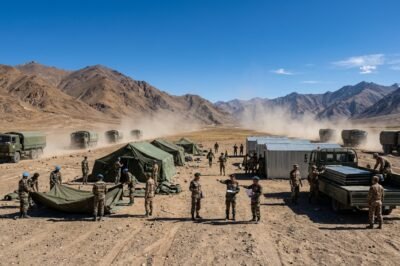
In a watershed moment for Himalayan geopolitics, India and China have successfully concluded the disengagement of their respective troops from the critical friction points of Depsang and Demchok in eastern Ladakh. This significant de-escalation marks the first major step toward restoring the status quo ante as it existed prior to the 2020 military standoff, which saw relations between the world’s two most populous nations plunge to their lowest point in decades. The completion of this process involves the dismantling of temporary structures, the withdrawal of heavy equipment, and the restoration of terrain to its original state, signaling a potential thaw in a relationship that has been characterized by deep-seated mistrust and high-altitude militarization. For over four years, the Line of Actual Control (LAC) has been a flashpoint of global concern, but the latest developments suggest that diplomatic persistence, coupled with strategic military posturing, has finally paved the way for a calibrated return to normalcy. As the two nuclear-armed neighbors move toward a verification phase, the international community watches closely, recognizing that stability on the roof of the world is a prerequisite for broader regional security and economic growth. This disengagement is not merely a tactical maneuver; it is a profound diplomatic signal that both New Delhi and Beijing are ready to move past the paralysis of the last four years, focusing instead on the complexities of border management and the broader bilateral agenda.
The Historical Context of the Eastern Ladakh Standoff
The roots of the current breakthrough lie in the dark events of May 2020, when a series of skirmishes escalated into a deadly confrontation in the Galwan Valley. That clash, which resulted in the loss of lives on both sides, shattered nearly three decades of relative peace maintained through various border protocols. Following the initial violence, both the Indian Army and the People’s Liberation Army (PLA) deployed tens of thousands of troops, backed by artillery, tanks, and fighter jets, across the high-altitude desert of Ladakh. While some friction points like Pangong Tso and Gogra-Hotsprings saw disengagement in 2021 and 2022, Depsang and Demchok remained the most stubborn obstacles to peace.
Depsang, in particular, was strategically sensitive because it sits near the Daulat Beg Oldie (DBO) airstrip and the critical Karakoram Pass. The Chinese presence there had prevented Indian troops from accessing traditional patrolling points, creating a strategic bottleneck. Similarly, in Demchok, the standoff at the Charding Nullah had long been a point of contention. The refusal of either side to blink for four years created a permanent state of high alert, necessitating massive infrastructure spending and a total restructuring of India’s northern defense posture. The resolution of these specific points is therefore seen as a crowning achievement for the negotiators involved in the Corps Commander-level talks.
Detailed Breakdown of the Disengagement Process at Depsang and Demchok
The disengagement process at Depsang and Demchok was a meticulously planned operation overseen by military commanders on both sides. According to defense sources, the process involved several phases, beginning with the cessation of forward deployments and the dismantling of temporary sheds, tents, and communication centers that had been erected over the past 50 months. In the Depsang plains, where the terrain is relatively flat but extremely high in altitude, both armies utilized heavy machinery to fill in trenches and remove man-made obstacles that hindered free movement. The goal was to ensure that the physical landscape returned to the state it was in before April 2020, allowing for a clear line of sight and reducing the risk of accidental encounters.
Verification has been the cornerstone of this disengagement. Following the physical withdrawal, both sides have employed a multi-layered verification mechanism. This includes the use of Unmanned Aerial Vehicles (UAVs) or drones to conduct overhead surveillance, ensuring that structures have indeed been removed. Additionally, ground-level verification teams, often consisting of junior officers, have met at designated points to confirm the withdrawal. Unlike previous disengagements that sometimes resulted in ‘buffer zones’ where neither side could patrol, the current agreement is geared toward restoring the patrolling rights that were established in the past. This subtle shift in the agreement’s framework is crucial for India, as it reaffirms its sovereign claims over areas that were previously blocked by PLA maneuvers.
Geopolitical Significance and the BRICS Connection
The timing of this disengagement is hardly a coincidence. The breakthrough was finalized just days before the BRICS summit in Kazan, Russia, where Prime Minister Narendra Modi and President Xi Jinping held their first formal bilateral meeting in five years. The meeting itself was made possible by the consensus reached on border patrolling arrangements. From a geopolitical perspective, the resolution of the Ladakh standoff suggests that both India and China recognize the limitations of a perpetual stalemate. For China, embroiled in trade tensions with the United States and facing economic headwinds at home, a stable border with India allows for a more focused approach to the Pacific and its internal economic challenges.
For India, the disengagement offers a chance to reallocate resources and focus on its broader vision of becoming a global manufacturing hub. The standoff had forced New Delhi to adopt a ‘China-plus-one’ strategy and implement strict scrutiny of Chinese investments. While the border resolution does not immediately erase the strategic competition between the two, it does lower the immediate temperature. By stabilizing its most volatile frontier, India demonstrates its capacity for strategic autonomy, proving it can manage its relations with a superpower neighbor through a combination of military resolve and sophisticated diplomacy, without necessarily relying on external alliances.
Impact on India-China Economic Ties and Trade Policies
The military disengagement is expected to have immediate and far-reaching consequences for the economic relationship between New Delhi and Beijing. Since 2020, India has implemented a series of restrictive measures aimed at curbing Chinese economic influence, including the banning of hundreds of mobile applications, increased scrutiny on Foreign Direct Investment (FDI) under Press Note 3, and the exclusion of Chinese vendors from 5G trials. These measures were explicitly linked to the situation on the border, with the Indian government maintaining that peace on the frontier was a prerequisite for normal trade relations.
With the completion of disengagement at Depsang and Demchok, there is now significant pressure from the Indian industry to ease some of these restrictions. Sectors such as electronics manufacturing, renewable energy, and pharmaceuticals rely heavily on Chinese components and technical expertise. Industry leaders argue that while security remains paramount, a blanket restriction on Chinese investment may be counterproductive to India’s goal of expanding its manufacturing sector. We may soon see a more nuanced approach where ‘non-sensitive’ investments are cleared more quickly. However, analysts warn that a full return to the pre-2020 economic status quo is unlikely, as India remains committed to reducing its trade deficit and building domestic capacity to avoid over-dependence on a single source.
Operational Realities: Verification and the Restoration of Patrolling Rights
The most critical aspect of the current disengagement is the restoration of patrolling rights. In previous disengagement cycles, the creation of buffer zones—while effective at preventing clashes—meant that Indian troops could no longer visit areas they had traditionally patrolled. This led to domestic criticism that India was losing control of its territory by stealth. The agreement for Depsang and Demchok specifically addresses this concern by outlining a schedule for patrols. Both sides have agreed to inform each other of their patrolling schedules to prevent face-offs, a move that introduces a layer of transparency that was previously missing.
Furthermore, the operational reality on the ground will involve the continued presence of a large number of troops in the ‘depth areas.’ While the frontline troops have disengaged, the massive infrastructure of roads, bridges, and permanent barracks built over the last four years remains. This means that while the immediate friction has been removed, the LAC has effectively been ‘permanently’ militarized compared to its 2019 state. The challenge for both militaries now is to manage this permanent presence without letting it escalate into new friction points. The successful verification of the current disengagement is therefore not the end of the process, but the beginning of a long-term confidence-building exercise that will require constant communication at both the local commander and diplomatic levels.
Conclusion: Navigating the Future of the Himalayan Border
The completion of troop disengagement at Depsang and Demchok is a momentous achievement that provides a much-needed breathing space for both India and China. It validates the principle that persistent diplomatic engagement, backed by a credible military deterrent, can resolve even the most intractable territorial disputes. However, it would be naive to assume that the underlying rivalry between these two Asian giants has been resolved. The border issue is a symptom of a larger strategic competition for leadership in Asia and influence on the global stage. Trust, once shattered, takes decades to rebuild, and the memory of the 2020 clashes will continue to inform India’s strategic calculations for years to come.
Looking ahead, the focus must shift from ‘disengagement’ to ‘de-escalation’ and ‘de-induction’ of the massive forces still stationed in the rear areas. Until the tens of thousands of troops are moved back to their permanent bases, the risk of a flare-up remains. The next few months will be a test of the sincerity of both nations. If the patrolling arrangements hold and the economic dialogue slowly resumes, we may look back at October 2024 as the moment the two nations decided to prioritize stability over conflict. For now, the successful withdrawal from Depsang and Demchok is a victory for diplomacy and a vital step toward a more stable and predictable Indo-Pacific region.


































Leave a Reply