
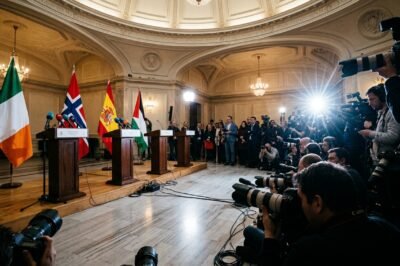
In a historic and coordinated diplomatic maneuver that has reverberated across the global stage, the governments of Ireland, Norway, and Spain have officially announced their formal recognition of a Palestinian state. This momentous decision, articulated simultaneously in Dublin, Oslo, and Madrid, marks one of the most significant shifts in European foreign policy toward the Middle East in decades. For years, the prospect of a two-state solution has been the rhetorical bedrock of international diplomacy, yet tangible progress toward that goal has often remained elusive. By moving beyond words and into the realm of formal legal recognition, these three European nations have effectively challenged the status quo, signaling a profound impatience with the lack of a viable peace process and a desire to exert pressure on the international community to take more concrete steps toward a permanent resolution. This move comes at a time of extreme volatility, as the humanitarian crisis in Gaza continues to draw global condemnation and the geopolitical fault lines of the region are being redressed in real-time.
The announcement is not merely a symbolic gesture; it is a calculated political act intended to bolster the moderate Palestinian leadership and provide a counter-narrative to extremist factions. By affirming the right of Palestinians to self-determination and statehood, Ireland, Norway, and Spain are attempting to preserve the viability of a two-state solution that many observers fear is slipping away. However, the move has immediately ignited a diplomatic firestorm, particularly in Jerusalem, where the Israeli government has decried the decision as a “reward for terrorism.” The ramifications of this recognition extend far beyond the immediate diplomatic frostiness, touching upon international law, European Union internal unity, and the future of Western-Israeli relations. As the world watches, the actions of these three nations may serve as a catalyst for other Western powers to reconsider their own positions, potentially altering the diplomatic landscape of the Middle East forever.
Historical Context and the Evolution of European Policy
The recognition of Palestine by Ireland, Norway, and Spain is the culmination of decades of evolving sentiment within these nations. Ireland, in particular, has long maintained a uniquely sympathetic stance toward Palestinian aspirations, often drawing parallels between the Palestinian struggle and its own historical quest for independence and peace. Throughout the late 20th century, Irish politicians have been among the most vocal in Europe calling for Palestinian rights, and this formal recognition is seen by many in Dublin as the natural progression of a long-held national conviction. Similarly, Norway has a storied history in Middle Eastern diplomacy, most notably as the architect of the 1993 Oslo Accords. While those accords failed to deliver a lasting peace, Norway has remained a committed mediator and a significant donor to Palestinian institutions, maintaining that a sovereign state is the only path to regional stability.
Spain’s involvement adds a significant heavyweight from the European Union’s southern flank. Prime Minister Pedro S!nchez has been increasingly critical of the military campaign in Gaza, arguing that the protection of civilian life and the promotion of a political horizon for Palestinians are inseparable requirements for peace. Unlike previous rounds of recognition by individual states, this coordinated effort by three influential European countries suggests a burgeoning consensus among certain Western liberal democracies that the traditional approach of waiting for a negotiated settlement before granting recognition has failed. By flipping the script—granting recognition to facilitate a settlement rather than waiting for one—these nations are attempting to create a new diplomatic reality on the ground.
The Israeli Response and Diplomatic Fallout
The reaction from Israel was swift and severe. Foreign Minister Israel Katz immediately recalled Israel’s ambassadors from Dublin, Oslo, and Madrid for “urgent consultations,” signaling a deep rupture in bilateral relations. The Israeli government argues that recognizing a Palestinian state in the wake of the October 7 attacks sends a dangerous message to militant groups, suggesting that violence can be leveraged to achieve political gains. Prime Minister Benjamin Netanyahu has characterized the move as a setback for peace, asserting that statehood should only emerge through direct negotiations between the parties involved, without external pre-conditions or unilateral declarations. The diplomatic tension has also manifested in symbolic rebukes, with Israeli officials summoning the ambassadors of the three European nations to the foreign ministry to view footage of the conflict, a move designed to highlight the security challenges Israel faces.
Beyond the immediate recall of ambassadors, there are concerns about the long-term impact on trade and security cooperation. Spain and Ireland are significant trading partners within the EU, and any sustained diplomatic freeze could complicate economic ties. Furthermore, the rift complicates the European Union’s attempt to forge a common foreign and security policy. While countries like Belgium and Slovenia have expressed support for the recognition, others, including Germany and France, remain more cautious, emphasizing that recognition should be a tool used at the right moment in a broader peace process. This internal friction within the EU could weaken the bloc’s collective influence in the Middle East, as member states appear increasingly divided on how to manage the crisis.
Geopolitical Implications for the Two-State Solution
The decision by these three nations is designed to breathe new life into the concept of the two-state solution, which has faced existential threats from expanding settlements, internal Palestinian divisions, and the lack of a credible negotiating table. By recognizing the state of Palestine based on the 1967 borders, with East Jerusalem as its capital, Ireland, Norway, and Spain are reinforcing the international legal framework that has underpinned peace efforts for decades. They argue that for a two-state solution to be credible, there must be a clear acknowledgment of the two states involved. This move is seen as a way to empower the Palestinian Authority (PA) in the West Bank, positioning it as the legitimate representative of a state-in-waiting, thereby countering the influence of Hamas.
However, critics argue that recognition without a functioning government that controls all claimed territories is premature. They point out that the Palestinian Authority currently lacks control over Gaza and faces significant governance challenges in the West Bank. There is also the question of how this recognition affects the United States’ role as the primary mediator. Washington has traditionally opposed unilateral recognition, maintaining that statehood must result from direct talks. If more European allies follow the lead of Ireland, Norway, and Spain, it could leave the U.S. increasingly isolated in its position, potentially forcing a recalibration of American strategy in the region. The move also emboldens the Palestinian push for full membership at the United Nations, a goal that has seen growing support in the General Assembly but remains blocked in the Security Council.
Economic and Market Impacts of Regional Instability
While the recognition is primarily a political and diplomatic event, its economic implications cannot be ignored. The Middle East remains a critical hub for global energy supplies and trade routes. Any escalation in diplomatic tensions that leads to broader regional instability can have a direct impact on oil prices and maritime security, particularly in the Red Sea and the Strait of Hormuz. For investors, the move signals a period of heightened geopolitical risk in the Eastern Mediterranean. European companies with significant investments in the region are closely monitoring the situation, as diplomatic falling-outs can sometimes lead to unofficial boycotts or changes in procurement policies.
Furthermore, the economic viability of a future Palestinian state is a core component of this discussion. Norway, as the chair of the Ad Hoc Liaison Committee (AHLC)—the international donor group for Palestinians—has long emphasized the need for a sustainable Palestinian economy. Formal recognition may lead to increased direct financial aid and developmental investment from the recognizing nations, aimed at building the infrastructure of statehood. Conversely, if Israel chooses to implement economic sanctions or withhold tax revenues collected on behalf of the PA in response to these diplomatic moves, the Palestinian economy could face a severe liquidity crisis, further destabilizing the region and creating a cycle of economic and political volatility that markets find difficult to price.
The Role of International Law and Global Precedent
The recognition of Palestine by Ireland, Norway, and Spain also touches upon significant questions of international law. Under the Montevideo Convention, the criteria for statehood include a defined territory, a permanent population, a government, and the capacity to enter into relations with other states. While the territorial control of the Palestinian Authority is contested and fragmented, the recognizing nations argue that the legal right to statehood is inalienable and cannot be indefinitely suspended by military occupation. By formalizing their relations, these countries are treating Palestine as a legal peer, which could have implications in international forums like the International Criminal Court (ICC) and the International Court of Justice (ICJ).
This move sets a precedent for other nations in the Global North. Historically, most recognitions of Palestine have come from countries in the Global South, Eastern Europe, and the Arab world. The addition of three Western European nations, two of which are EU members and one of which is a NATO member (Norway), significantly shifts the demographic of support. It suggests that the “Western wall” of opposition to unilateral recognition is cracking. If this trend continues, it could lead to a tipping point where the international community treats Palestinian statehood as a fait accompli, regardless of the status of negotiations, fundamentally changing the leverage dynamics between Israeli and Palestinian leadership.
Future Implications and the Path Forward
The formal recognition of a Palestinian state by Ireland, Norway, and Spain marks a point of no return in their respective foreign policies. In the short term, we can expect a period of intense diplomatic maneuvering as other nations decide whether to follow suit. The immediate focus will be on whether this move can be translated into a meaningful improvement of the situation on the ground, particularly in terms of humanitarian access to Gaza and a cessation of hostilities. There is a hope among the recognizing parties that this act of “diplomatic shock therapy” will force all stakeholders back to the negotiating table with a renewed sense of urgency and a clearer understanding of the eventual outcome.
However, the risks remain high. The move could further entrench hardline positions in Israel, leading to increased settlement activity or more aggressive security measures. Internally, the Palestinian leadership must prove that it can govern effectively and maintain order if it is to live up to the responsibilities of recognized statehood. Ultimately, while recognition is a powerful symbolic and legal tool, it is not a substitute for a comprehensive peace agreement that addresses security, borders, and the status of refugees. The path forward remains fraught with challenges, but the actions of Ireland, Norway, and Spain have undeniably introduced a new and potent variable into the complex equation of Middle Eastern peace. The world now waits to see if this spark of European diplomacy will lead to a broader flame of resolution or simply add to the heat of an already burning conflict.




































Leave a Reply