
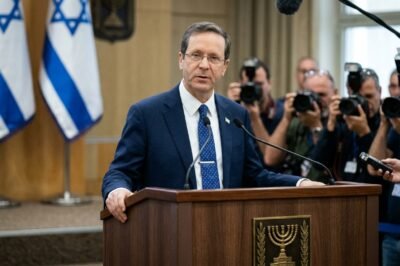
The 2026 Israeli general elections have reached a boiling point, transcending typical political rivalry to touch upon the very core of the nation’s democratic identity. As the final ballots are counted in what is being described as one of the most polarized contests in the country’s history, the atmosphere has been marred by a series of vitriolic exchanges and targeted rhetoric. President Isaac Herzog, traditionally a figure of national unity, has been forced to step into the fray, issuing a stern and uncompromising condemnation of racist remarks directed at the Arab minority. This intervention comes at a critical juncture where the narrow margins of the projected coalition suggest that every sector of the population—and every seat in the Knesset—will determine the future trajectory of the state. The eyes of the world are fixed on Jerusalem, not just to see who will lead the next government, but to witness how the Israeli social fabric survives the strain of this internal discord.
The intensity of the 2026 election cycle cannot be overstated. Following years of fluctuating stability and multiple rounds of voting, the electorate remains deeply divided between traditional nationalist blocs and a diverse array of centrist and progressive parties. However, the current cycle has seen a disturbing uptick in exclusionary language used on the campaign trail, which has now spilled over into the official election day proceedings. President Herzog’s call for restraint is not merely a formality; it is a desperate attempt to prevent the political climate from devolving into civil unrest. The Arab minority, comprising roughly 20% of the population, finds itself at the heart of a storm, with their legitimacy as voters and citizens being questioned by hardline factions. As we break down the results and the subsequent fallout, the role of the presidency as a moral compass has never been more relevant or more tested.
The Deepening Divide: President Herzog’s Moral Intervention
President Isaac Herzog’s statement, delivered from the President’s Residence in Jerusalem, was characterized by its gravity and sense of urgency. Herzog noted that the use of racist tropes and the delegitimization of the Arab sector are not only a threat to the individuals targeted but a ‘stain on the democratic process’ itself. He emphasized that the strength of Israel lies in its diversity and that the democratic right to vote must be protected from intimidation and hate speech. This move is significant because the Presidency in Israel is largely ceremonial; for a President to speak so forcefully during an active election count indicates a perceived existential threat to social cohesion.
Critics of the nationalist rhetoric argue that the targeting of Arab voters is a calculated strategy to depress turnout in key districts. Conversely, the President’s intervention has been met with mixed reactions across the political spectrum. While centrist and left-leaning parties have lauded Herzog for his courage, some figures on the far-right have accused the President of overstepping his constitutional bounds and interfering in the political will of the people. This friction highlights the profound ideological gap that the next Prime Minister will have to navigate, regardless of which bloc eventually secures a majority.
Breakdown of the 2026 Election Results and Demographics
Preliminary data from the Central Elections Committee suggests a razor-thin margin between the Likud-led bloc and the opposition coalition. Voter turnout among the Arab population has shown a surprising resilience despite the hostile rhetoric, with early reports suggesting a participation rate that matches or exceeds the 2022 levels. The influence of the Arab parties—Ra’am and the Hadash-Ta’al alliance—remains a pivotal factor in the ‘Kingmaker’ scenario that has defined Israeli politics for the last decade. As the counting of ‘double envelopes’ (votes from soldiers, diplomats, and prisoners) begins, the final seat distribution remains in flux.
The demographic shifts in the 2026 election are telling. There is an increasing trend of younger voters gravitating toward more ideological extremes, both on the religious right and the secular left. However, the Arab sector’s voting patterns show a pragmatic shift toward parties that prioritize civil rights, infrastructure, and crime prevention within their communities over broader geopolitical issues. This internal focus has made them a more potent, if controversial, partner for potential coalition builders who are desperate to reach the 61-seat threshold in the 120-seat Knesset.
Economic Impacts and Market Volatility
The financial markets have responded to the election uncertainty and the social tension with a palpable sense of anxiety. The Israeli Shekel (ILS) experienced a sharp 1.2% dip against the US Dollar following the reports of civil friction at polling stations and the subsequent presidential address. Investors are particularly concerned about the prospect of another ‘stalemate government’ or a coalition that includes ultra-nationalist elements that might prioritize ideological spending over fiscal responsibility. The Tel Aviv Stock Exchange (TASE) saw a sell-off in the banking and technology sectors, as these industries are most sensitive to international perceptions of Israeli stability.
- Shekel Volatility: The currency is expected to remain under pressure until a clear coalition agreement is signed.
- Tech Investment: Concerns regarding the ‘Brain Drain’ and international tech investment have resurfaced amidst the divisive social atmosphere.
- Credit Ratings: Global agencies like Moody’s and S&P are closely monitoring the rhetoric for signs of institutional erosion.
Financial analysts suggest that if the racist rhetoric translates into policy or if the Arab minority is systematically excluded from the political process, the long-term economic repercussions could be severe. The inclusion of the Arab sector in the workforce and high-tech industry is a cornerstone of Israel’s long-term economic growth strategy. Disrupting this integration through discriminatory political practices would not only be a social failure but a major economic setback.
International Reactions and Geopolitical Standing
The global community has reacted swiftly to the developments in Jerusalem. The United States State Department issued a statement reiterating the importance of ‘inclusive democratic values’ and the protection of minority rights. European leaders have been more direct, with several foreign ministries expressing ‘deep concern’ over the reported racist remarks. These international reactions are not just diplomatic pleasantries; they have real-world implications for Israel’s security cooperation and trade agreements. The Abraham Accords, which have redefined regional dynamics, are also seen as being at risk if internal Israeli politics take a hard turn toward exclusion.
Middle Eastern partners, particularly those who have normalized relations with Israel, are watching the treatment of the Arab minority with extreme care. Any perceived systematic disenfranchisement or state-sanctioned racism provides fodder for regional adversaries and complicates the efforts of moderate Arab regimes to maintain their ties with the Jewish state. President Herzog’s condemnation serves as a signal to these international partners that the Israeli establishment is still committed to democratic norms, even as the political landscape shifts beneath its feet.
The Role of Social Media and Disinformation
A significant factor in the escalation of tensions during the 2026 elections has been the role of digital platforms. Disinformation campaigns, many of which targeted Arab-majority areas with ‘fake news’ regarding polling station closures or violent threats, have been documented by independent watchdogs. The use of AI-generated content to spread inflammatory remarks has also reached a new height, making it difficult for the average voter to discern truth from propaganda. President Herzog specifically touched upon the ‘digital poison’ that has infected the national discourse, calling for a return to civil debate.
Law enforcement and the cyber directorate have been working overtime to trace the origins of these campaigns, some of which are suspected to be backed by foreign actors seeking to destabilize Israeli society. The irony of the situation is that while Israel remains a global leader in cyber technology, its own democratic processes are being significantly challenged by the misuse of that very technology. The 2026 election will likely serve as a case study for how modern democracies must evolve to protect their electoral integrity against the backdrop of algorithmic radicalization.
Conclusion: The Path to National Reconciliation
As the final numbers are tallied and the horse-trading for a coalition begins, the shadow cast by the 2026 election rhetoric will not easily dissipate. President Herzog’s condemnation was a necessary first step, but it is far from a cure for the deep-seated divisions that have been laid bare. The future of the Israeli government hinges on whether the political class can move past the exclusionary tactics used during the campaign and embrace a model of governance that includes all its citizens. If the racist remarks targeting the Arab minority are allowed to become a normalized part of the political lexicon, the damage to Israel’s internal stability and international reputation may be irreparable.
The coming weeks will be a test of leadership for the potential Prime Ministers. Will they distance themselves from the extremist elements that fueled the fire, or will they succumb to the pressure of coalition arithmetic? For the Arab minority, the 2026 election is a reminder of their precarious position and their undeniable power. For the rest of the nation, it is a moment of reflection on what kind of democracy Israel intends to be in the middle of the 21st century. The path to reconciliation is long, but it must begin with the acknowledgment that a house divided against itself cannot stand.






























Leave a Reply