
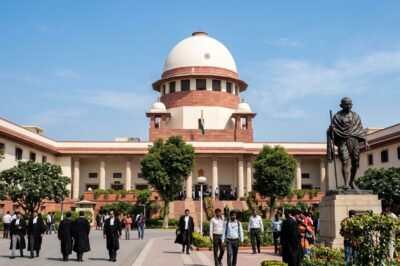
In a landmark clarification that provides significant relief to thousands of public servants and students across India, the Supreme Court has explicitly stated that its recent pronouncements regarding the Other Backward Classes (OBC) creamy layer and the sub-classification of reserved categories will not have retrospective effects. This decision serves as a critical safeguard for the principle of legal certainty, ensuring that appointments, promotions, and educational admissions concluded under previous legal frameworks remain undisturbed. The apex court’s role as the final arbiter of constitutional validity has once again been underscored as it navigates the complex intersection of social justice, administrative stability, and the fundamental rights of citizens. By declaring that these changes are prospective in nature, the court has effectively neutralized potential litigious chaos that could have arisen from reopening decades of reservation-based decisions. This move is seen as a strategic judicial intervention to balance the evolving needs of social equity with the practical necessity of maintaining an orderly civil service and academic structure.
The Core Clarification: Why Prospective Application Matters
The Supreme Court’s clarification centers on the doctrine of prospective overruling, a judicial tool used to prevent the unsettling of settled matters. When the court introduces a significant shift in legal interpretation—such as the nuances of the creamy layer or the criteria for sub-classification—it must decide whether this new rule applies only to future cases or if it reaches back in time to invalidate previous actions. In this instance, the bench led by the Chief Justice of India emphasized that the March verdict was intended to refine the reservation framework for the future, not to act as a tool for retroactive disqualification. This distinction is vital because a retrospective application would have meant that individuals who secured positions or admissions based on the then-prevailing definitions of the creamy layer might have seen their status challenged or revoked.
Furthermore, the court acknowledged the administrative nightmare that would ensue if the verdict were applied retrospectively. Thousands of government departments and educational institutions would have been forced to re-audit their rosters, potentially leading to a massive wave of demotions or removals. By affirming the prospective nature of the ruling, the Supreme Court has protected the “vested rights” of individuals who have already entered the workforce or completed their education. This decision aligns with the broader judicial philosophy that the law should be predictable and that individuals should be able to rely on the legality of state actions at the time they are performed. It also prevents a bottleneck in the judiciary, as it forestalls a deluge of petitions from those whose careers might have been jeopardized by a retrospective change in policy.
Background on OBC Reservation and the Genesis of the Creamy Layer
To understand the weight of this clarification, one must look back at the history of reservation in India, particularly the landmark Indra Sawhney vs. Union of India case of 1992. It was in this case that the Supreme Court upheld the 27 percent reservation for OBCs while simultaneously introducing the concept of the “creamy layer.” The creamy layer refers to the relatively wealthy and educated members of the OBC community who are deemed to have reached a level of social and economic advancement where they no longer require the benefits of reservation. The primary objective was to ensure that the benefits of affirmative action reach the most marginalized and truly backward sections of the community, rather than being cornered by those who have already ascended the socio-economic ladder.
Over the decades, the criteria for the creamy layer—primarily based on annual parental income and occupational status—have been periodically revised by the central government. However, legal challenges have frequently arisen regarding how these criteria are applied and whether states have the power to sub-classify these groups further to ensure equitable distribution. The March 2024 verdict, which this clarification addresses, delved into these intricate details of sub-classification and the necessity of applying the creamy layer principle strictly to maintain the integrity of the reservation system. The recent clarification ensures that while these refined rules will guide future policy, they will not be used as a yardstick to measure the validity of past successes achieved by members of these communities.
The Legal Mechanics of Retrospectivity in Constitutional Law
The question of whether a law or a judicial ruling applies retrospectively is one of the most debated topics in constitutional jurisprudence. Generally, in criminal law, the principle of non-retrospectivity (Article 20 of the Indian Constitution) is absolute—one cannot be punished for an act that was not a crime when it was committed. However, in civil and administrative matters, the courts have more discretion. The Supreme Court often employs the doctrine of “prospective overruling” to change the law without affecting past transactions. This is particularly relevant in reservation cases where the lives and livelihoods of millions are at stake. The court noted that a sudden shift in the eligibility criteria for reservations could violate the right to equality if applied to those who have already settled into their roles.
The clarification also addresses the concerns of State governments that were apprehensive about the immediate implementation of the verdict. Many states have their own specific lists and criteria for OBC reservations, and a sudden federal judicial shift with retrospective effect would have created a constitutional conflict. By providing this clarity, the Supreme Court has given the executive branch at both the Central and State levels the necessary time and space to adjust their policies and notification processes. This ensures that the transition to the new legal standard is smooth and does not lead to a disruption in the delivery of public services or the functioning of the bureaucracy.
Social Justice vs. Administrative Stability: The Court’s Balancing Act
At the heart of the reservation debate is a delicate balance between achieving social justice and maintaining administrative efficiency. The Supreme Court’s March verdict was a step toward a more granular and fair application of reservation, recognizing that the OBC category is not a monolith. Sub-classification and the exclusion of the creamy layer are tools designed to prevent the “percolation” of benefits being blocked at the top. However, the court is also mindful that the pursuit of social justice cannot be so disruptive that it undermines the stability of the state. If every new judicial interpretation led to the mass dismissal of employees, the resulting instability would harm the very society the court seeks to protect.
This clarification, therefore, represents a pragmatic approach. It acknowledges that while the reservation policy needs to evolve to be more inclusive of the “backward among backward,” it must do so without causing systemic shock. The court’s decision ensures that the progress made by individuals from OBC backgrounds in previous decades is respected. It validates the efforts of those who entered the system when the rules were different, while setting a higher standard of scrutiny for the future. This dual approach helps in maintaining public trust in the reservation system, as it demonstrates that the rules of the game will not be changed after the match has been played, even if the rules for the next match are being improved.
Implications for State Governments and Future Policy Sub-classification
The clarification has profound implications for how State governments will now approach the issue of sub-classification. With the assurance that past actions are safe, states can now focus on the rigorous data collection required to implement sub-classification moving forward. The Supreme Court has previously emphasized that any sub-classification or exclusion must be backed by empirical data showing the relative backwardness of different groups. Now, states can proceed with forming commissions and gathering this data without the looming threat of legal challenges to their existing workforce.
Furthermore, this provides a clear roadmap for the legislature. If the government decides to amend the statutes or issue new executive orders regarding the creamy layer, they now have a clear judicial precedent that such changes should be framed prospectively. This clarity reduces the risk of future litigation and allows for a more focused debate on the merits of the policy rather than its procedural implementation. It also empowers the National Commission for Backward Classes (NCBC) to work with states to refine the criteria for the creamy layer, ensuring that it remains relevant to the current economic realities of the country without being hindered by historical baggage.
The Economic and Market Dimensions of the Ruling
From an economic perspective, the stability of the public sector workforce is crucial for investor confidence and effective governance. The public sector in India remains a significant employer and a driver of economic activity. Any move that would have led to widespread administrative turnover or legal uncertainty regarding the status of thousands of employees would have been viewed negatively by market analysts. The Supreme Court’s clarification provides that much-needed stability. It ensures that the human capital already integrated into the state machinery remains productive and secure.
Moreover, the prospectivity of the ruling helps in maintaining the socio-economic status of the emerging middle class within the OBC communities. By protecting the status of those who have already moved out of poverty through reservation, the court prevents a potential economic slide for these families. This is important for maintaining domestic consumption and the overall growth trajectory of the country. Social mobility is a long-term process, and the court’s decision recognizes that once a family has achieved a certain level of advancement through legitimate legal means, it is in the interest of the state to protect that advancement while shifting the focus of affirmative action to those still left behind.
Conclusion: Future Implications and the Road Ahead
The Supreme Court’s clarification on the non-retrospective application of the OBC creamy layer verdict is a masterstroke of judicial diplomacy and legal logic. It upholds the evolution of social justice while honoring the sanctity of past administrative decisions. As India moves forward, the focus will now shift to how the central and state governments will utilize this legal clarity to make the reservation system more equitable. The requirement for empirical data and the emphasis on the most backward sections within the OBC category will likely lead to more sophisticated and targeted social policies.
Ultimately, this ruling reinforces the idea that the Constitution of India is a living document, capable of adapting to the changing needs of society without sacrificing the foundational principles of fairness and certainty. The prospective application of the March 2024 verdict ensures that the gains of the past are preserved, even as the doors of opportunity are calibrated more precisely for the future. For the beneficiaries of reservation, it is a message of security; for the policymakers, it is a call to action; and for the legal system, it is a testament to the power of the doctrine of prospective overruling in maintaining a balanced and just society.





































Leave a Reply