
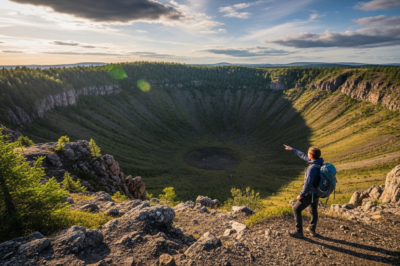
In an era where technology allows us to peer into every corner of the globe from the comfort of our homes, the line between amateur exploration and professional scientific discovery has become increasingly blurred. A recent and staggering example of this phenomenon has emerged from the rugged wilderness of Quebec, Canada. What began as a casual browsing session on Google Maps by an observant hiker has culminated in the official confirmation of a massive, 390-million-year-old meteor impact crater. This discovery, which has sent ripples through the international geological community, highlights not only the sheer scale of cosmic events that have shaped our planet but also the profound impact that citizen science can have in the modern age. The site, characterized by a distinct circular depression that remained hidden in plain sight for eons, is now being hailed as one of the most significant geological finds in recent Canadian history. Researchers from the University of Montreal and other leading institutions have spent months validating the hiker’s observation, utilizing advanced mineralogical testing and aerial surveys to prove that this was no ordinary valley or volcanic formation, but the scarred remains of a violent celestial collision from the Devonian period.
The Serendipitous Discovery: From Digital Maps to Geological Reality
The story of this discovery begins not in a laboratory, but on a smartphone screen. Joël Lapointe, an avid hiker and outdoorsman, was planning a future excursion into the remote Mars-Ouatchiouane region of Quebec when he noticed something unusual on the Google Maps satellite layer. Nestled among the dense forests and winding rivers was a remarkably circular feature, approximately 15 kilometers in diameter, that didn’t seem to align with the typical jagged topography of the Canadian Shield. While most would have dismissed it as a curious geographic anomaly, Lapointe’s intuition prompted him to share his findings with experts. His initial email to geologists at the University of Montreal sparked immediate interest. Unlike the well-known Manicouagan Reservoir, which is often referred to as the ‘Eye of Quebec’ and is easily visible from space, this newly identified pit was obscured by millions of years of erosion and dense vegetation. However, the symmetry was too perfect to be ignored. Upon receiving Lapointe’s data, geologists began the painstaking process of comparing the site’s morphology with known impact structures worldwide. The discovery serves as a testament to the power of democratic technology, where a high-resolution satellite image and a curious mind can lead to a breakthrough that decades of traditional surveying might have missed.
The Devonian Period: Contextualizing a 390-Million-Year-Old Event
To truly understand the magnitude of this discovery, one must travel back nearly 390 million years to the Devonian Period, often referred to by paleontologists as the ‘Age of Fishes.’ During this epoch, the Earth was a vastly different place. The supercontinent of Gondwana was drifting, and the first vascular plants were beginning to colonize the land, creating the planet’s first true forests. It was during this time of biological transition that a massive bolide—likely an asteroid or a large comet fragment—hurtled through the Earth’s atmosphere. When it struck the region we now call Quebec, the energy released would have been equivalent to billions of tons of TNT, instantly vaporizing the impactor and excavating a deep cavity into the Earth’s crust. The environmental consequences would have been catastrophic on a regional scale, triggering seismic waves that traveled thousands of miles and sending a plume of debris into the stratosphere. Because this event occurred hundreds of millions of years before the rise of the dinosaurs, the fossil record of the impact is sparse, but the geological record is etched forever into the bedrock. This crater provides a rare look at the mid-Paleozoic Era, a time when the Earth’s surface was being reshaped by both biological evolution and cosmic intervention.
Scientific Confirmation: Shatter Cones and Mineralogical Fingerprints
Confirming a meteor impact requires more than just a circular shape; it requires physical evidence of ‘shock metamorphism.’ When a meteor strikes, it generates pressures and temperatures far exceeding those found in volcanic or tectonic processes. To verify Lapointe’s find, a team led by Pierre Rochette and other specialists conducted a preliminary field mission to the site. The ‘smoking gun’ of any impact crater is the presence of shatter cones. These are rare, fan-shaped patterns in rocks that only form under the extreme high-pressure shock waves of an impact. During their trek into the Quebec bush, the research team identified several specimens of these cones in the local bedrock. Furthermore, laboratory analysis revealed ‘shocked quartz’ grains. Under a microscope, these quartz crystals display planar deformation features (PDFs)—microscopic lines that serve as a permanent record of the intense pressure pulse. These findings were the definitive proof needed to confirm that the ‘giant pit’ was indeed a 390-million-year-old crater. The mineralogical data also allowed scientists to rule out other possibilities, such as a kimberlite pipe or a collapsed magma chamber, which do not produce the specific shock signatures found at the site.
The Scale of the Impact: Visualizing a Cosmic Collision
The newly confirmed crater measures roughly 15 kilometers (9.3 miles) across, placing it among the significant impact structures on the planet. While it is smaller than the 100-kilometer Manicouagan crater or the 180-kilometer Chicxulub crater that ended the reign of the dinosaurs, its impact was nonetheless devastating. Calculations suggest that the asteroid responsible was likely around 1 kilometer in diameter. Upon impact, it would have created a ‘transient cavity’ several kilometers deep before the surrounding walls collapsed inward to form the wide, shallow bowl structure seen today. The heat generated would have melted the surrounding rock into a layer of impact melt, some of which may still be preserved beneath the surface sediment. For the ecosystems of the Devonian period, the impact would have meant total destruction within a radius of hundreds of kilometers, followed by a ‘nuclear winter’ effect as dust blocked out the sun. By studying the size and depth of this pit, geophysicists can better refine their models of how Earth’s crust responds to high-velocity impacts, which is crucial for assessing the risks posed by near-Earth objects (NEOs) in the modern era.
Why Canada is a Hotbed for Impact Craters
The discovery of this crater in Quebec is not entirely surprising to geologists, as Canada is home to some of the world’s most famous and well-preserved impact sites. This is largely due to the Canadian Shield, a massive area of exposed Precambrian igneous and high-grade metamorphic rocks that forms the ancient geological core of the North American continent. Unlike regions with high tectonic activity or rapid sedimentation, the Canadian Shield is incredibly stable, acting as a ‘geological freezer’ that preserves ancient structures for hundreds of millions of years. However, the Canadian landscape is also heavily forested and covered by glacial till from the last Ice Age, which means many craters remain hidden under trees and lakes. To date, Canada has over 30 confirmed impact craters, including the Sudbury Basin and the Charlevoix crater. This new 390-million-year-old site adds a vital new data point to this collection. Each crater provides a specific snapshot of the Earth’s history, helping scientists understand the frequency of impacts and how they have influenced the evolution of life and the composition of the atmosphere over geological time.
The Future of Citizen Science and Satellite Archaeology
The fact that a hiker found this crater using a free tool like Google Maps highlights a major shift in scientific discovery. We are living in an era of ‘democratized data,’ where high-resolution imagery once reserved for intelligence agencies is now available to anyone with an internet connection. This discovery is expected to inspire a new wave of ‘armchair geologists’ and ‘satellite archaeologists’ to scour the Earth’s surface for anomalies. Already, Google Earth has been used to find unknown pyramids in Egypt, lost Roman villas in Italy, and new species in remote rainforests. For the scientific community, the challenge now lies in managing the influx of data from the public. While not every circular pond is a meteor crater, the success of Joël Lapointe shows that the public’s eye is an invaluable asset. Moving forward, researchers hope to utilize AI and machine learning to scan satellite data for specific patterns associated with impacts, but as this story proves, human curiosity and the ability to spot ‘something that doesn’t look right’ remain irreplaceable.
Conclusion: Reflecting on Our Place in the Cosmos
The confirmation of the 390-million-year-old crater in Quebec is more than just a win for geological mapping; it is a humbling reminder of the Earth’s violent past and its place within a larger, often chaotic solar system. For 390 million years, this site remained a silent witness to the rise and fall of countless species, the shifting of continents, and the freezing and thawing of the planet during ice ages. It took the combination of ancient geological preservation, modern satellite technology, and the keen eye of a single hiker to bring its story to light. As geologists prepare for more in-depth field studies to determine the exact age and composition of the impactor, the world is reminded that there are still many mysteries hidden in plain sight. This discovery underscores the importance of protecting our natural landscapes, as they are the only archives we have of our planet’s long and tumultuous history. It also serves as a clarion call for the continued support of both professional planetary defense and citizen science, ensuring that we remain vigilant about the celestial bodies that continue to cross our path.





































Leave a Reply