
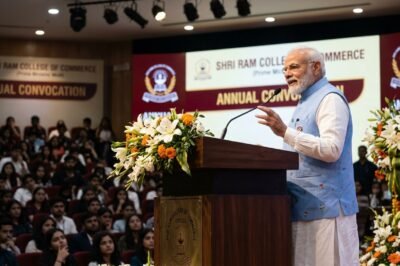
In the high-octane arena of Indian politics, where every syllable is scrutinized and every gesture is a calculated move, Prime Minister Narendra Modi’s recent return to Shri Ram College of Commerce (SRCC) has ignited a firestorm of nostalgic analysis and critical debate. Returning to the very stage that served as a launching pad for his national ambitions over a decade ago, the Prime Minister chose to revisit a metaphor that has since become a staple of his philosophical brand: the glass that is half-full of water and half-full of air. This rhetorical homecoming is not merely a repetition of a catchy line; it is a profound testament to the consistency of a political identity that has dominated the Indian landscape for thirteen years. When he first uttered these words in 2013, Modi was the Chief Minister of Gujarat, an outsider knocking on the gates of Delhi with a promise of a Gujarat Model of development. Today, he stands as a two-term Prime Minister seeking a third, yet the core message remains unchanged. This recurrence invites a deep dive into the mechanics of political branding, the psychology of optimism he projects, and the shifting context of an India that has transformed significantly since that seminal February afternoon in 2013. By recycling this specific line, Modi reinforces a narrative of unwavering positivity, attempting to bridge the gap between his early promises and his current governance record, while simultaneously challenging his critics to view the glass through his lens of Amrit Kaal.
The 2013 Flashback: A Turning Point in National Politics
To understand the significance of this recycled line, one must look back at the India of 2013. The country was grappling with policy paralysis, high inflation reaching nearly 10 percent, and a series of high-profile corruption scandals that had dampened the national spirit. When Narendra Modi took the stage at SRCC on February 6, 2013, he was not just delivering a speech; he was presenting an alternative vision. His famous line—that while most see a glass as half-full or half-empty, he sees it as half-filled with water and the other half with air—became an instant sensation. It was a masterclass in positive framing. At that time, India’s GDP growth had slowed to around 5 percent, and the youth were hungry for a leader who didn’t just point out problems but offered a change in perspective. That speech at SRCC is often cited by political analysts as the moment Modi successfully transitioned from a regional strongman to a credible national challenger. It set the tone for the 2014 general election campaign, which was built on the foundation of hope, aspiration, and the rejection of a defeatist mindset.
The Half-Air Philosophy: Optimism as a Political Tool
The metaphor of the glass half-filled with air is more than just clever wordplay; it is a central pillar of Modi’s political communication. By including air in the equation, he suggests that nothing is ever truly empty or lacking; rather, there is always a potential or a resource that others are simply failing to acknowledge. This philosophy aligns with his government’s emphasis on Atmanirbhar Bharat and the Viksit Bharat 2047 vision. Statistically, the Prime Minister often backs this optimism by highlighting the transformation in India’s digital economy. For instance, in 2013, digital transactions were a fraction of what they are today. By 2023, India accounted for nearly 46 percent of the world’s real-time digital payments. When Modi revisits the SRCC metaphor, he is essentially telling the youth that the air he spoke about in 2013 has been converted into tangible results like the UPI ecosystem, the expansion of the startup landscape (from a few hundred to over 100,000 recognized startups), and the rapid construction of highways at a rate of 37 kilometers per day. He is urging the next generation of students to see the invisible potential in the Indian economy that his administration aims to harness.
From Gujarat CM to Global Leader: A Rhetorical Journey
The repetition of the SRCC line also highlights the evolution of Modi’s persona. In 2013, he was the disruptor. His language was defiant and focused on challenging the status quo of the Lutyens elite. Thirteen years later, his rhetoric has softened into that of a global statesman, yet he retains the core elements that first made him popular. The recycling of the glass metaphor serves as a bridge between the Modi of 2013 and the Modi of today. It suggests a sense of continuity and reliability. For a leader, being able to repeat a message over a decade apart and have it still resonate is a rare feat in politics. This consistency is mirrored in his policy focus as well. The 2013 speech touched upon the importance of skill development and making India a manufacturing hub—themes that have manifested into the Skill India and Make in India initiatives. By returning to SRCC and using the same imagery, he is closing a rhetorical circle, claiming that the vision he laid out as a Chief Minister has been the guiding light for his tenure as Prime Minister.
The Digital Legacy: Why This Line Resonates in the Age of Reels
In today’s digital-first political landscape, the recycling of such iconic lines is a deliberate strategy to capture the attention of a generation that might have been in elementary school when the original speech was delivered. The 2013 SRCC speech was one of the first Indian political events to go truly viral on social media platforms like Facebook and Twitter. Today, the same line is perfectly packaged for Instagram Reels and YouTube Shorts. The Prime Minister’s team understands the power of political memory. By echoing his past self, Modi creates a sense of historical inevitability. Critics often point to the areas where the water in the glass seems low—such as youth unemployment figures or rural distress—but the Prime Minister’s reliance on the half-air metaphor allows him to pivot away from immediate data points toward a broader, more aspirational narrative. This is particularly effective with the Gen Z demographic at SRCC, who value authenticity and vision over traditional bureaucratic jargon.
Economic Realities: Comparing the India of 2013 and 2024
A deep breakdown of this news story requires a comparison of the economic backdrop of the two speeches. In 2013, the Fragile Five was a term used by Morgan Stanley to describe emerging market economies that had become too dependent on unreliable foreign investment to finance their growth; India was on that list. Fast forward to 2024, and India is the fastest-growing major economy in the world, with a GDP growth rate projected at over 7 percent. The foreign exchange reserves, which were around 270 billion USD in early 2013, have more than doubled to over 600 billion USD. However, the air in the glass remains a subject of debate. While infrastructure has seen a massive boost—with the number of airports increasing from 74 in 2014 to over 150 today—the challenge of job creation for the millions of graduates coming out of institutions like SRCC remains a critical issue. The Prime Minister’s use of the recycled line is an attempt to convince this crucial voting bloc that the air of 2013 has indeed become the infrastructure and digital oxygen of 2024, even as some sectors still feel the vacuum.
Conclusion: The Strategic Implications of Rhetorical Persistence
As Prime Minister Modi looks toward future electoral battles, his return to the Shri Ram College of Commerce and the reuse of the half water-half air line signals a strategy of reinforcing his core brand values: optimism, vision, and long-term planning. It is a reminder to the electorate of where they started and how far they have come under his leadership. For the students of SRCC, the speech served as both a history lesson and a future-looking mandate. The implications for the future are clear: the BJP will likely continue to use this narrative of historical continuity to contrast their decade of stability against what they characterize as the chaos of the previous era. By claiming that the glass was never empty, Modi is positioning himself not just as a manager of the state, but as a reframer of the national consciousness. Whether the air in the glass is seen as a sign of potential or a lack of substance will continue to be the central question of Indian political discourse, but for now, the Prime Minister has successfully reclaimed the stage where his national journey began, using the same old words to tell a brand-new story of a rising India.



































Leave a Reply