
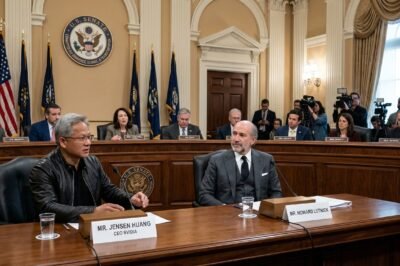
The global technology landscape witnessed a seismic shift this week as reports surfaced that Jensen Huang, the visionary CEO of Nvidia, and Howard Lutnick, the prominent head of Cantor Fitzgerald and a key figure in modern financial infrastructure, have been summoned to testify before the United States Senate. According to reports from Al Jazeera, this summons marks a significant escalation in the federal government’s scrutiny of the artificial intelligence sector and the critical supply chains that power it. As Nvidia has transformed from a graphics card manufacturer into the world’s most valuable semiconductor company, its influence over the global economy has become undeniable. This congressional inquiry seeks to peel back the layers of how AI dominance, export controls, and national security intersect in an era where data is the new oil. For investors, policymakers, and tech enthusiasts, the testimony represents more than just a regulatory hurdle; it is a defining moment that could dictate the future trajectory of Silicon Valley and Washington’s complex relationship.
The Weight of Leadership: Why Huang and Lutnick?
The selection of Jensen Huang and Howard Lutnick for this high-profile testimony is no coincidence. Huang, often seen as the face of the AI revolution, leads a company whose GPUs are the literal bedrock of large language models and generative AI systems. Without Nvidia’s hardware, the current pace of technological advancement would likely grind to a halt. The Senate’s interest in Huang stems from concerns regarding market monopolization, the pricing of high-end chips, and the strategic distribution of hardware to geopolitical rivals. Lawmakers are increasingly worried that one company holds too much leverage over the fundamental infrastructure of the 21st century.
On the other hand, Howard Lutnick brings a different but equally critical dimension to the discussion. As a major player in the financial markets and a vocal advocate for the integration of technology in trade, Lutnick’s perspective is vital for understanding the economic ramifications of AI oversight. His recent involvement in political circles and his deep understanding of how capital flows through the tech sector make him a primary witness for how regulation might stifle or stimulate domestic growth. Together, their testimony is expected to cover a broad spectrum of issues, from the technical intricacies of chip architecture to the macro-economic shifts caused by the shift toward automated intelligence.
Antitrust Concerns and Market Dominance
One of the primary pillars of the Senate’s inquiry is the potential for antitrust violations within the semiconductor industry. Nvidia currently commands a staggering majority of the market share for AI-grade chips, a position that has led to accusations of anti-competitive practices. Smaller startups and even established tech giants have whispered concerns about the difficulty of obtaining Nvidia’s latest ‘Blackwell’ architecture chips, suggesting that the company may be favoring certain partners or using its market position to dictate terms that disadvantage competitors. The Senate Judiciary Committee is expected to press Huang on whether Nvidia’s business model restricts innovation from other players in the field.
Statistically, Nvidia’s growth has been unprecedented, with revenue figures that have doubled and tripled in year-over-year comparisons. This financial meteorism has drawn the eyes of regulators who fear that a ‘too big to fail’ scenario is emerging in the tech hardware space. The hearing will likely explore if the current ecosystem allows for a fair and level playing field or if the barriers to entry created by Nvidia’s proprietary software stack, CUDA, have created a ‘walled garden’ that prevents software developers from migrating to alternative hardware solutions. The outcome of these questions could lead to new legislative frameworks designed to break up monolithic control over the AI supply chain.
National Security and Export Control Strategies
In addition to market competition, national security remains at the forefront of the American legislative agenda. The U.S. government has already implemented several rounds of export controls aimed at preventing high-end AI chips from reaching adversarial nations, most notably China. These controls are designed to ensure that the most advanced computational power remains within the hands of the U.S. and its allies, preventing rivals from using AI for military surveillance or autonomous weaponry. Huang will be expected to provide detailed accounts of how Nvidia is complying with these mandates and whether ‘gray market’ sales are still allowing restricted technology to slip through the cracks.
Howard Lutnick’s role in this part of the discussion is equally pivotal. Given his deep ties to global trade and his insights into how financial instruments track the movement of sensitive technology, he can provide the Senate with a realistic view of how effective these sanctions actually are. Legislators are concerned that despite strict regulations, the globalized nature of the tech industry makes total containment nearly impossible. There will likely be discussions regarding the CHIPS Act and whether additional subsidies or stricter enforcement mechanisms are needed to maintain the United States’ technological edge over its global competitors.
The Economic Ripple Effect: Wall Street and Beyond
The financial markets have already begun to react to the news of the summons. Whenever tech titans are called to Washington, volatility tends to follow. Investors are particularly sensitive to any hints of new taxes, stricter export limits, or forced divestitures. For Nvidia, which has been a primary driver of the S&P 500’s recent gains, even a minor regulatory setback could result in billions of dollars in lost market capitalization. Lutnick, with his background at Cantor Fitzgerald, will be uniquely positioned to explain how regulatory uncertainty impacts capital investment and the broader stability of the Nasdaq.
Furthermore, the testimony will touch upon the ‘AI Bubble’ debate. Some economists argue that the massive valuations of AI companies are based on speculative futures rather than current utility. By questioning Huang and Lutnick, the Senate aims to determine if the economic foundation of the AI boom is sound or if the country is heading toward a tech-driven financial correction. The discussion will include:
- The sustainability of high-margin chip sales in a tightening economy.
- The impact of high interest rates on AI infrastructure spending.
- The role of venture capital in inflating the valuations of AI-adjacent startups.
- The potential for AI to displace labor and the resulting tax implications for the government.
Ethics, AI Safety, and the Public Interest
Beyond the spreadsheets and the legal jargon, the Senate is also focused on the human element of AI. The ethical implications of a world powered by Nvidia’s chips are vast. Topics such as algorithmic bias, the potential for deepfakes to disrupt democratic processes, and the long-term safety of autonomous systems are all on the table. While Huang is a hardware leader, his chips provide the horsepower for these software-driven societal changes. The Senate will likely ask how Nvidia ensures that its products are not being used for unethical purposes, such as mass surveillance or the generation of harmful misinformation.
This part of the hearing will serve as a bridge between technical oversight and social responsibility. Lawmakers are feeling pressure from their constituents to ensure that the AI revolution does not come at the cost of privacy or civil liberties. The testimony of these two leaders will be a litmus test for whether the tech industry is capable of self-regulation or if a more heavy-handed approach from the federal government is necessary to protect the public interest. The concept of ‘AI Sovereignty’—the idea that nations must control their own AI destiny—will likely be a recurring theme during the hours of questioning.
Conclusion: Navigating the Future of Innovation and Regulation
The summoning of Jensen Huang and Howard Lutnick to the U.S. Senate is a watershed moment for the 21st-century economy. It represents the inevitable collision between the breakneck speed of technological innovation and the deliberate, often cautious pace of government oversight. As the proceedings unfold, the world will be watching to see if the U.S. can strike a delicate balance: fostering an environment where companies like Nvidia can continue to push the boundaries of human achievement, while ensuring that this power is exercised responsibly and within the bounds of the law. The implications of this testimony will reach far beyond the hearing room, influencing international trade agreements, corporate strategies, and the very way we interact with technology in our daily lives. Whether this leads to a new era of collaborative growth or a period of restrictive tension remains to be seen, but one thing is certain: the era of tech leaders operating without deep government engagement has officially come to an end.





































Leave a Reply