
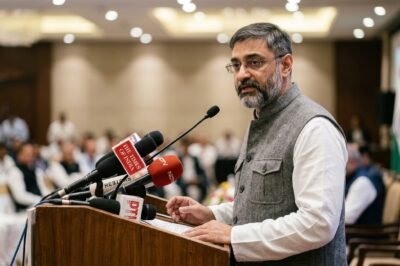
In the ever-evolving landscape of Indian cinema, the intersection of art and ideology has become a volatile battleground. The recent release of the film ‘Dhurandhar’ has reignited a fierce national debate regarding the boundaries of storytelling and the influence of political messaging. As critics and supporters clash over the film’s intent, a prominent voice has emerged from the Prime Minister’s Economic Advisory Council (EAC-PM). Sanjeev Sanyal, an economist known for his deep interest in Indian history and culture, has stepped into the fray to defend the film against allegations of being a mere ‘propaganda’ tool. His reaction is not just a defense of a single movie but a broader critique of how historical narratives are curated and consumed in modern India. This discourse highlights a significant shift in the cultural zeitgeist, where the reclamation of history is often met with accusations of bias, yet hailed by others as an essential step toward national self-awareness. The controversy surrounding ‘Dhurandhar’ serves as a microcosm for the larger ideological struggle currently defining the Indian creative industry.
Sanjeev Sanyal, whose expertise spans from global financial markets to the ancient geography of the Indian subcontinent, brings a unique perspective to this cinematic dispute. His involvement signals that the debate over ‘Dhurandhar’ is not merely about box office numbers or artistic merit, but about the very soul of the Indian narrative. Sanyal has long argued that India’s history has been viewed through a colonial or Eurocentric lens for too long, and cinema is one of the most potent tools for correcting this imbalance. When he reacts to the label of ‘propaganda,’ he is addressing a deep-seated intellectual gatekeeping that has historically decided which stories are ‘objective’ and which are ‘motivated.’ For Sanyal, the film represents a legitimate exploration of a ‘Dhurandhar’—a stalwart or a formidable figure—whose story deserves to be told without the baggage of dismissive labels.
## The Evolution of Historical Narrative in Indian Cinema
For decades, Indian cinema was dominated by a specific brand of secular-liberal storytelling that often sidelined traditionalist or nationalist perspectives. However, the last decade has seen a dramatic shift. Films like ‘The Kashmir Files,’ ‘RRR,’ and now ‘Dhurandhar’ have challenged the status quo by bringing overlooked historical figures and events to the forefront. This evolution is not accidental; it reflects a growing appetite among the Indian audience for stories that resonate with their cultural and civilizational identity. Sanjeev Sanyal points out that for a narrative to be successful, it must connect with the lived reality or the collective memory of the people. The rise of this genre signifies a ‘democratization’ of history where filmmakers are no longer afraid to tackle themes that were once considered taboo or ‘too political’ for the silver screen.
## Sanjeev Sanyal’s Critique of the ‘Propaganda’ Label
When Sanyal addressed the ‘propaganda’ claims against ‘Dhurandhar,’ he highlighted a significant double standard in the industry. He argued that every piece of art, from literature to cinema, carries an inherent viewpoint. The term ‘propaganda’ is often used selectively to delegitimize narratives that do not align with a particular ideological framework. Sanyal suggests that if a film depicting the struggles of a nationalist figure is called propaganda, then many ‘classic’ films of the past that promoted specific socialistic or state-driven agendas should be viewed through the same lens. By calling out this selective labeling, Sanyal is advocating for a more pluralistic approach to cinema, where multiple interpretations of history and society can coexist without being shut down by pejorative terminology.
## The Economic Viability of Nationalist Storytelling
Beyond the cultural implications, there is a clear economic dimension to the success of films like ‘Dhurandhar.’ As an economist, Sanyal understands that the market is a powerful indicator of social trends. The financial success of films that celebrate Indian heritage and strength demonstrates a massive market demand that was previously untapped. In the past, ‘nationalist’ films were often niche or low-budget, but today they are high-production-value spectacles that compete with global blockbusters. This shift has created a new economic ecosystem within Bollywood and regional film industries, attracting investors and creators who see ‘cultural pride’ as a sustainable and profitable theme. The data shows that the Indian middle class is increasingly willing to spend their disposable income on content that makes them feel connected to their roots.
## Media Discourse and Intellectual Gatekeeping
The reaction to Sanyal’s comments also sheds light on the role of the media in shaping public opinion. The Times of India and other major outlets have framed the ‘Dhurandhar’ debate as a clash between ‘independent art’ and ‘state-aligned messaging.’ Sanyal’s rebuttal challenges this binary. He posits that the intellectual elite, who have long held the keys to cultural criticism, are uncomfortable with the loss of their monopoly over the ‘truth.’ When a member of the Prime Minister’s advisory council defends a film, it is seen by some as government overreach, but Sanyal frames it as a personal and intellectual engagement with a medium that influences millions. This tension between traditional media critics and new-age cultural influencers is a defining feature of the current discourse.
## The Impact on India’s Cultural Soft Power
Finally, the debate over ‘Dhurandhar’ and Sanyal’s defense of it must be viewed through the lens of soft power. India is currently seeking to project its civilizational identity on the global stage. Cinema is a primary vehicle for this projection. Sanyal believes that for India to be a global leader, it must first be confident in its own story. Films that depict Indian ‘Dhurandhars’—heroes of intellect, spirit, and valor—contribute to a global image of a confident, resurgent nation. While critics fear that this leads to jingoism, proponents like Sanyal argue that it is a necessary corrective to a century of self-deprecation. The global success of Indian films that embrace their ‘Indianness’ suggests that the world is ready for a diverse range of stories from the subcontinent, regardless of the ‘propaganda’ tags applied at home.
In conclusion, Sanjeev Sanyal’s reaction to the ‘Dhurandhar’ controversy is a significant moment in the ongoing cultural transition of India. It marks a point where high-level policy advisors are actively engaging in the defense of cultural products that align with a broader national vision. Whether one views ‘Dhurandhar’ as a masterpiece of historical reclamation or a calculated piece of political messaging, its impact is undeniable. As the lines between cinema, history, and politics continue to blur, the dialogue initiated by figures like Sanyal will be crucial in determining how India tells its story to itself and to the world. The future of Indian cinema lies in its ability to navigate these complex waters, balancing artistic integrity with the deep-seated need for a narrative that feels authentically and unapologetically Indian.





































Leave a Reply