
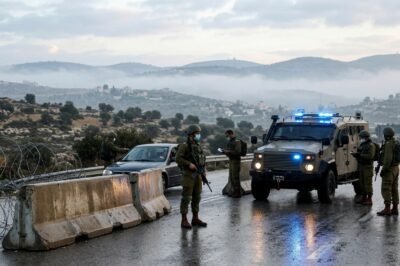
In a move that underscores the volatile intersection of security and governance in the Middle East, Prime Minister Benjamin Netanyahu has officially ordered a comprehensive closure of the West Bank. This decisive action comes in the immediate aftermath of a violent attack on Israeli citizens, a development that has sent shockwaves through the nation just days before voters head to the polls. The timing of the security directive is particularly sensitive, as Netanyahu faces one of the most challenging electoral landscapes of his career. By prioritizing national safety through restrictive measures, the Prime Minister is signaling a hardline stance that resonates with his core constituency while simultaneously drawing criticism from those who view the closure as a heavy-handed political maneuver. As the region braces for the fallout, the closure represents more than just a tactical security shift; it is a manifestation of the enduring tension that defines the Israeli-Palestinian conflict, magnified by the high stakes of democratic selection. This analysis explores the multifaceted implications of the closure, from its tactical necessity to its profound impact on the regional economy and the political future of the Israeli leadership. The atmosphere in Jerusalem and the surrounding territories has reached a fever pitch, with security forces on high alert and the international community watching closely as the situation unfolds.
The Immediate Context of the Security Directive
The decision to seal off the West Bank followed a targeted attack on Israeli civilians that left several injured and the nation in a state of mourning. According to military sources, the attackers utilized the relative ease of movement within the territories to execute a strike that breached the security perimeter of a residential hub. In the wake of this violence, the Prime Minister convened an emergency security cabinet meeting, where the consensus pointed toward an immediate and total lockdown. This closure involves the restriction of movement for thousands of Palestinian workers who commute daily into Israel, the suspension of transit through major checkpoints, and an increased military presence along the Green Line. Security analysts argue that such measures are essential to prevent follow-up attacks, which often occur in the wake of successful militant operations as copycat actors seek to exploit gaps in the defense infrastructure.
Furthermore, the IDF has deployed additional battalions to the area, focusing on high-friction zones where clashes between settlers and local residents have historically intensified. The closure is not just a physical barrier but a psychological one, aimed at reassuring the Israeli public that the government is capable of maintaining order under duress. However, the operational complexity of a full closure cannot be overstated. It requires seamless coordination between the Shin Bet, the border police, and the regular army. For Netanyahu, the speed of this response is a critical component of his leadership narrative, framing him as the “Mr. Security” figure that has defined his political brand for decades. The logistical scale of the operation involves thousands of personnel and the activation of reserve units to ensure that every possible vulnerability is monitored.
Political Strategy and the Election Calculus
As the Israeli electorate prepares to cast their ballots, the security situation has traditionally played a decisive role in the outcome. Netanyahu’s Likud party has long positioned itself as the only credible defender of Israeli sovereignty, and this latest closure is seen by many as a calculated move to reinforce that image. In the context of a tightly contested election, any perception of weakness can be politically fatal. By taking a hardline stance, Netanyahu is effectively neutralizing his rivals on the right who might otherwise accuse him of being soft on terror. The political stakes are exceptionally high, as the Prime Minister seeks to secure a majority that would allow him to form a stable coalition, something that has eluded the Israeli political system in recent years.
Critics, however, suggest that the timing of the closure is too convenient to be purely based on security needs. Opposition leaders have pointed out that while the attack was tragic, a total closure disproportionately affects the civilian population and may actually fuel further resentment, creating a cyclical pattern of violence. They argue that Netanyahu is using the tools of state security to manipulate voter sentiment, shifting the national conversation away from economic issues and toward existential threats. Despite these criticisms, polling suggests that security remains the top priority for a significant portion of the Israeli public. For these voters, the closure is a necessary evil—a temporary suspension of normalcy to ensure that the democratic process can proceed without the threat of imminent violence at polling stations.
Socio-Economic Impacts on Palestinian and Israeli Markets
The economic ramifications of a West Bank closure are immediate and severe. Tens of thousands of Palestinian laborers rely on daily permits to work in Israel, particularly in the construction and agricultural sectors. When these borders are sealed, the loss of income for these families is catastrophic, leading to a rapid decline in local purchasing power within the West Bank. This economic vacuum often serves as a breeding ground for further unrest, as the frustration of financial instability boils over. For the Israeli economy, the sudden absence of a significant portion of its manual labor force can lead to delays in major infrastructure projects and increased costs for basic goods, creating a ripple effect that touches everything from housing prices to food supply chains.
Market analysts have noted that prolonged closures often lead to a cooling of investor confidence in the region. The volatility associated with sudden border changes makes long-term planning difficult for businesses that operate across the Green Line. Additionally, the closure affects the flow of goods, impacting trade agreements and the transit of exports that originate in the territories but are processed through Israeli ports. While the security cabinet views the closure as a temporary necessity, the cumulative effect of frequent lockdowns is a gradual erosion of the economic bridges that some had hoped would eventually lead to a more stable peace. The financial cost of the closure, both in terms of lost productivity and the high price of military mobilization, adds another layer of complexity to Netanyahu’s governance challenges.
Security Logistics and the Role of the IDF
The implementation of a full West Bank closure is a massive logistical undertaking for the Israel Defense Forces (IDF). It involves the establishment of hundreds of temporary roadblocks and the intense monitoring of the separation barrier, which spans hundreds of kilometers. The IDF’s Central Command is tasked with managing this operation, ensuring that security is maintained without triggering a humanitarian crisis. This delicate balance requires sophisticated intelligence gathering and the use of advanced surveillance technology, including drones and thermal imaging, to monitor movement in real-time. The role of the IDF during these periods is twofold: to act as a deterrent against further militant activity and to manage the friction points between different populations in the region.
In addition to the physical closure, there is an increased focus on cyber-security and intelligence operations. The Shin Bet works around the clock to intercept communications and disrupt cells that may be planning further strikes. The closure provides a controlled environment in which these operations can be conducted with a lower risk of civilian interference. However, the military also faces the challenge of maintaining morale among its troops, who are often caught in the middle of a highly charged political atmosphere. The orders coming from the Prime Minister’s office must be translated into clear, actionable directives on the ground, a process that is frequently complicated by the fluid nature of the security threat. As the election nears, the IDF’s presence becomes a permanent fixture of the daily landscape, serving as a constant reminder of the high price of security.
International Response and Humanitarian Concerns
The international community has reacted to the closure with a mix of concern and calls for restraint. The United Nations and various human rights organizations have highlighted the impact of the lockdown on the Palestinian civilian population, particularly regarding access to medical care and basic services. While many nations acknowledge Israel’s right to defend its citizens, there is a growing consensus that collective punishment—limiting the movement of an entire population in response to the actions of a few—is a violation of international law. Diplomatic pressure is mounting on the Netanyahu administration to ensure that the closure is as brief as possible and that humanitarian corridors remain open for essential supplies and medical emergencies.
The United States, Israel’s closest ally, has maintained a cautious stance, emphasizing the need for security while also urging both sides to de-escalate. The Biden administration is particularly concerned about the potential for the current situation to boil over into a larger conflict that could destabilize the broader Middle East. These international dynamics play a role in Netanyahu’s decision-making process, as he must balance domestic security needs with the maintenance of vital diplomatic relationships. The optics of a sealed-off West Bank can be damaging on the global stage, especially when contrasted with the democratic exercise of an election taking place just a few kilometers away. Consequently, the government must engage in a rigorous public relations effort to justify the measures to its international partners, framing the closure as a purely defensive and temporary necessity.
Conclusion: Future Implications for Regional Stability
The decision to close the West Bank ahead of the elections is a profound moment in the current political cycle, reflecting the deep-seated security challenges that continue to plague the region. While the immediate goal is the protection of Israeli citizens and the preservation of order during the voting process, the long-term implications are far more complex. The closure may provide a temporary reprieve from violence, but it does little to address the underlying issues that drive the conflict. As Netanyahu seeks another term in office, his reliance on these security measures will likely remain a cornerstone of his policy, further entrenching the status quo. The success or failure of this strategy will be judged by the voters at the ballot box and, ultimately, by the level of stability that follows the formation of the next government.
Looking forward, the regional stability will depend on whether the incoming administration can transition from emergency security measures to a more sustainable framework for engagement. If the closure is perceived as a purely political tool, it may exacerbate tensions and lead to a more volatile security environment in the months to come. Conversely, if it is managed with a clear exit strategy and a commitment to restoring economic ties, it may serve its purpose as a temporary stabilizing force. For now, the eyes of the world remain fixed on the West Bank, where the intersection of military might, political ambition, and human struggle continues to define the future of two peoples. The coming days will be a true test of Netanyahu’s leadership and the resilience of the regional security architecture under the pressure of an impending election.
































Leave a Reply