
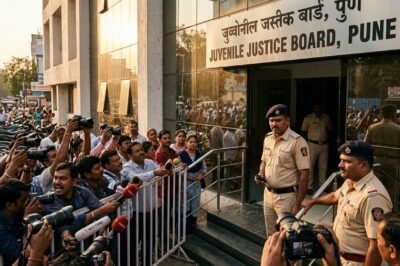
The harrowing incident in Pune’s Kalyani Nagar has not only claimed two young lives but has also ignited a national debate regarding the accountability of the elite and the robustness of the Indian juvenile justice system. On a fateful Sunday morning, a high-speed Porsche, allegedly driven by a 17-year-old under the influence of alcohol, mowed down two IT professionals, Aneesh Awadhiya and Ashwini Koshta. The immediate aftermath saw a wave of public fury, especially after the Juvenile Justice Board (JJB) initially granted the minor bail under remarkably lenient conditions, including writing a 300-word essay on road safety. This perceived trivialization of a double fatality led to a massive outcry, prompting the Pune Police to file a review petition. In a significant escalation of the legal proceedings, the JJB has now revoked the previous bail order and remanded the minor to an observation home until June 5. This decision marks a pivotal moment in a case that has become a litmus test for the principle of equality before the law in contemporary India.
The Legal Reversal and the Role of the Juvenile Justice Board
The decision to remand the minor to an observation home did not come in a vacuum. It followed a rigorous pursuit by the Pune Police, who argued that the gravity of the offense necessitated a more stringent approach than what was initially provided. The prosecution emphasized that the minor’s actions led to the loss of two lives and that the initial bail conditions failed to reflect the severity of the crime. Under Section 104 of the Juvenile Justice (Care and Protection of Children) Act, the board has the power to review its own orders. This specific provision was invoked to argue that the minor’s presence in a controlled environment was essential for both his rehabilitation and the integrity of the ongoing investigation.
During the proceedings, the defense maintained that the law favors the rehabilitation of juveniles over punitive measures. However, the prosecution countered by highlighting the alleged consumption of alcohol at two different establishments prior to the crash, which points toward a conscious disregard for public safety. The board’s decision to move the minor to an observation home until June 5 is seen as an interim measure while the legal system grapples with the question of whether the 17-year-old should be tried as an adult. This particular facet of the law, introduced after the 2012 Delhi gang-rape case, allows for minors aged 16-18 to be tried as adults in cases of heinous crimes, provided a preliminary assessment supports such a move.
Investigative Breakthroughs and the Web of Deceit
The investigation into the Porsche crash has expanded far beyond the act of driving itself. Pune Police have uncovered a complex web of alleged attempts to cover up the crime and shield the minor from the full force of the law. Central to this is the arrest of the minor’s father, a prominent real estate developer, and his grandfather. Investigations suggest that there were systematic attempts to influence witnesses and perhaps even tamper with evidence. Reports have emerged indicating that the family’s driver was allegedly coerced into taking the blame for the accident, a claim that has sent shockwaves through the local community and added a layer of criminal conspiracy to the case.
Furthermore, the role of the establishments that served alcohol to the minor has come under intense scrutiny. The Pune excise department has been active in sealing bars and restaurants that violated the legal drinking age limit and operational hours. This crackdown highlights a systemic failure in urban governance where high-profile venues often operate with impunity. The police have also been investigating the blood sample collection process, amid allegations that the initial samples might have been compromised to show zero alcohol content. These developments suggest a high-stakes battle between a well-connected family and a police force under immense pressure from the state government and the public to deliver justice.
Socio-Economic Reflections: Luxury, Law, and the Elite
The Pune Porsche crash has touched a raw nerve in Indian society, highlighting the stark divide between the ‘privileged elite’ and the ‘common citizen.’ The sight of a multi-crore luxury car being used as a weapon of destruction has become a potent symbol of unaccountable wealth. For many, the initial lenient bail was a confirmation of their worst fears: that the law in India is different for the rich. This case has transcended local news to become a national discourse on ‘affluenza’—a term used to describe a psychological condition in wealthy young people where a sense of entitlement leads to a lack of empathy and a disregard for social norms.
Public protests and social media campaigns have been relentless, demanding that the wealth of the accused should not dictate the pace or direction of the investigation. This societal pressure has undoubtedly influenced the political landscape, with the Maharashtra Chief Minister and Deputy Chief Minister making public statements ensuring that ‘no one will be spared.’ The case serves as a grim reminder of the need for stricter enforcement of traffic laws and more transparent judicial processes that can withstand the influence of powerful lobbies. It also calls for a deeper look into the culture of high-end parties and the ease with which minors can access restricted substances in metropolitan hubs.
Statistical Context and the Rise of High-Speed Accidents
While the Porsche crash has garnered significant media attention due to the profile of the accused, it is part of a larger, more disturbing trend of high-speed accidents in Indian cities. Statistics from the Ministry of Road Transport and Highways indicate that over-speeding accounts for over 70% of road accidents in India. In urban centers like Pune, the influx of high-performance luxury vehicles has not been met with a corresponding increase in road safety awareness or stricter patrolling. The ‘thrill’ of speed, often fueled by substance abuse, has turned city roads into hazardous zones for pedestrians and two-wheeler riders.
Furthermore, the data on juvenile involvement in road accidents shows a worrying uptick. According to the National Crime Records Bureau (NCRB), thousands of cases are registered annually where minors are found at the helm of vehicles involved in accidents. Experts argue that the lack of stringent parental accountability is a major factor. In the Pune case, the police have taken the rare step of booking the father under the Juvenile Justice Act for ‘neglect,’ setting a precedent that parents can be held criminally liable for the actions of their children if they knowingly allow them access to vehicles and high-risk environments.
The Global Perspective on Juvenile Crimes and Accountability
The debate over whether to try a minor as an adult is not unique to India. Globally, legal systems are struggling to balance the principles of juvenile reform with the need for retributive justice in heinous cases. In the United States, several states have ‘transfer’ laws that allow minors to be tried in adult courts for serious offenses like murder or vehicular manslaughter. Similarly, in the United Kingdom, the ‘grave crimes’ procedure allows for more severe sentencing for juveniles. The Pune case brings India’s 2015 amendment to the JJ Act into sharp focus, requiring a psychological and physical assessment of the minor to determine his mental capacity to understand the consequences of his actions.
Critics of the ‘adult trial’ approach argue that the juvenile brain is not fully developed, particularly in areas related to impulse control and risk assessment. However, proponents argue that when a crime is as devastating as the one in Pune, the age of the perpetrator should not be a ‘get out of jail free’ card. The international community often looks at how democratic nations handle such high-profile cases to judge the strength of their rule of law. Ensuring a fair trial while acknowledging the immense loss of the victims’ families is a delicate balance that the Indian judiciary must now navigate.
Future Implications: Judicial Reforms and Urban Safety
The long-term implications of the Pune Porsche crash will likely be felt in the realms of legislative reform and urban safety protocols. There is a growing demand for making the laws regarding ‘parental liability’ even more stringent to act as a deterrent. Additionally, the role of technology in monitoring high-speed vehicles and the integration of ‘smart’ traffic management systems are being touted as necessary steps to prevent such tragedies. The case may also lead to a re-evaluation of how the Juvenile Justice Board operates, ensuring that its members are sensitized to the public impact of their decisions without compromising the core tenets of juvenile protection.
In conclusion, the remand of the minor to an observation home until June 5 is merely the beginning of a long legal journey. It represents a victory for public persistence and a reminder that the scales of justice must remain balanced. As the investigation continues to peel back the layers of influence and negligence, the ultimate goal remains the same: ensuring that the lives of Aneesh Awadhiya and Ashwini Koshta were not lost in vain. The outcome of this case will define how India treats the intersection of wealth, youth, and the law for years to come, sending a clear message on whether the country is ready to uphold the sanctity of life over the influence of the powerful.






































Leave a Reply