
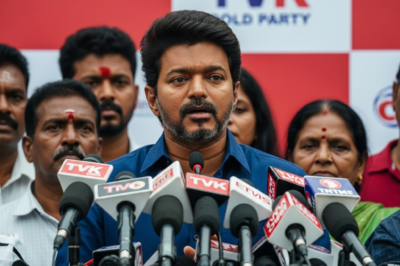
The political landscape of Tamil Nadu has been set ablaze with the latest announcement from Tamilaga Vettri Kazhagam (TVK), the political outfit recently launched by the iconic actor-turned-politician Vijay. In a move that has resonated across the state and beyond, the TVK has officially demanded the complete scrapping of the National Eligibility cum Entrance Test (NEET), citing significant irregularities and a systematic bias against students from rural and marginalized backgrounds. This demand comes at a time when the National Testing Agency (NTA) is already under immense scrutiny due to allegations of paper leaks, grace mark controversies, and administrative failures in the 2024 NEET-UG examinations. For Vijay, who is preparing for a full-scale political debut in the 2026 Assembly elections, the NEET issue serves as a critical entry point into the hearts of the Tamil electorate, who have long viewed the centralized exam as an affront to state sovereignty and social justice. The resolution passed by TVK doesn’t just call for an end to the exam but also proposes a return to the system where medical admissions are based on Class 12 marks, ensuring that the state’s education board is given its due respect. This development is not merely a political statement; it is a calculated maneuver to align with the regional sentiment that has dominated Tamil Nadu politics for nearly a decade.
The Strategic Rise of TVK and Vijay’s Educational Vision
Since the official unveiling of his party, Tamilaga Vettri Kazhagam, Vijay has been meticulously choosing his battles. By prioritizing the NEET controversy, he is tapping into a deeply emotional and systemic grievance within Tamil Nadu. The state has a history of resistance against centralized exams, dating back to the time when it first abolished state-level entrance exams in favor of board-mark-based admissions to protect rural students who could not afford expensive private coaching. Vijay’s stance is a direct challenge to the current centralized educational framework promoted by the Union Government. During the party’s recent executive committee meeting, TVK passed several resolutions, but the one concerning NEET stood out as the most aggressive. The party argues that the centralized exam undermines the ‘Concurrent List’ status of education, effectively stripping states of their right to determine the criteria for professional course admissions. By positioning TVK as a champion of ‘State Rights,’ Vijay is attempting to fill a political vacuum, offering a fresh alternative to the established Dravidian majors while echoing their most popular slogans. The party’s resolution explicitly states that the Union Government should move education back to the State List of the Constitution to prevent such ‘impositions’ in the future.
Analyzing the Core Arguments Against NEET in Tamil Nadu
The opposition to NEET in Tamil Nadu is rooted in the philosophy of Social Justice. Critics, including the TVK leadership, argue that the exam creates an uneven playing field. Students from wealthy urban families can afford specialized coaching centers that drill them for the specific format of the NEET exam, whereas students from government schools or poor rural families are left at a disadvantage. Statistics from previous years have shown a decline in the number of first-generation graduates and rural students entering medical colleges since the inception of NEET. Furthermore, the TVK has highlighted the repetitive nature of the ‘coaching culture’ which they claim kills the creativity and holistic learning intended by the school curriculum. The party’s demand emphasizes that the Class 12 board exams, which are conducted over a year of rigorous study, are a much better reflection of a student’s capability and hard work than a single three-hour multiple-choice question paper. By demanding the total scrapping of the exam, TVK is echoing the sentiments of millions of parents who are concerned about the mental health and financial burden placed on their children by the current medical admission process.
The 2024 NEET Scandals: Fuel to the Fire
The timing of TVK’s demand is particularly potent given the national uproar over the 2024 NEET-UG results. Reports of massive paper leaks in Bihar, the suspicious distribution of grace marks, and an unprecedented number of students scoring perfect totals have led to a loss of public trust in the National Testing Agency. Protests have erupted in several cities, and the Supreme Court of India has had to intervene, expressing concern over the ‘sanctity’ of the examination. For TVK, these scandals serve as empirical evidence that a centralized system is not only unfair but also prone to systemic corruption and mismanagement. Vijay’s party has used these incidents to bolster their argument that the ‘One Nation, One Exam’ policy is a failure. They contend that if a centralized body cannot ensure a leak-proof and transparent examination for millions of students, the authority should be handed back to the respective state governments who are better equipped to manage their own admission processes. This narrative has gained significant traction, making the anti-NEET stance a unifying factor for various political and social groups across the state.
The Legal and Constitutional Battle for State Sovereignty
One of the more sophisticated elements of TVK’s demand is the focus on the Constitutional division of powers. Originally, education was a State subject. However, during the Emergency in 1976, it was moved to the Concurrent List via the 42nd Amendment. This shift allowed the Central Government to legislate on education, leading eventually to the imposition of NEET. TVK’s resolution calls for a constitutional amendment to restore education to the State List. This is a significant political plank because it moves the conversation from a mere ‘exam issue’ to a larger debate on Federalism. By framing it this way, Vijay is appealing to the intellectual and regional pride of Tamil Nadu. The state government has already passed bills to exempt Tamil Nadu from NEET, which have faced hurdles at the gubernatorial and presidential levels. TVK’s entry into this debate adds a new layer of pressure on the Union Government, suggesting that the demand for educational autonomy is not just the agenda of the ruling DMK, but a unanimous desire of the Tamil people and their emerging political leaders.
Impact on the 2026 Tamil Nadu Assembly Elections
Political analysts believe that Vijay’s firm stance on NEET is a strategic move to consolidate the youth and female vote banks before the 2026 elections. Education and student welfare are topics that resonate deeply with families across the socio-economic spectrum. By taking a lead on this issue, TVK is effectively challenging the DMK’s monopoly on the anti-NEET narrative. It also puts the AIADMK in a position where they must either radicalize their stance or risk being seen as secondary to Vijay’s new energy. Furthermore, it creates a clear ideological boundary between TVK and the BJP, the latter being the primary proponent of NEET. This clarity is essential for a new party looking to establish its identity. If Vijay can successfully mobilize the student community and their parents, he could pose a significant threat to the status quo. His popularity as a cinema icon already provides him with a massive platform; combining that with a potent, justice-oriented political issue like the abolition of NEET makes him a formidable contender in the upcoming electoral battle.
Conclusion: The Path Forward for TVK and Education Reform
The demand by Vijay’s TVK for the complete scrapping of NEET is more than just a political headline; it is a call for a fundamental rethink of how India treats its students and its federal structure. As the protests against the NTA continue to simmer across the country, the voices from Tamil Nadu, now bolstered by one of its biggest stars, are becoming impossible to ignore. Whether the Union Government will yield to such regional pressures remains to be seen, but the discourse has certainly shifted. TVK has successfully linked the local grievances of Tamil students with a national crisis of credibility in the examination system. As we move closer to the 2026 elections, the NEET issue will likely remain at the forefront of the political agenda, serving as a litmus test for the influence of regional parties in the face of centralized policy-making. For the millions of medical aspirants in Tamil Nadu, Vijay’s intervention offers a glimmer of hope for a future where their local academic achievements are valued over a controversial and centralized testing mechanism.



































Leave a Reply