
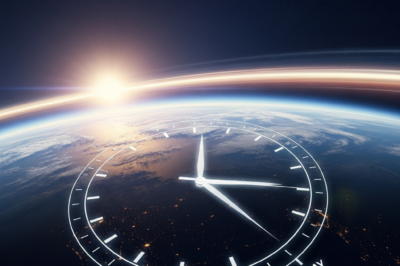
In a world where every second is meticulously cataloged by atomic clocks, the very foundation of our temporal reality is undergoing a subtle yet profound shift. Recent reports, echoing findings from major scientific journals and highlighted by news outlets like the Times of India, suggest that 2026 will play host to the shortest day in recorded history. This phenomenon is not the result of a cosmic anomaly or a sudden shift in our orbit, but rather a culmination of Earth’s accelerating rotation. While a change of a few milliseconds may seem inconsequential to the average person, to the worlds of high-frequency trading, global navigation systems, and telecommunications, it represents a seismic shift that could redefine how we synchronize our lives with the stars. The ‘shortest day’ of 2026 is set to arrive this month, serving as a reminder that our planet is a dynamic, living system that refuses to be confined by the rigid ticks of a human-made clock. This acceleration has left researchers and metrologists scrambling to understand whether this is a temporary fluctuation or a long-term trend driven by deeper geophysical changes.
The Mechanics of Planetary Spin: Why Earth is Speeding Up
To understand why the day is getting shorter, we must first look at the Earth as a massive, rotating object governed by the laws of angular momentum. For centuries, the general consensus was that Earth’s rotation was slowing down, primarily due to the tidal friction caused by the Moon’s gravitational pull. This friction has historically lengthened the day by about 2.3 milliseconds every century. However, recent data from the International Earth Rotation and Reference Systems Service (IERS) indicates a surprising reversal. Over the last few years, the Earth has been spinning faster, leading to shorter days that deviate from the standard 86,400-second definition. Several factors contribute to this acceleration. One of the primary drivers is the ‘Chandler Wobble,’ a small deviation in the Earth’s axis of rotation. Changes in the Earth’s inner core—a solid iron sphere floating in a liquid outer shell—also play a massive role. Scientists believe that shifts in the movement of molten iron or changes in the core’s rotation relative to the mantle can alter the planet’s overall angular velocity. When the interior of the planet moves or redistributes its mass closer to the axis of rotation, the planet spins faster, much like a figure skater pulling their arms in to increase the speed of their spin.
The 2026 Phenomenon: A Millisecond That Matters
The specific ‘shortest day’ predicted for 2026 is expected to break the record previously set in 2022, when June 29th was measured at 1.59 milliseconds shorter than the standard day. While the exact date this month depends on atmospheric pressure systems and ocean currents, the trend is clear: the planet is in an ‘acceleration phase.’ The reason 2026 is so pivotal is that we are approaching a threshold where Coordinated Universal Time (UTC) may need to be adjusted in an unprecedented way. Traditionally, we have added ‘leap seconds’ to our clocks to allow the Earth’s slowing rotation to catch up with our precise atomic time. Since 1972, we have added 27 leap seconds. But with the Earth speeding up, for the first time in history, we may face a ‘negative leap second.’ This would mean removing a second from the clock to stay in sync with the Earth’s spin. For the software developers and engineers who manage the world’s digital infrastructure, the prospect of a negative leap second is a nightmare scenario, as most legacy systems were built to add time, not subtract it.
The Role of Atomic Clocks and Global Synchronization
Humanity no longer relies on the sun’s position to tell time; we rely on the vibrations of cesium atoms. These atomic clocks are accurate to one second in millions of years. However, our civilian timekeeping (UTC) is a hybrid system that combines atomic precision with the Earth’s actual rotation (UT1). The discrepancy between the two is what necessitates the leap second. The International Bureau of Weights and Measures (BIPM) in France is the ultimate arbiter of this time. As 2026 approaches, the debate within the BIPM has intensified. Some scientists argue that we should abandon leap seconds altogether and allow UTC to drift away from the Earth’s rotation, while others believe maintaining the link to the planet’s natural cycle is essential. This ‘tiny time change’ mentioned in recent reports refers to the gap between these two systems. If the Earth continues to spin at this accelerated rate throughout 2026, the cumulative effect will force a decision that has been delayed for decades: do we prioritize the machine or the planet?
Climate Change: The Unexpected Variable in Time
Perhaps the most fascinating and alarming contributor to the Earth’s changing speed is the impact of anthropogenic climate change. As the Earth warms, the massive ice sheets in Greenland and Antarctica are melting at an unprecedented rate. This ice, which was previously locked at the poles (near the Earth’s axis of rotation), is turning into water and flowing into the global oceans, redistributing mass toward the equator. Initially, one might think this redistribution would slow the Earth down—similar to a skater extending their arms. However, the Earth is also undergoing a process called ‘glacial isostatic adjustment.’ As the heavy ice melts, the land underneath it, which was previously compressed, is slowly rising back up. This rising of the crust at the poles actually makes the Earth more ’round’ and less ‘oblate,’ which tends to speed up the rotation. The interplay between the melting ice (slowing it down) and the crustal rebound (speeding it up) is a complex tug-of-war that determines the length of our day. The fact that climate change is now a variable in planetary timekeeping shows just how deeply human activity is intertwined with the very mechanics of the solar system.
Technological and Economic Implications of a Faster Earth
The modern world is built on the premise of synchronized time. The Global Positioning System (GPS), which we use for everything from driving directions to military operations, relies on timing accuracy down to the nanosecond. A discrepancy of even a few milliseconds in Earth’s rotation can lead to positioning errors of several meters if not properly accounted for. Furthermore, the global financial sector depends on Precision Time Protocol (PTP) to timestamp high-frequency trades. If different servers around the world are out of sync by even a fraction of a second, it could lead to ‘time-travel’ trades where the sequence of transactions is recorded incorrectly, potentially crashing markets. Major tech companies like Meta, Google, and Amazon have already advocated for the end of the leap second, citing the ‘smearing’ of time that occurs when systems try to reconcile these jumps. A negative leap second in 2026 could potentially break the internet’s NTP (Network Time Protocol) servers, leading to widespread outages in cloud computing and telecommunications infrastructure. The ‘shortest day’ is not just a scientific curiosity; it is a stress test for the digital age.
The Future of Timekeeping: Beyond 2026
Looking ahead, the international scientific community has already made a landmark decision to pause the introduction of leap seconds by 2035. The goal is to allow the discrepancy between atomic time and Earth’s time to grow larger—perhaps up to a full minute—before making a massive adjustment. However, the 2026 acceleration might force our hand sooner than expected. As we monitor the Earth’s rotation this month and throughout the coming year, we are witnessing a unique moment in human history. We are the first generation to have the tools to measure the planet’s heartbeat with such precision that we can actually feel it racing. Whether the shortest day of 2026 is a fluke of atmospheric pressure or a sign of a fundamental shift in the Earth’s core, it serves as a humbling reminder. Despite our mastery of technology and our ability to slice time into billionths of a second, we remain passengers on a spinning rock whose pace is ultimately governed by forces far beyond our control. The tiny time change may look small on a spreadsheet, but it tells a story of a planet in flux, a climate in crisis, and a civilization desperately trying to keep up with the rhythm of the cosmos.







































Leave a Reply