
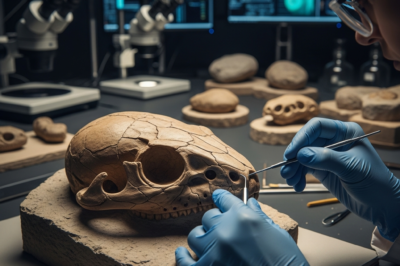
Exactly two centuries ago, the scientific world was forever altered when William Buckland officially named the Megalosaurus, marking the birth of modern paleontology. This 200-year milestone serves as a poignant backdrop for a revolutionary leap in the field: the application of high-resolution digital brain scanning on a 100-million-year-old snake fossil. As we commemorate the bicentennial of the first dinosaur’s identification, we find ourselves at the precipice of a new era where technology allows us to peer inside the skulls of creatures that vanished long before humans existed. This recent study, which focuses on the neuroanatomy of ancient serpents from the Cretaceous period, offers an unprecedented glimpse into the sensory worlds of prehistoric reptiles and challenges our long-held assumptions about how snakes evolved from their legged ancestors. By merging the historical weight of Victorian-era discovery with the cutting-edge precision of 21st-century imaging, researchers are finally solving mysteries that have remained buried in the sediment of time.
The Bicentennial of Paleontology: From Megalosaurus to Micro-CT
In 1824, the description of a ‘Great Lizard’ from the Stonesfield slate in Oxfordshire laid the groundwork for the study of extinct life. For decades, paleontology was a science of comparative anatomy based on what could be seen with the naked eye or measured with a caliper. However, the discovery and subsequent analysis of a 100-million-year-old snake fossil using modern brain scans represents the logical conclusion of those early efforts. While Buckland had only fragmented bones to work with, today’s scientists utilize micro-computed tomography (micro-CT) to visualize internal structures without damaging the delicate fossils. This transition from external observation to internal reconstruction marks a paradigm shift. The snake in question, dating back to a time when the Earth was dominated by titanosaurs and the first flowering plants were just beginning to bloom, provides a unique link between the rudimentary understanding of the 19th century and the data-driven certainty of the modern age.
Unlocking the Cretaceous Mind: The Power of Endocasts
The primary challenge in studying ancient brains is that soft tissue rarely fossilizes. To understand the brain of a 100-million-year-old snake, scientists look at the ‘endocast’—the internal cavity of the skull that the brain once occupied. By using advanced scanning technology, researchers have successfully mapped the shape of the brain, the orientation of the inner ear, and the pathways of cranial nerves. These digital reconstructions act as a biological blueprint, revealing which parts of the snake’s brain were most developed. For instance, the size of the olfactory bulbs compared to the optic lobes can tell us whether the snake relied more on its sense of smell or its vision to hunt. In this specific specimen, the results suggest a complex sensory system that was far more sophisticated than previously thought for a creature living in the shadow of the dinosaurs.
The Evolutionary Missing Link: Transition from Lizards to Serpents
One of the most persistent debates in evolutionary biology is whether snakes evolved from land-dwelling burrowing lizards or from marine reptiles. The 100-million-year-old fossil analyzed in this study provides critical evidence in favor of the burrowing hypothesis. By examining the semicircular canals of the inner ear—the organs responsible for balance—scientists can determine the animal’s lifestyle. The structure found in these ancient snake brain scans closely mirrors that of modern burrowing species, which require specific vestibular adaptations to navigate three-dimensional underground environments. This find suggests that the iconic legless form of the snake was not an adaptation for the sea, but rather a specialized evolution for life in the soil, allowing these ancient predators to infiltrate the burrows of small mammals and other reptiles during the Mid-Cretaceous.
Technological Breakthroughs in Fossil Imaging
The ability to scan a fossil that is millions of years old requires more than just a standard medical CT scanner. Researchers used synchrotron radiation, a type of high-energy X-ray produced by particle accelerators, to penetrate the dense mineralization of the fossil. This process allows for a resolution at the micrometer scale, capturing details that are thinner than a human hair. By processing thousands of individual X-ray slices, a 3D model is generated that can be rotated, dissected, and analyzed digitally. This technology has effectively ‘digitally excavated’ the snake, revealing the delicate bones of the braincase that were previously hidden by rock. This non-destructive method ensures that the original fossil remains intact for future generations while providing a wealth of data that would have been impossible to extract only twenty years ago.
Implications for Modern Herpetology and Conservation
Understanding the evolutionary trajectory of snakes is not just an exercise in historical curiosity; it has profound implications for how we view modern biodiversity. By tracing the neuroanatomical changes over 100 million years, scientists can better understand how modern snakes adapted to survive the mass extinction event that wiped out the dinosaurs. The study highlights the resilience of the serpent lineage and the specialized sensory equipment that allowed them to colonize nearly every environment on Earth. Furthermore, this research aids in the classification of modern species, helping herpetologists identify which traits are ancestral and which are recent adaptations. As we face a modern biodiversity crisis, understanding the deep history of these resilient animals provides essential context for their conservation and the preservation of the ecosystems they inhabit.
A Future Defined by Digital Paleontology
As we look toward the next 200 years of paleontology, it is clear that the field will be defined by the intersection of biology, physics, and computer science. The success of the 100-million-year-old snake brain scan is just the beginning. We are moving toward a ‘digital fossil record’ where researchers from across the globe can access 3D models of rare specimens without the need for physical travel. This democratization of data, combined with the power of artificial intelligence to analyze morphological patterns, will undoubtedly lead to more breakthroughs. We may soon find ourselves looking at the neural pathways of the very first vertebrates or the complex social behaviors of dinosaurs encoded in their brain structures. The journey that began with William Buckland and a few fossilized teeth has evolved into a high-tech quest to understand the very essence of life on Earth.
Conclusion: The Legacy of Discovery
The discovery and analysis of the 100-million-year-old snake fossil serve as a powerful reminder of how far we have come since the first dinosaur was named two centuries ago. From the speculative drawings of the 1820s to the high-resolution brain scans of the 2020s, our pursuit of knowledge remains unchanged, even as our tools become infinitely more complex. By peering into the skull of an ancient serpent, we are not just looking at a relic of the past; we are looking at the foundational steps of an evolutionary success story. This research bridges the gap between history and the future, proving that even after 100 million years, the earth still has secrets waiting to be revealed through the lens of modern science.







































Leave a Reply