
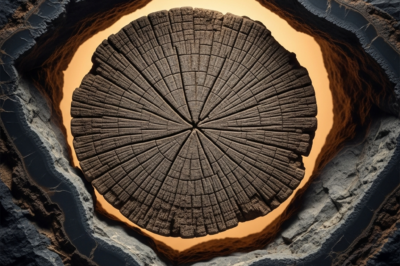
The majestic peaks of the Swiss Alps have always stood as a testament to the raw, transformative power of our planet’s tectonic forces. However, a recent discovery published in scientific journals and highlighted by major news outlets has provided an even more intimate look at this geological violence. Scientists have identified fragments of fossilized wood that did not merely sit on a mountain top but underwent a harrowing journey five kilometers deep into the Earth’s crust. This organic material, once part of a lush European forest during the Jurassic period, was subjected to temperatures reaching a blistering 240 degrees Celsius before being thrust back to the surface. This remarkable find acts as a geological ‘black box,’ recording the extreme conditions of the Alpine orogeny and offering a rare glimpse into the subduction and exhumation processes that shape our continents. This discovery is not just a curiosity of natural history; it is a profound revelation of how resilient organic matter can be and how the Earth’s surface is constantly being recycled in a slow-motion dance of destruction and creation. To understand how a piece of wood can travel so deep and return to tell the tale, one must dive into the mechanics of plate tectonics and the unique chemistry of fossilization.
A Botanical Time Capsule: The Discovery in the Helvetic Nappes
In the heart of the Swiss Alps, within a geological formation known as the Helvetic nappes, researchers have made a discovery that defies the typical expectations of organic preservation. These nappes, which are essentially massive sheets of rock that have been pushed over one another during mountain building, contain fragments of fossilized wood known as ‘jet.’ This wood originated from trees that grew on the European paleocontinent over 180 million years ago. While finding fossils in the mountains is not uncommon, the state of this wood tells a story of an extreme odyssey. Instead of simply being compressed into coal at shallow depths, these particular fragments were dragged down into the dark, sweltering depths of the Earth’s crust. The discovery serves as a vital bridge between biology and geology, proving that even the most delicate organic structures can survive the crushing pressures of planetary reconstruction if the conditions are precisely right. This wood did not just survive; it recorded the temperature and pressure history of the Alps like a biological thermometer, providing scientists with data points that were previously theoretical. The Helvetic nappes represent a complex sequence of sedimentary rocks that were deposited on the northern margin of the Tethys Ocean, and finding such well-preserved organic material within them provides a new benchmark for understanding the vertical movements of the Earth’s crust.
The Science of Geothermal Heating: Surviving 240°C
As the wood descended to a depth of approximately five kilometers, it entered a zone of intense heat and pressure. In the Earth’s crust, temperature typically increases by about 25 to 30 degrees Celsius for every kilometer of depth. At five kilometers, the ambient temperature would naturally reach extreme levels, but the tectonic environment of the Alpine collision likely amplified these conditions. The fossilized wood was heated to roughly 240 degrees Celsius—a temperature that would typically incinerate organic material in the presence of oxygen. However, because this wood was buried deep within oxygen-poor sedimentary layers, it underwent a process called coalification rather than combustion. The high heat caused the organic molecules to reorganize, stripping away hydrogen and oxygen and leaving behind a dense, carbon-rich substance. This ‘jet’ wood became incredibly hard and chemically stable, allowing it to maintain its structural integrity even as the rocks around it began to deform and metamorphose. This resilience is a key focus for geologists, as it demonstrates that organic markers can remain identifiable even after enduring high-grade diagenesis. The chemical signature of the wood, analyzed through advanced spectroscopy, confirmed that it had indeed reached these thermal peaks, providing a definitive record of the burial depth.
Tectonic Elevators: The Incredible Journey of Exhumation
How does something buried five kilometers deep return to the surface to be found by a geologist’s hammer? The answer lies in the concept of tectonic exhumation. Approximately 35 million years ago, the African plate began to move northward, colliding with the Eurasian plate. This collision closed the Tethys Ocean and began the process of mountain building that we call the Alpine orogeny. During this time, the Earth’s crust was folded, buckled, and thrust upward. The wood, which was trapped within the sedimentary layers of the European margin, was caught in this tectonic vice. Huge slabs of rock were detached from their original positions and pushed over one another in ‘nappes.’ This mechanical process acted like a giant elevator, bringing material from deep within the crust back toward the surface. The exhumation process is often as violent as the burial, involving massive friction and secondary heating, yet the jet wood remained preserved within its host rock. This movement is a clear illustration of the Earth’s dynamic nature, where the ‘surface’ is merely a temporary state for material that may have spent millions of years in the deep subsurface.
Rethinking the Formation of the Alps through Organic Matter
The study of these wood fragments has forced geologists to refine their models of how the Alps were formed. Traditionally, scientists relied on mineral indicators—such as the growth of specific crystals—to determine the depth and temperature history of a mountain range. However, minerals can sometimes be misleading or difficult to date precisely. Organic matter like fossilized wood provides a different set of data. The degree of carbonization in the wood acts as a precise indicator of the maximum temperature the rock reached. By mapping these temperatures across different parts of the Helvetic nappes, researchers can create a 3D model of the ancient burial zone. This has revealed that the burial was deeper and the heating more intense than some previous models suggested. It also shows that the exhumation was relatively rapid in geological terms, preventing the wood from being completely obliterated by prolonged exposure to high temperatures. The presence of this wood in the high Alps serves as a reminder that the mountains are composed of materials that were once at the bottom of an ocean or deep within a tectonic subduction zone, fundamentally shifting our perspective on the stability of the ground beneath our feet.
The Role of ‘Jet’ in Geological Reconstruction
Jet is a gemstone-quality form of wood-derived coal, famously used in Victorian mourning jewelry. In the context of the Swiss Alps, however, its value is purely scientific. Because jet is highly resistant to chemical weathering and physical crushing, it preserves the internal cellular structure of the original tree. Under a microscope, scientists can still see the tracheids and growth rings of the Jurassic conifers. This structural preservation is crucial because it allows researchers to confirm that the material is indeed wood and not a generic bit of bitumen or graphite. The ability of wood to transform into jet at such depths is a testament to the unique properties of lignin and cellulose when subjected to anaerobic heat. Furthermore, the study of jet allows for ‘vitrinite reflectance’ testing, a standard method in the petroleum industry to determine the thermal maturity of sedimentary basins. By applying these industrial techniques to the Alpine fossils, geologists can bridge the gap between economic geology and fundamental Earth science, using the same tools to find oil that they use to reconstruct the history of the planet’s greatest mountain ranges.
Implications for Paleoclimate and Planetary Science
Beyond the immediate geological history of Europe, this discovery has broader implications for our understanding of the carbon cycle and even planetary science. The fact that organic carbon can be buried so deep and then returned to the surface means that the Earth has a mechanism for ‘storing’ and ‘recycling’ biological material over hundreds of millions of years. This long-term carbon storage is a critical component of the Earth’s climate regulation system. Furthermore, understanding how organic matter survives extreme conditions on Earth helps astrobiologists define the search for life on other planets. If wood can survive 240 degrees Celsius and five kilometers of burial, it suggests that organic signatures of life might be more durable than we previously thought, potentially surviving in the crusts of other rocky planets or moons. The Alpine wood fragments are a masterclass in durability, showing that the history of life is not just written on the surface of the Earth, but is deeply intertwined with the mechanical and thermal processes of the deep interior. As researchers continue to explore the Swiss peaks, they are likely to find more of these ‘messengers from the deep,’ each one providing a new piece of the puzzle regarding our planet’s turbulent past.
Conclusion: The Endurance of Nature’s Records
The saga of the European wood fragments—from Jurassic forests to the scorching depths of the crust and finally to the snowy peaks of the Alps—is a powerful reminder of the scale and complexity of geological time. It highlights the incredible resilience of organic structures and the efficiency of the Earth’s tectonic recycling system. By studying these 180-million-year-old survivors, scientists are gaining unprecedented insights into the birth of the Alps and the extreme conditions that exist beneath our feet. This discovery underscores the importance of multidisciplinary research, combining botany, chemistry, and physics to unlock the secrets of the Earth’s history. As we look at the jagged silhouettes of the mountains, we now know that they hold within them the scorched remains of ancient forests, a hidden history of heat and pressure that is only just beginning to be understood. The story of the Swiss jet is a testament to the fact that even a simple piece of wood can become one of the most important scientific instruments on the planet, provided it has been through enough to have a story worth telling.





































Leave a Reply