
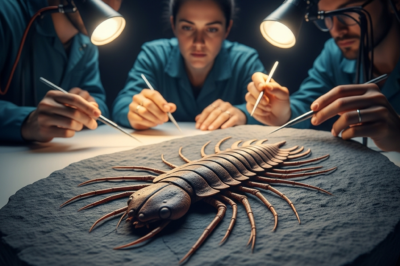
Deep within the ancient rock strata of the Chengjiang fossil site in Yunnan Province, China, lies a discovery that has fundamentally altered our understanding of the evolutionary tree of life. Scientists have unearthed a tiny, impeccably preserved sea creature dating back approximately 518 million years to the Cambrian period, a time often referred to as the ‘Cambrian Explosion’ due to the rapid diversification of complex organisms. This creature, a member of the megacheiran class, represents a pivotal missing link in the history of arthropods, specifically the subphylum Chelicerata, which includes modern-day spiders, scorpions, and horseshoe crabs. The core of this discovery lies in the creature’s front-most appendages—primitive, claw-like structures that researchers believe are the direct evolutionary ancestors of the venomous fangs and grasping chelicerae seen in arachnids today. This finding not only provides a visual timeline of anatomical transformation but also resolves long-standing debates regarding the homology of arthropod limbs, proving that the tools used by modern predators were forged in the primordial soup of the early Cambrian oceans.
The Cambrian Explosion and the Roots of Life
The Cambrian period, which began roughly 541 million years ago, stands as one of the most significant eras in Earth’s history. It was during this time that most major animal phyla first appeared in the fossil record. The 518-million-year-old specimen in question emerged from the Chengjiang Lagerstätte, a UNESCO World Heritage site renowned for its soft-tissue preservation. Unlike most fossil beds that only preserve hard shells or bones, the unique chemical conditions at Chengjiang allowed for the fossilization of delicate internal organs, nervous systems, and appendages. This level of detail is crucial for studying creatures like the ancient megacheirans, which lacked mineralized skeletons. By examining these fossils, paleontologists are essentially looking at a ‘snapshot’ of evolution in real-time, observing how basic body plans were experimented with before settling into the forms we recognize today. The discovery of this specific sea creature highlights the incredible diversity of life that existed half a billion years ago, reminding us that the blueprint for modern biodiversity was laid down in an environment that was almost entirely alien to our current world.
Anatomy of a Tiny Titan: Unmasking the 518-Million-Year-Old Fossil
The creature, though small in stature, possessed a complex anatomy that suggests it was a highly specialized hunter or scavenger. Measuring only a few centimeters in length, its most striking feature was its ‘great appendages’—a pair of large, multi-segmented limbs located at the very front of its head. These appendages were equipped with sharp, spine-like projections, likely used to snatch and disable prey in the murky depths of the Cambrian seas. Detailed analysis of the fossilized remains shows a segmented body, a primitive gut, and evidence of a nervous system that mirrors the organization of modern arthropods. The preservation is so exquisite that scientists can identify the points where muscles attached to the exoskeleton, allowing for biomechanical modeling of how the creature moved and fed. This creature represents a transitional form, sitting squarely between the more primitive lobopodians (worm-like creatures with legs) and the more advanced euarthropods. Its existence proves that the specialization of head appendages for feeding was a winning strategy that appeared very early in the evolutionary timeline, setting the stage for the rise of the most successful animal group on the planet.
From Grabbers to Fangs: The Evolutionary Pivot
The most groundbreaking aspect of this research is the connection it draws between the ancient ‘great appendage’ and the modern spider fang. For decades, evolutionary biologists have debated whether the fangs of spiders (chelicerae) were derived from the same ancestral structures as the antennae of insects or the claws of crustaceans. This 518-million-year-old fossil provides the ‘smoking gun’ evidence that chelicerae evolved from the first pair of appendages on the ancestral arthropod head. Through a process known as ‘evolutionary migration,’ these large, grasping limbs gradually reduced in size and shifted their position toward the mouth. Over millions of years, what were once long, multi-jointed arms used for swimming and grabbing became the compact, powerful, and often venom-injecting fangs we see in modern arachnids. This transition was likely driven by the need for more precise feeding mechanisms as prey became more diverse and better armored. The study uses neuro-anatomical evidence—specifically the way the brain is wired to these appendages—to confirm that the nerves controlling the ancient creature’s claws are homologous to the nerves that control a spider’s fangs today.
Technological Marvels in Paleontology: Visualizing the Invisible
The identification of these evolutionary links would not have been possible without the advent of cutting-edge imaging technology. Traditional paleontological methods involved painstaking manual excavation and observation under a microscope. However, to see the internal structures of a 518-million-year-old fossil, researchers employed micro-CT scanning and synchrotron radiation. These techniques allow scientists to create high-resolution, three-dimensional digital reconstructions of the fossils without damaging the original specimens. By ‘slicing’ through the rock virtually, researchers can see the pathways of nerves and the orientation of muscle fibers that have been replaced by minerals over eons. In the case of this Cambrian creature, these scans revealed a centralized brain structure with specific lobes dedicated to processing sensory input from the great appendages. This ‘neuropaleontology’ is a burgeoning field that allows us to understand not just what ancient animals looked like, but how they behaved and perceived their environment. It provides a level of certainty in phylogenetic mapping that was previously unthinkable, bridging the gap between morphology and genetics.
Challenging Preconceived Notions of Arachnid Ancestry
Before this discovery, the evolutionary history of arachnids was often shrouded in mystery, with several competing theories about their origins. Some scientists believed that spiders and their kin branched off from a separate lineage that never possessed the ‘great appendages’ seen in other Cambrian arthropods. This fossil effectively debunks those theories, firmly placing arachnids within the megacheiran lineage. This has major implications for how we construct the tree of life. It suggests that the common ancestor of all chelicerates was a formidable aquatic predator, far removed from the terrestrial hunters we know today. Furthermore, it highlights the concept of ‘exaptation’—where a structure originally evolved for one function (grabbing prey) is later repurposed for another (injecting venom and fine-tuned manipulation). This discovery also forces a re-evaluation of other fossil groups, as scientists now have a clear morphological template to look for when identifying potential ancestors in other parts of the world, from the Burgess Shale in Canada to the Emu Bay Shale in Australia.
The Global Significance of the Discovery and Future Outlook
The findings published regarding this 518-million-year-old creature have sparked a global conversation among the scientific community. It is a testament to the power of international collaboration, as researchers from China, the UK, and the US worked together to analyze the data and interpret its significance. This discovery does more than just fill a gap in the fossil record; it provides a profound sense of continuity in the history of life on Earth. It reminds us that even the most specialized and fearsome traits of modern animals have humble, ancient origins. Looking forward, the focus will likely shift to the molecular level, as scientists attempt to reconcile these fossil findings with genomic data from living arthropods. There is also the tantalizing possibility of finding even older fossils that could reveal the very first steps of this evolutionary journey. As we continue to refine our understanding of the Cambrian period, we gain not only knowledge of the past but also a deeper appreciation for the resilience and adaptability of life. The tiny sea creature of 518 million years ago may have vanished, but its legacy lives on in every spider web spun and every scorpion that skitters across the desert floor.





































Leave a Reply