
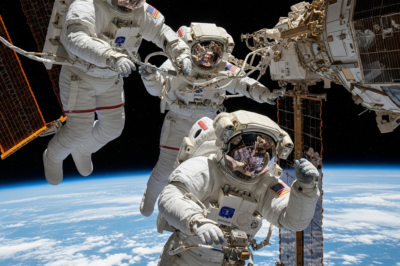
In a breathtaking display of precision engineering and human endurance, NASA astronauts Anil Menon and Jessica Meir recently transitioned from the relative safety of the International Space Station (ISS) into the vacuum of space to perform a series of critical hardware upgrades. This mission, which highlights the ongoing evolution of the orbital laboratory, serves as a poignant reminder of the complexities involved in maintaining a multi-billion-dollar facility that has been continuously inhabited for over two decades. Floating approximately 250 miles above the Earth’s surface, the duo spent several hours meticulously working on the station’s exterior, a feat that requires not only physical stamina but also intense mental focus. As the ISS orbits the planet at a staggering speed of 17,500 miles per hour, every movement made by the astronauts must be calculated and deliberate. This spacewalk, formally known as an Extravehicular Activity (EVA), is part of a broader effort by NASA and its international partners to ensure the station remains operational and scientifically productive as it approaches the final decade of its planned lifespan. The successful completion of this mission underscores the importance of human-robotic synergy and the tireless dedication of the ground teams that manage these high-stakes operations from Mission Control in Houston.
The Logistics of Extravehicular Activity: Preparing for the Void
Preparation for a spacewalk begins months, and often years, before an astronaut even arrives at the ISS. For Anil Menon and Jessica Meir, the journey to the Quest airlock involved hundreds of hours of training in the Neutral Buoyancy Laboratory (NBL) at NASA’s Johnson Space Center. In this massive pool, which contains a full-scale mockup of the ISS, astronauts practice their tasks in an environment that simulates the weightlessness of space. However, even the most rigorous training cannot fully prepare a person for the psychological reality of being separated from the vacuum of space by only a few layers of specialized fabric. On the day of the EVA, the process of ‘pre-breathing’ is essential. Because the Extravehicular Mobility Unit (EMU) suits operate at a lower pressure than the station, astronauts must breathe pure oxygen for several hours to purge nitrogen from their bloodstreams, preventing the onset of decompression sickness, commonly known as ‘the bends.’ Once suited up and checked by their crewmates inside the station, Menon and Meir entered the airlock, where the atmosphere was slowly bled away until a vacuum was achieved. Only then were they cleared to open the outer hatch and step into the cosmic expanse, tethered to the station by safety lines that are literally their only link to survival.
Technical Deep Dive: The Solar Array Wing and Power Infrastructure Upgrades
The primary objective of this specific spacewalk was the continued installation and maintenance of the ISS power system, specifically focusing on the new International Space Station Roll-Out Solar Arrays (iROSA). The original solar arrays on the ISS have performed remarkably well but are reaching the end of their design life and are beginning to show signs of degradation. To bolster the station’s power generation capabilities for future scientific experiments and the increasing demands of commercial modules, NASA has been systematically adding these smaller, more efficient iROSA units. During their time outside, Menon and Meir were tasked with preparing the mounting brackets and routing the high-voltage cables necessary to integrate these new arrays into the station’s existing power grid. This work is incredibly delicate; handling connectors and bolts while wearing pressurized gloves is akin to trying to repair a watch while wearing oven mitts. Furthermore, the astronauts had to navigate the ‘Integrated Truss Structure,’ the backbone of the ISS, which provides the necessary framework for the solar wings. Their movements were coordinated with the robotic arm, Canadarm2, which assisted in positioning heavy equipment and providing a stable platform for the astronauts to work from during the most complex phases of the installation.
The Significance of Anil Menon: From Emergency Physician to Orbital Pioneer
Anil Menon’s participation in this mission carries significant weight, both for NASA and for the global scientific community. As a first-generation Indian-American and a former emergency medicine physician, Menon brings a unique perspective to the astronaut corps. Before being selected as an astronaut candidate in 2021, he served as SpaceX’s first flight surgeon, where he played a pivotal role in the medical preparations for the first human spaceflights under the Commercial Crew Program. His transition from monitoring the health of astronauts from the ground to being an active participant in an EVA is a testament to his versatile expertise. In the context of this spacewalk, Menon’s medical background provides an added layer of safety awareness, as he is intimately familiar with the physiological stresses that the human body undergoes during long-duration exposure to microgravity and the physical exertion of a spacewalk. For the Indian diaspora and aspiring scientists worldwide, Menon’s journey represents the pinnacle of achievement in the STEM fields, illustrating how diverse backgrounds in medicine and engineering can converge in the pursuit of space exploration.
Jessica Meir’s Legacy: Expertise in Extreme Environments
Jessica Meir is no stranger to the rigors of spaceflight. Having already cemented her place in history as a participant in the first three all-female spacewalks alongside Christina Koch, Meir’s presence on this mission provided a stabilizing influence of veteran experience. With a PhD in marine biology, her pre-NASA career focused on the physiology of animals in extreme environments, such as emperor penguins in the Antarctic and bar-headed geese. This deep understanding of how organisms adapt to low-oxygen and high-pressure situations translates directly to the challenges of living and working on the ISS. During the spacewalk, Meir’s role was often that of the ‘lead’ spacewalker, guiding the workflow and ensuring that all safety protocols were strictly adhered to. Her ability to remain calm under pressure and her meticulous attention to detail were evident as she and Menon navigated the complex external structure of the station. Meir’s continued contributions to the ISS program are vital as NASA prepares for the Artemis missions, which will return humans to the lunar surface and eventually send them to Mars.
The Future of the ISS and the Transition to Commercial Low-Earth Orbit
While the work performed by Menon and Meir ensures the ISS remains viable in the short term, it also highlights the transitional phase of the space station. NASA has committed to operating the ISS through at least 2030, but the agency is already looking toward the future. The upgrades being installed now are intended to support not just NASA-led science, but also the growing number of private entities that are using the station for research and development. From pharmaceutical companies testing drug crystallization in microgravity to tech firms developing new materials, the demand for power and infrastructure on the ISS has never been higher. Eventually, the ISS will be decommissioned and safely de-orbited, making way for a new generation of commercial space stations. Companies like Axiom Space, Blue Origin, and Voyager Space are already developing modules that will eventually detach from the ISS or launch as independent platforms. The maintenance being performed today by astronauts like Menon and Meir is essentially building the bridge to this new era of commercialized low-Earth orbit, where the ISS serves as the foundational blueprint for future habitats.
A Scientific and Geopolitical Milestone: The Conclusion of a Successful Mission
As the spacewalk concluded and Menon and Meir safely re-entered the Quest airlock, the success of the mission was broadcast to a global audience. The implications of such an achievement extend far beyond the technical specs of a solar array. It is a reminder that despite the geopolitical tensions on Earth, the International Space Station remains a sanctuary of international cooperation. The partnership between NASA, Roscosmos, ESA, JAXA, and CSA has survived decades of political shifts, proving that the pursuit of scientific knowledge can transcend national boundaries. The data gathered from the ISS during these missions continues to inform our understanding of human health, climate change, and fundamental physics. As we look toward the horizon of deep space exploration, the lessons learned during this EVA—ranging from the durability of materials to the efficiency of crew coordination—will be the building blocks for the next giant leap. Anil Menon and Jessica Meir have added another chapter to the storied legacy of the ISS, ensuring that the ‘brightest star in the sky’ continues to shine as a beacon of human ingenuity and collaborative spirit for years to come.

































Leave a Reply