
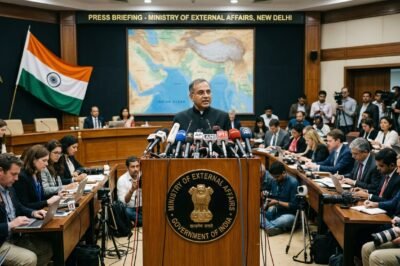
The Ministry of External Affairs (MEA) of India has recently issued a robust and uncompromising rejection of the newly established “so-called” Pakistan-China boundary joint commission. This diplomatic maneuver by Islamabad and Beijing, aimed at formalizing territorial arrangements in regions that India maintains are under illegal occupation, has been characterized by New Delhi as having no legal basis and being completely unacceptable. The Indian government’s stance is rooted in its long-standing and consistent position that the entire Union Territories of Jammu and Kashmir, as well as Ladakh, are integral and inalienable parts of India. By convening a commission to discuss boundaries in these sensitive areas, Pakistan and China are seen as attempting to provide a veneer of legitimacy to an illegal status quo that has persisted for decades. This development marks a significant escalation in the ongoing diplomatic friction between the three nuclear-armed neighbors, highlighting a deep-seated mistrust that continues to define the geopolitical landscape of South Asia. The MEA’s statement is a clear signal to the international community that India will not tolerate any third-party intervention or bilateral agreements that infringe upon its sovereign territorial rights, especially those involving territories ceded illegally by Pakistan to China in the past.
The Historical Burden of the 1963 Sino-Pakistan Frontier Agreement
To understand the current friction, one must look back to the 1963 Sino-Pakistan Frontier Agreement, a document that India has never recognized. Under this controversial pact, Pakistan ceded over 5,000 square kilometers of the Shaksgam Valley in the Gilgit-Baltistan region to China. India has consistently maintained that Pakistan had no legal authority to cede this land, as it was part of the princely state of Jammu and Kashmir which acceded to India in 1947. The Shaksgam Valley, a high-altitude wilderness, has since become a strategic point of interest for China, particularly in its efforts to link the Xinjiang Uyghur Autonomous Region with the Karakoram Highway. The recent move to establish a joint commission is viewed by New Delhi as a continuation of this illegal framework, designed to further entrench Chinese presence in Indian-claimed territory.
Furthermore, the 1963 agreement was always viewed by India as a temporary arrangement by the signatories, yet it has been used by Beijing and Islamabad to create permanent infrastructure and strategic depth against India. The Indian government’s latest rejection emphasizes that no amount of bureaucratic layering, such as a “joint commission,” can mask the fundamental illegality of the original transfer. By repeatedly bringing up the 1963 agreement in modern diplomatic contexts, Pakistan and China are attempting to normalize a territorial dispute that India considers non-negotiable. This historical context provides the bedrock for India’s current assertive diplomacy, as it seeks to prevent the further erosion of its territorial integrity through bilateral deals between its two primary adversaries.
Legal Inconsistencies and the 1947 Instrument of Accession
India’s legal argument rests firmly on the Instrument of Accession signed by Maharaja Hari Singh in October 1947. This document legally transferred the entire territory of the princely state of Jammu and Kashmir to the Dominion of India. From a constitutional and international law perspective, India argues that any subsequent occupation by Pakistan or administrative control by China is a violation of this legal reality. The MEA’s recent statement reinforces that since the territory belongs to India, any commission formed by other nations to discuss its boundaries is inherently void and lacks any standing in international law. This is not just a matter of pride but a fundamental legal principle that India has upheld in the United Nations and other global forums for over seven decades.
The rejection also highlights the internal legal contradictions within the Pakistan-China relationship regarding these territories. While Pakistan often refers to the region as “disputed” to seek international intervention, its bilateral actions with China suggest a de facto permanent settlement. India points out that Pakistan cannot simultaneously claim a region is disputed and then proceed to establish boundary commissions with a third party. This inconsistency is a major focal point for Indian diplomats, who argue that such actions reveal the true expansionist intentions of the China-Pakistan nexus. By standing firm on the 1947 legal framework, India aims to delegitimize any administrative or cartographic changes attempted by the joint commission.
The Geopolitical Nexus: CPEC and Strategic Encirclement
The timing of the Pakistan-China boundary joint commission cannot be separated from the broader context of the China-Pakistan Economic Corridor (CPEC). As a flagship project of China’s Belt and Road Initiative (BRI), CPEC passes directly through Pakistan-occupied Kashmir (PoK), a move India has vociferously protested since the project’s inception. The establishment of a boundary commission is seen as a strategic step to provide legal and security safeguards for Chinese investments in the region. For India, this represents a “strategic encirclement,” where China’s economic and military footprint is expanding along India’s western and northern borders simultaneously, utilizing Pakistani territory as a springboard.
Moreover, the joint commission signifies a deepening of the “all-weather” friendship between Beijing and Islamabad, which India views as a coordinated effort to keep New Delhi preoccupied with border security. The construction of dual-use infrastructure, including roads, tunnels, and communication networks in the Shaksgam and Karakoram areas, has direct military implications. India fears that the formalization of boundaries through this commission will lead to increased Chinese military presence in PoK, thereby complicating India’s defense posture along both the Line of Control (LoC) and the Line of Actual Control (LAC). The rejection of the commission is thus a proactive measure to signal that India is aware of these strategic undercurrents and will contest them vigorously.
India’s Systematic Opposition to Unilateral Status Quo Changes
In recent years, the Indian government under Prime Minister Narendra Modi has adopted a policy of “proactive diplomacy” regarding its borders. This involves not just responding to incursions but also systematically opposing any unilateral attempts to change the status quo on the ground or on paper. The rejection of the joint commission follows a pattern of similar rebuttals to China’s renaming of places in Arunachal Pradesh and Pakistan’s release of political maps that include Indian territories. India’s MEA spokesperson, Randhir Jaiswal, made it clear that such “so-called” official acts do not change the reality of Indian sovereignty. This approach is intended to create a “persistent objector” status in international law, ensuring that India’s claims remain active and legally potent.
This systematic opposition also serves to galvanize domestic public opinion and maintain a unified national stance on territorial integrity. By using strong language like “completely unacceptable” and “no legal basis,” the government communicates its resolve to both the domestic electorate and the international community. This rhetorical firmness is backed by increased infrastructure development on the Indian side of the borders, ensuring that diplomatic rejections are matched by physical readiness. India’s message is that it will no longer remain a passive spectator to the cartographic aggressions of its neighbors, choosing instead to challenge every illegal move made by the Pakistan-China alliance.
Regional Stability and the Role of International Law
The escalating rhetoric over boundary commissions raises serious questions about regional stability in South Asia. When two nuclear-armed states coordinate to redefine boundaries on land claimed by a third nuclear-armed state, the risk of miscalculation increases. India’s rejection is also a call to the international community to recognize the dangers of such unilateralism. New Delhi has often pointed out that the stability of the global order depends on the respect for sovereignty and territorial integrity, principles that are being undermined by the Pakistan-China joint commission. By framing the issue within the context of international law, India seeks to garner support from other nations that are also wary of China’s territorial ambitions.
Furthermore, the MEA’s stance emphasizes that bilateral issues should be resolved through established bilateral channels rather than through the creation of new, illegitimate mechanisms involving third parties. India has consistently advocated for the Simla Agreement and the Lahore Declaration as the frameworks for resolving issues with Pakistan. By bypassing these and involving China, Pakistan is seen as complicating the path to peace. The international community, including bodies like the UN, is being reminded by India that allowing such illegal commissions to proceed unchecked sets a dangerous precedent for other territorial disputes across the globe.
Future Implications for Tri-Border Relations
The rejection of the Pakistan-China boundary joint commission is likely to lead to a further hardening of positions in the coming months. We can expect an increase in diplomatic posturing at international forums such as the United Nations, the Shanghai Cooperation Organization (SCO), and the G20. India will likely continue to block any attempts to mainstream CPEC or other projects that pass through occupied territories. On the ground, this could translate into heightened vigilance along the frontiers, as the formalization of the Pakistan-China boundary might lead to more integrated military patrols and infrastructure projects near the Indian borders. The “two-front” challenge for India is no longer a theoretical scenario but a lived reality that requires constant diplomatic and military calibration.
In the long run, India’s firm stance may force a rethink in neutral world capitals about the legality of investments in disputed regions. By consistently challenging the legal basis of the Pakistan-China commission, India creates a






































Leave a Reply