
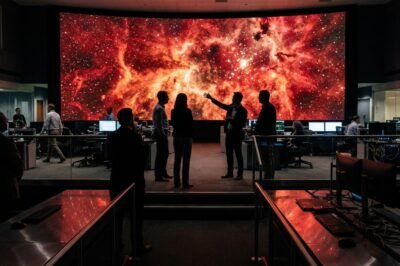
The cosmos has always been a canvas of infinite mystery, but few hues evoke as much wonder and scientific intrigue as the deep, vibrant shades of red. When NASA releases a curated collection of its most stunning crimson-tinted imagery, it is not merely an aesthetic exercise for the public; it is a profound revelation of the invisible forces shaping our galaxy. These images, often captured by the James Webb Space Telescope (JWST) and the Hubble Space Telescope, transcend traditional photography by translating raw data from the infrared and electromagnetic spectrums into visual masterpieces. The ‘red’ we see is frequently a proxy for heat, ancient light stretched by the expansion of the universe, or the presence of complex organic molecules in interstellar dust clouds. This analysis explores how these ten iconic images from NASA redefine our understanding of the celestial architecture, bridging the gap between cold scientific data and the raw, breathtaking beauty of the final frontier. By examining these images, we are not just looking at stars; we are looking at the foundational processes of creation and destruction that define our existence.
### The Science of Seeing Red: Why the Color Matters
In the realm of astrophysics, red is far more than a color; it is a diagnostic tool. Most of the ‘red’ images featured by NASA are the result of infrared astronomy. Because light stretches as it travels across the expanding universe—a phenomenon known as cosmological redshift—the oldest and most distant objects in the universe appear in the infrared part of the spectrum. Instruments like the Mid-Infrared Instrument (MIRI) on the James Webb Space Telescope are specifically designed to pierce through thick veils of cosmic dust that block visible light. When NASA’s editors and scientists assign red filters to this data, they are highlighting areas of dense gas where new stars are being born or identifying the chemical signatures of methane and carbon dioxide in exoplanet atmospheres. By focusing on the red spectrum, astronomers can see the ‘skeletons’ of galaxies, revealing the structural bones of the universe that remained hidden for decades under the glare of closer, brighter stars.
### Stellar Nurseries: The Crimson Glow of Creation
Among the most striking images in NASA’s collection are those of stellar nurseries like the Pillars of Creation or the Carina Nebula. In these regions, massive clouds of hydrogen gas and dust collapse under their own gravity to form new suns. The intense red hues in these images often represent ionized hydrogen or the presence of polycyclic aromatic hydrocarbons—sooty molecules that are the building blocks of life. These nebulas act as cosmic laboratories. By analyzing the density of the red regions, scientists can calculate the rate of star formation and the efficiency with which a galaxy recycles its material. The visual impact of these glowing clouds serves as a reminder of the turbulent environment from which our own solar system emerged billions of years ago.
### Galactic Collisions and the Infrared Echo
When galaxies collide, the resulting gravitational tidal forces trigger massive bursts of star formation. NASA’s images of interacting galaxies, such as the Antennae Galaxies, show brilliant red filaments connecting the two merging bodies. These filaments are ‘bridges’ of gas and dust. The red coloration here is critical for mapping the distribution of dark matter and understanding how galactic mergers drive the evolution of the universe. These images provide a snapshot of the future of our own Milky Way, which is destined to merge with the Andromeda galaxy in about four billion years. The data captured in these red-heavy frames allows theorists to refine their simulations of cosmic evolution, proving that these images are as much about the future as they are about the past.
### The Death of Stars: Supernova Remnants in High Definition
At the other end of the stellar life cycle, the death of a star produces some of the most intricate red structures in the night sky. Supernova remnants, like the Crab Nebula or Cassiopeia A, exhibit complex webbing and lace-like patterns. In these instances, the red light often denotes the presence of nitrogen or sulfur atoms that have been energized by the shockwave of the star’s explosion. These images are essential for understanding how heavy elements—like the iron in our blood and the calcium in our bones—are distributed throughout the cosmos. NASA’s ability to capture the fine detail of these debris fields allows researchers to track the expansion velocity of the remnants, providing a literal clock for dating some of the most violent events in our galactic history.
### Atmospheric Secrets of Distant Worlds
Perhaps the most groundbreaking application of red-spectrum analysis in recent years has been the study of exoplanet atmospheres. While not always as visually sprawling as a nebula, the ‘red’ data from transmission spectroscopy is revolutionary. When a planet passes in front of its host star, the star’s light filters through the planet’s atmosphere. NASA’s visual representations of this data often use red gradients to show the presence of water vapor, clouds, or even carbon-rich haze. This is the frontline of the search for life beyond Earth. The ‘beautiful red space images’ of exoplanets are often artistic renderings based on precise data points, representing a synthesis of art and science that helps the public conceptualize worlds that are hundreds of light-years away but potentially habitable.
### The Future of Cosmic Observation
As we look toward the next decade of space exploration, the reliance on the red and infrared ends of the spectrum will only increase. Projects like the Nancy Grace Roman Space Telescope will build upon the foundations laid by the images seen today, mapping the universe with a field of view 100 times greater than Hubble. The implications are staggering: we are on the verge of mapping the ‘cosmic web’ in unprecedented detail. These beautiful images are the precursors to a more complete map of reality, one where we can see the first stars ever to ignite and the slow, majestic dance of dark energy. NASA’s commitment to sharing these visuals ensures that the quest for knowledge remains a shared human endeavor, fueled by the same awe our ancestors felt while looking at the stars, now amplified by the power of modern technology.
In conclusion, NASA’s collection of red space images is more than a digital gallery; it is a testament to human ingenuity. By shifting our perspective to the infrared, we have uncovered a universe that is far more active, dusty, and interconnected than previously imagined. These images challenge our perceptions of reality and remind us that the most beautiful truths of the universe often lie just beyond the reach of the naked eye.






































Leave a Reply