
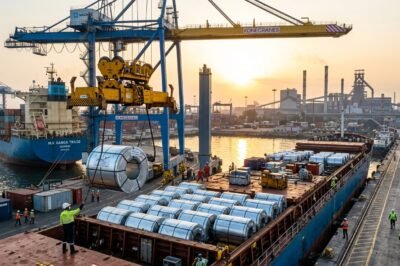
The global steel industry is currently navigating through one of its most complex and volatile phases in recent memory, characterized by shifting geopolitical alliances, increasingly stringent environmental regulations, and a resurgence of protectionist economic policies among major global powers. In this high-stakes environment, the recent announcement that India has secured a substantial 1.64 million-tonne steel export quota from the European Union (EU) emerges as a landmark achievement for the Indian metallurgical sector. This development is not merely a routine administrative update; it represents a hard-won victory in the complex arena of international trade diplomacy. Of the total allocation, a significant 6.95 lakh tonnes are specifically designated under the Free Trade Agreement (FTA) framework, providing a clear and preferential pathway for Indian steel manufacturers to maintain and expand their market presence in the lucrative European landscape. For Indian industry giants such as Tata Steel, JSW Steel, and ArcelorMittal Nippon Steel India, this quota provides a critical window of opportunity to optimize their export strategies amidst global uncertainty. As the European Union continues to refine its safeguard measures, understanding the intricate layers of this quota allocation becomes essential for industry stakeholders, policymakers, and investors alike. This analysis provides a deep dive into the structural components of the quota, the competitive advantages it offers, and the broader economic implications for India’s status as a burgeoning global industrial powerhouse.
The Evolution and Impact of European Union Steel Safeguards
To fully grasp the magnitude of the 1.64 million-tonne quota, it is necessary to examine the historical context of the European Union’s steel safeguard measures. These safeguards were originally implemented in 2018 as a defensive response to the United States’ Section 232 tariffs, which threatened to divert global steel flows toward Europe, potentially destabilizing the domestic market. The EU’s system operates on a Tariff-Rate Quota (TRQ) mechanism, where specific volumes of steel can enter the market with zero or minimal duties, while any volume exceeding these thresholds is hit with a significant 25% safeguard duty. This system has become a permanent fixture of European trade policy, forcing exporting nations like India to engage in rigorous negotiations to secure their share of the market.
For the Indian steel industry, which has historically relied on the European market for a substantial portion of its high-value exports, these safeguards have often acted as a bottleneck. The recent allocation of 1.64 million tonnes demonstrates a recognition by the European Commission of India’s role as a vital supplier in the global supply chain. This quota is part of a broader recalibration of trade relations, as Europe looks to diversify its sources of industrial raw materials away from traditional partners like Russia and China. By securing this volume, India is not only protecting its existing export interests but is also positioning itself as a reliable alternative in an era where supply chain resilience is prioritized over pure cost-efficiency.
Dissecting the 1.64 Million-Tonne Quota Allocation
The total quota of 1.64 million tonnes is not a monolithic figure but is instead broken down into specific product categories and timeframes. This granular approach is designed to prevent a surge in any one particular type of steel that could harm European producers. The allocation typically covers a wide range of steel products, including hot-rolled flat products, cold-rolled sheets, and various types of coated steel used in the automotive and construction industries. The quarterly nature of these quotas means that Indian exporters must meticulously plan their logistics and production schedules to ensure they do not exceed their limits too early in the period, which would trigger the dreaded 25% duty.
Statistical analysis of recent trade data suggests that India has been consistently exhausting its quotas in key categories, particularly in hot-rolled coils. The 1.64 million-tonne figure provides a buffer that allows for steady growth compared to previous periods. Furthermore, the allocation is often divided into ‘country-specific’ quotas and a ‘global’ pool. India’s ability to secure a large country-specific portion is a strategic advantage, as it protects Indian exporters from being crowded out by other major steel-producing nations such as Vietnam, Turkey, or South Korea. This predictability is essential for maintaining long-term contracts with European buyers who require a stable and cost-effective supply of metal.
The Strategic Significance of the 6.95 Lakh Tonnes FTA Provision
A critical component of this announcement is the 6.95 lakh tonnes designated under the Free Trade Agreement (FTA) provisions. This specific carve-out is highly significant because it operates under a different set of rules and administrative procedures than the general safeguard quotas. Steel exported under FTA provisions often benefits from even lower administrative hurdles and serves as a testament to the deepening economic ties between India and various European trade blocs. This allocation ensures that a substantial portion of India’s exports is insulated from the broader fluctuations of global trade policy, providing a ‘safe harbor’ for Indian manufacturers.
The inclusion of such a large volume under the FTA umbrella highlights the success of India’s recent trade diplomacy efforts. By leveraging existing and burgeoning trade agreements, India is effectively ‘locking in’ market access that is less susceptible to the protectionist whims of the moment. This 6.95 lakh tonne allocation acts as a competitive edge, as it allows Indian exporters to offer more aggressive pricing and better delivery terms than competitors who are solely dependent on the general global quota pool. It also encourages Indian steel companies to focus on high-margin, specialized steel products that are often covered by these preferential trade arrangements, thereby moving the industry up the value chain.
Economic Multipliers and the Impact on Indian Domestic Manufacturers
The successful negotiation of this quota has profound implications for the domestic Indian economy. The steel sector is a major employer and a key contributor to India’s GDP. By ensuring a steady outlet for surplus production, the EU quota helps maintain high capacity utilization rates across Indian steel plants. When domestic demand fluctuates, the ability to pivot to the European market ensures that production lines remain active and jobs are protected. Furthermore, the foreign exchange earned from these exports is vital for India’s balance of trade, especially given the capital-intensive nature of the steel industry’s ongoing expansion plans.
Major players like JSW Steel and Tata Steel have invested billions in expanding their capacities, with an eye on both the growing domestic infrastructure demand and the global export market. The 1.64 million-tonne quota provides the necessary demand-side visibility to justify these massive capital expenditures. Moreover, the stringent quality standards of the European market act as a catalyst for Indian manufacturers to adopt more advanced production technologies. Meeting EU specifications often requires investments in research and development and precision manufacturing, which ultimately improves the overall technological sophistication of the entire Indian industrial base.
Global Competitiveness and the Looming Challenge of CBAM
While the quota allocation is a significant win, it arrives at a time when the European Union is introducing one of the most transformative trade policies in decades: the Carbon Border Adjustment Mechanism (CBAM). Often referred to as a ‘carbon tax’ on imports, CBAM is designed to level the playing field between European producers, who face high carbon costs, and importers from regions with less stringent environmental regulations. Starting in its transitional phase and moving toward full implementation, CBAM will require Indian steel exporters to report the carbon footprint of their products and eventually pay a levy based on those emissions.
This environmental regulation presents a long-term challenge that could potentially offset the benefits of the 1.64 million-tonne quota. Indian steel production is traditionally carbon-intensive, relying heavily on coal-based blast furnaces. To remain competitive in the EU market under the CBAM regime, Indian companies must accelerate their transition to ‘green steel’ production. This involves investing in hydrogen-based steelmaking, scrap recycling, and carbon capture technologies. The quota provides the volume needed to stay in the game today, but the future of Indian steel in Europe will depend on the industry’s ability to decarbonize its operations rapidly and efficiently.
The Geopolitical Landscape and India’s Role as a Reliable Partner
The broader geopolitical context cannot be ignored when analyzing this trade development. The European Union’s decision to grant a significant quota to India is part of a strategic shift to reduce dependency on China, which has long dominated global steel production. China’s massive overcapacity and subsidies have frequently led to allegations of dumping, prompting the EU to maintain strict anti-dumping duties against Chinese products. By contrast, India is increasingly viewed as a ‘like-minded’ democratic partner with a transparent legal system and a growing economic synergy with the West.
This ‘China Plus One’ strategy is a major tailwind for the Indian steel industry. As European manufacturers seek to diversify their procurement, India stands out as the most viable alternative capable of producing at the necessary scale. The 1.64 million-tonne quota is a reflection of this trust and the ongoing efforts to integrate the Indian and European economies more closely. However, India must remain vigilant, as other emerging economies like Vietnam and Indonesia are also vying for this space. Maintaining high quality, competitive pricing, and a commitment to international trade norms will be essential for India to sustain its preferred status in the eyes of European policymakers.
Conclusion: Navigating the Path Toward Sustainable Export Growth
In conclusion, the allocation of a 1.64 million-tonne steel quota by the European Union is a pivotal moment that provides a significant boost to India’s export ambitions. By securing nearly 7 lakh tonnes under the FTA framework, India has demonstrated its prowess in trade negotiations and its ability to protect the interests of its domestic industrial giants. This quota provides the volume, predictability, and preferential access needed to thrive in a competitive global market. However, the victory is not an end in itself but rather a starting point for the next phase of growth. The Indian steel industry must use this window of opportunity to modernize its facilities, invest in green technologies, and prepare for the inevitable arrival of carbon-based trade barriers like CBAM.
The road ahead will require a coordinated effort between the private sector and the government to ensure that India remains a dominant player in the global steel trade. Continued investment in port infrastructure, logistics, and research will be necessary to capitalize on these quotas fully. As the world moves toward a more fragmented and regulated trade environment, India’s success in securing this 1.64 million-tonne allocation serves as a powerful reminder of the country’s rising influence and its potential to shape the future of global industry. By balancing current export opportunities with long-term sustainability goals, the Indian steel sector is well-positioned to become a cornerstone of the nation’s economic future.






































Leave a Reply