
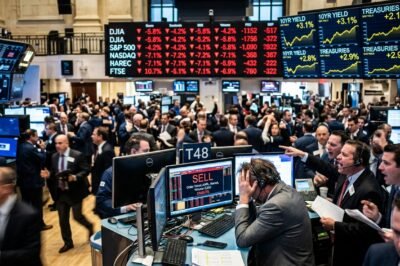
The global financial landscape is currently undergoing a seismic shift as a persistent and aggressive bond selloff continues to rattle investors, leading to a significant downturn in stock futures. This phenomenon, which has seen government bond yields surge to multi-year highs, represents a fundamental repricing of risk in an era defined by stubborn inflation and hawkish central bank policies. As the yield on the benchmark 10-year U.S. Treasury note climbs, the ripple effects are being felt across every asset class, from high-growth technology stocks to emerging market currencies. Investors are no longer merely speculating on the timing of interest rate cuts; they are now bracing for a prolonged period of elevated borrowing costs. This transition from the ‘cheap money’ era to a ‘higher-for-longer’ paradigm has created a vacuum of liquidity, forcing a mass exit from long-duration assets and a painful recalibration of equity valuations. The Wall Street Journal’s recent reports highlight a growing sense of unease among institutional traders who fear that the traditional correlation between stocks and bonds has turned predatory, with rising yields acting as a direct anchor on corporate growth prospects. This analysis dives into the structural drivers of this market rout and what it portends for the global economy in the coming months.
The Mechanics of the Yield Surge and Inflationary Pressures
At the heart of the current market turmoil is the relentless rise in sovereign bond yields. In the United States, the 10-year Treasury yield, often considered the bedrock of global finance, has broken through critical resistance levels, fueled by a combination of resilient economic data and a massive supply of new government debt. When bond yields rise, it is a signal that investors are demanding a higher return for lending money over the long term, usually because they anticipate higher inflation or more aggressive central bank intervention. Currently, both factors are at play. The Federal Reserve has maintained a steadfastly hawkish tone, suggesting that while the pace of rate hikes might slow, the pivot to lower rates is much further off than markets had previously priced in. This disconnect between market expectations and central bank reality is being resolved through a violent selloff in the bond market.
Furthermore, the term premium—the extra compensation investors require for the risk of holding long-term debt—is returning to the market after years of being suppressed by quantitative easing. As central banks transition to quantitative tightening (QT), they are no longer the ‘buyers of last resort.’ This leaves the market to absorb a record amount of Treasury issuance, primarily driven by expanding fiscal deficits. Without the artificial floor provided by central bank purchases, yields must rise to attract private capital. This structural shift in the supply-demand dynamics of the bond market is a primary driver of the current volatility, creating a feedback loop where falling bond prices lead to forced liquidations, further driving yields higher and equity futures lower.
The Stock-Bond Correlation: Why Equity Futures are Bleeding
The relationship between bonds and stocks has historically been nuanced, but in the current environment, the negative correlation is stark. Higher bond yields act as a direct headwind for stocks for two primary reasons: the discount rate and the cost of capital. Most professional analysts value stocks using a Discounted Cash Flow (DCF) model, where future earnings are discounted back to the present using a rate derived from government bond yields. When the ‘risk-free’ rate (the 10-year Treasury) increases, the present value of those future earnings decreases. This is particularly damaging for growth stocks and technology companies, whose valuations are heavily weighted toward earnings far in the future. As yields climb, the ‘Magnificent Seven’ and other tech giants see their theoretical valuations evaporate, leading to the sharp drops observed in Nasdaq and S&P 500 futures.
Secondly, rising yields represent a tangible increase in the cost of capital for corporations. Companies that relied on cheap debt to fund share buybacks, acquisitions, or research and development are now facing a reality where refinancing that debt will be significantly more expensive. This squeeze on profit margins is a major concern for equity investors, who are now revising their earnings estimates downward for the upcoming quarters. The shift from ‘TINA’ (There Is No Alternative to stocks) to ‘TIARA’ (There Is A Real Alternative) is also in full swing; with short-term Treasuries offering yields north of 5%, many investors are opting for the safety of fixed income over the volatility of the equity market, further draining liquidity from the stock market.
Global Contagion: From Treasuries to Gilts and Bunds
While the selloff began in the U.S. Treasury market, it has rapidly evolved into a global contagion. In Europe, the German Bund and the UK Gilt have seen similar spikes in yields. The European Central Bank (ECB) finds itself in a precarious position, attempting to combat sticky inflation while the Eurozone economy shows signs of stagnation. The rise in yields across the Atlantic exerts upward pressure on European rates, as investors move capital to where the returns are highest. This global synchronization of rising rates is particularly dangerous for highly indebted nations within the Eurozone, as it increases the risk of ‘fragmentation’—where the borrowing costs of weaker economies rise much faster than those of stronger ones, threatening the stability of the monetary union.
Emerging markets are also feeling the heat. A rising U.S. yield typically strengthens the U.S. Dollar, as global capital flows into dollar-denominated assets. This puts immense pressure on emerging market currencies, making it more expensive for these nations to service their dollar-denominated debt. To defend their currencies, many emerging market central banks are forced to raise their own interest rates, even if their domestic economies are weak. This ‘reverse currency war’ is a direct byproduct of the global bond selloff, highlighting how interconnected the modern financial system has become. The resulting drain on global liquidity is a primary reason why stock futures in Asia and Europe are tracking the downward movement of their American counterparts.
Institutional Sentiment and the Role of the ‘Basis Trade’
Institutional sentiment has turned decidedly cautious, with many hedge funds and asset managers deleveraging their positions. One particular area of concern cited by market observers is the ‘basis trade’—a popular strategy among hedge funds that involves exploiting small price differences between Treasury futures and the underlying cash bonds. This strategy often involves significant leverage. As the bond market becomes increasingly volatile and yields move rapidly, the risks associated with these leveraged positions grow. If a large-scale liquidation were to occur in the basis trade, it could lead to a liquidity crunch similar to what was seen in the repo markets in 2019 or the Gilt market in 2022. This ‘hidden’ risk is weighing heavily on market psychology, contributing to the ‘sell first, ask questions later’ mentality seen in stock futures.
The Impact on the Housing and Consumer Sectors
- Mortgage Rates: As the 10-year yield rises, mortgage rates follow suit, often exceeding 7% or 8%, which effectively freezes the housing market as affordability plummets.
- Consumer Spending: Higher interest rates on credit cards and auto loans reduce the discretionary income of households, slowing the overall economy.
- Corporate Refinancing: Small and medium-sized enterprises (SMEs) that lack the cash reserves of mega-caps are particularly vulnerable to rising debt service costs.
Statistical Breakdown: The Scale of the Rout
The scale of the current selloff is historic. Over the last month, the 10-year Treasury yield has moved more than 50 basis points in a matter of weeks, a volatility level usually reserved for equity markets. Historically, such rapid moves in the bond market are precursors to ‘financial accidents.’ For instance, the 1987 market crash and the 1994 bond market rout were both preceded by similar spikes in yields. Currently, the spread between the 2-year and 10-year Treasury yields remains inverted, although it has begun to ‘bear steepen’—a technical term describing a situation where long-term rates rise faster than short-term rates. Historically, a bear steepening of the yield curve is often a more accurate signal of an impending recession than the initial inversion itself, as it suggests the market is finally pricing in a long-term economic slowdown.
Conclusion: Navigating the New Interest Rate Paradigm
The ongoing bond selloff and the subsequent drop in stock futures are not merely a temporary market correction; they represent a fundamental realignment of the global financial system. For over a decade, investors operated under the assumption that central banks would always step in to provide liquidity and keep rates low. That era is officially over. The future implications are profound: we are likely entering a period of lower average equity returns, higher volatility, and a greater emphasis on fundamental valuation over speculative growth. Companies with strong balance sheets and consistent cash flows will likely outperform, while those reliant on cheap credit will struggle to survive.
As we look forward, the key will be watching the inflation data and the Fed’s reaction to it. If inflation remains sticky, the bond selloff could have much further to run, potentially pushing the 10-year yield toward levels not seen since the early 2000s. For equity investors, this means that the ‘buy the dip’ strategy that worked so well for the last decade may no longer be viable. Success in this new environment will require a disciplined approach to risk management and a keen eye on the macroeconomic indicators that are now driving the bus. The volatility we see today in stock futures is the market’s way of digesting this new reality—a process that is likely to be long, loud, and characterized by continued uncertainty.







































Leave a Reply