
Northern Regional Workshop Pushes Producer Companies Towards Stronger Governance, Digital Markets and Artisan-Led Growth
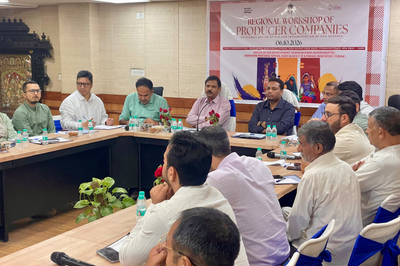
New Delhi: The Office of the Development Commissioner (Handicrafts), Northern Regional Office, New Delhi, organised a one-day Regional Workshop/Seminar on the “Overall Review of Producer Companies and Implementation of DCH Schemes” at the Conference Hall of Rajiv Gandhi Handicrafts Bhawan, Palika Kendra, Connaught Place, New Delhi.
The workshop brought together Directors of Producer Companies (PCs), representatives of Handicraft Service Centres (HSCs) and officials of the Northern Regional Office to review the functioning of Producer Companies, identify implementation challenges and explore practical measures to strengthen their institutional, financial and commercial performance.
Welcoming the participants, Shri Virendra Kumar, Regional Director (Handicrafts), called for open and constructive discussions on the challenges being faced by Producer Companies at the field level. He emphasised the importance of identifying practical solutions through coordination among Producer Companies, HSCs and the Regional Office.
Comprehensive review of Producer Companies
A key feature of the workshop was the “PC 360° Review”, which examined multiple dimensions of Producer Company functioning, including governance, statutory compliance, business performance, convergence with government departments, shareholder welfare, programme implementation, utilisation certificates, physical and financial closure, artisan databases, MIS, e-Aadhaar and financial management.
Participants were advised to conduct regular Board meetings, maintain statutory records and registers, clearly define responsibilities among Directors and ensure timely compliance. The workshop also underlined the need for stronger coordination between Producer Companies and Handicraft Service Centres.
A major focus was the transition of Producer Companies from programme-oriented organisations into market-driven and commercially viable enterprises. PCs were encouraged to improve product quality and range, strengthen market linkages, understand customer requirements and make effective use of assets created through government-supported programmes. Tracking orders, sales, repeat customers and artisan participation was also highlighted as an important part of business development.
Focus on implementation, documentation and accountability
The workshop stressed the timely completion of programmes and submission of Utilisation Certificates (UCs). A structured “Plan–Prove–Close” approach was highlighted for programmes under the National Handicrafts Development Programme.
Producer Companies and implementing agencies were advised to ensure appropriate selection of Master Crafts Persons, Resource Persons and artisans, undertake relevant market surveys and develop prototypes according to market requirements. Participants were also reminded of the importance of systematic photographic and videographic documentation.
The workshop emphasised that documentation should not be treated merely as a formality at the end of a programme. Programme records, supporting documents, payment details, MIS entries, UCs and physical and financial closure records need to remain complete, consistent and traceable.
Artisan database and financial discipline
The importance of maintaining a reliable and updated artisan database was also discussed. The database should capture details relating to artisan identity, contact information, craft and skills, cluster, programme participation, membership and bank or payment readiness.
Financial discipline emerged as another important area. Producer Companies were advised to maintain proper supporting documents, operate Zero Balance Savings Accounts with concerned CNA Banks and ensure payments to artisans and vendors through the prescribed PFMS mechanism.
The workshop stressed the importance of maintaining a complete payment trail linking programme implementation, evidence, payments, UCs and final closure, thereby strengthening transparency and accountability.
Strengthening membership and share capital
Increasing membership and share capital was identified as essential to the long-term sustainability of Producer Companies. Directors were encouraged to identify suitable artisan groups, create awareness about the benefits and responsibilities of membership and ensure that artisan shareholders actively participate in business activities.
The objective is to develop Producer Companies as member-owned enterprises capable of generating economic value for their shareholders rather than remaining dependent primarily on government assistance.
IndiaHandmade opens wider digital markets
Digital commerce received significant attention during the workshop. Representatives from IndiaHandmade, Ms. Priti Sharma and Shri Swapnil Vyas, highlighted the opportunities available to artisans, Producer Companies and producer groups through IndiaHandmade.com.
The speakers encouraged Producer Companies to register on the platform and use it to market their exclusive handicraft products to customers beyond their traditional geographical markets. A live demonstration covered seller registration, documentation, product uploading, inventory management and online sales.
According to the presentation, artisans, Producer Companies and producer groups collectively generated approximately ₹45 lakh in business through the IndiaHandmade platform during the previous seven days. The performance was presented as an indication of the growing potential of digital commerce for the artisan sector.
IndiaHandmade was launched by the Union Minister of Textiles on April 22, 2023, with the objective of providing artisans and weavers with direct access to customers through an e-commerce platform. The platform offers a zero-commission marketplace and provides support through WSCs and HSCs for areas such as onboarding, GST, inventory and online selling.
The platform has reportedly onboarded more than 6,000 sellers and hosts over 30,000 products, while more than 100 training sessions have been conducted to familiarise artisans and sellers with digital commerce.
Successful Producer Companies share models
The workshop also featured presentations by selected Producer Companies showcasing successful initiatives, business models, product development strategies and market approaches.
Kashmir Carpet Producer Company Limited presented its vision of strengthening the traditional hand-knotted carpet sector in Jammu and Kashmir through collective enterprise, improved market access and sustainable livelihoods. The company works across villages in Srinagar and Budgam and focuses on GI-tagged Kashmiri hand-knotted carpets while exploring diversification into rugs, dhurries, cushion covers, wall hangings, table runners and bedspreads.
Suryanagri Kadhai Craft Producer Company Limited of Jodhpur presented another model of artisan-led enterprise development. The company works with traditional crafts such as appliqué, Kantha, Jogi embroidery, Ajrakh and patchwork while developing contemporary textile and lifestyle products. Its market network includes its own website, online marketplaces, IndiaHandmade, wholesale buyers, retailers, boutiques and international customers.
These examples demonstrated how traditional skills can be combined with product innovation, professional management and modern marketing to create sustainable business opportunities.
10–20–30 day action framework
To ensure that the workshop translated into measurable action, a 10–20–30 day follow-through framework was outlined.
During the first 10 days, Producer Companies are expected to update their profiles, UC status, artisan databases and compliance records. The following 10 days will focus on addressing pending documentation, implementation bottlenecks and MIS or payment-trail gaps. During the final 10 days, tangible progress is expected in programme closure, market initiatives, membership and share capital enhancement.
The framework seeks to convert workshop discussions into specific actions with defined responsibilities, timelines and follow-up evidence.
Towards sustainable artisan enterprises
In his concluding remarks, Shri Virendra Kumar appreciated the participation of Producer Companies and their willingness to share achievements, challenges and operational difficulties. He assured participants that genuine issues raised during the workshop would be placed before the competent authority for consideration and resolution.
He also emphasised that the role of the Department should extend beyond programme implementation to include handholding, mentoring, facilitation and continuous support. Producer Companies, he said, must ultimately evolve into strong, self-reliant and commercially sustainable enterprises capable of generating regular income and economic opportunities for artisan shareholders.
The workshop reinforced a broader vision for the handicraft sector: moving from compliance to commerce and from participation to enterprise. With stronger governance, professional financial management, reliable artisan data, digital market access, product innovation and collective ownership, Producer Companies can play a significant role in transforming traditional craftsmanship into sustainable economic enterprises.
The workshop concluded with a shared call for “Strong Producer Companies, Empowered Artisan Shareholders and Sustainable Handicraft Enterprises.”





































Leave a Reply