
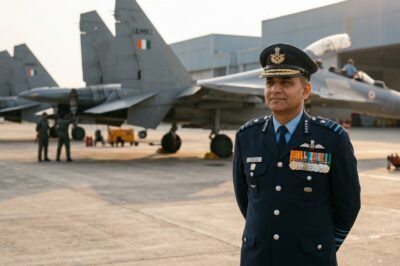
The corridors of power in New Delhi recently witnessed a significant transition as Air Chief Marshal Amar Preet Singh officially assumed the mantle of the Chief of the Air Staff (CAS) of the Indian Air Force (IAF). Stepping into the shoes of Air Chief Marshal Vivek Ram Chaudhari, the new Chief inherits a force at a critical juncture of modernization, indigenization, and heightened geopolitical sensitivity. Air Chief Marshal Singh, a decorated officer with over 5,000 hours of flying experience, brings to the table a blend of combat-hardened tactical wisdom and administrative foresight. His appointment is seen not just as a routine change in leadership but as a strategic signal of continuity and evolution within India’s aerial defense framework. As the nation faces multifaceted security challenges along its borders, the leadership of a veteran who has seen the heat of battle in the high-altitude terrains of Kargil and the internal security complexities of Jammu and Kashmir is regarded as a vital asset for the Ministry of Defence and the Indian government at large.
The Transition of Power: From V.R. Chaudhari to A.P. Singh
The formal handover ceremony at the Air Headquarters marked the end of an era for Air Chief Marshal V.R. Chaudhari, whose tenure was defined by the rapid induction of the Rafale fighter jets and the initiation of several key indigenous projects. The transition comes at a time when the Indian Air Force is recalibrating its operational readiness to meet the requirements of a multi-domain battlefield. Air Chief Marshal Amar Preet Singh, who previously served as the Vice Chief of Air Staff, has been an integral part of this recalibration process, ensuring that the shift in leadership remains seamless and focused on long-term national security goals.
During the ceremony, the traditional baton exchange symbolized the weight of responsibility that now rests on the shoulders of the new CAS. The outgoing Chief lauded the professionalism of the force and expressed confidence in his successor’s ability to navigate the complex challenges of the 21st century. This change of guard is pivotal as the IAF seeks to maintain its qualitative edge over regional adversaries while managing the logistical hurdles associated with a diverse fleet of aircraft ranging from vintage platforms to cutting-edge fifth-generation technologies. The institutional memory and technical expertise shared between the outgoing and incoming chiefs provide a stable foundation for the ambitious reforms currently underway in the defense sector.
The Crucible of Combat: Operation Safed Sagar and Operation Rakshak
Air Chief Marshal Singh’s career is anchored in the realities of active combat and strategic operations. His participation in Operation Safed Sagar during the 1999 Kargil War is particularly noteworthy. As a fighter pilot during this conflict, he was part of the historic effort to utilize air power in the treacherous, high-altitude terrain of the Himalayas to dislodge enemy intruders. This operation was a turning point for the IAF, highlighting the need for precision-guided munitions and the ability to operate at the absolute limits of an aircraft’s performance envelope. The lessons learned during Safed Sagar continue to inform the IAF’s doctrine today, especially regarding high-altitude warfare and close air support.
In addition to his wartime service, his involvement in Operation Rakshak—the long-standing counter-insurgency and internal security mission in Jammu and Kashmir—showcases his versatility as a leader. Operating in the volatile environment of J&K requires not just technical skill but a deep understanding of the socio-political nuances of conflict zones. These experiences have shaped his perspective on the role of air power in hybrid warfare scenarios, where the lines between conventional and unconventional threats are often blurred. His ground-level understanding of these operations ensures that the IAF’s strategic planning remains rooted in the practical realities of the field.
A Vision for Atmanirbhar Bharat: Indigenization of Air Power
One of the primary mandates for the new Air Chief is the aggressive pursuit of the ‘Atmanirbhar Bharat’ (Self-Reliant India) initiative within the aerospace sector. Air Chief Marshal Singh has been a vocal proponent of domestic manufacturing and has played a key role in the testing and evaluation of the Light Combat Aircraft (LCA) Tejas. Under his leadership, the IAF is expected to accelerate the induction of the Tejas Mk1A and push for the timely development of the Tejas Mk2 and the Advanced Medium Combat Aircraft (AMCA). The goal is to reduce dependency on foreign Original Equipment Manufacturers (OEMs) and build a robust domestic ecosystem for defense production.
The challenges in this path are significant, ranging from engine technology hurdles to the integration of complex sensor suites. However, the new Chief’s technical background as a flight test engineer gives him a unique advantage in overseeing these projects. He understands the technical bottlenecks that often lead to delays and is expected to work closely with the Defence Research and Development Organisation (DRDO) and Hindustan Aeronautics Limited (HAL) to streamline the procurement and testing cycles. By prioritizing indigenous platforms, the IAF aims to ensure that its future fleet is tailored to specific Indian requirements and is immune to the vagaries of international supply chains and geopolitical sanctions.
Navigating Geopolitical Turbulence: The Two-Front Challenge
The strategic environment surrounding India remains complex, with persistent tensions along the Line of Actual Control (LAC) with China and the Line of Control (LoC) with Pakistan. Air Chief Marshal Singh takes command at a time when the IAF must maintain a state of high alert to deter any misadventures. The standoff in Eastern Ladakh has underscored the importance of rapid deployment and the maintenance of a credible air deterrent in the northern sector. The new Chief will need to oversee the continued buildup of infrastructure at forward airbases, including the hardening of shelters and the deployment of advanced surface-to-air missile systems like the S-400 Triumf.
Furthermore, the concept of a ‘two-front war’ remains a central pillar of Indian strategic planning. Ensuring that the IAF has the necessary numbers—ideally moving toward the sanctioned strength of 42 squadrons—is a daunting task given the retirement of older fleets like the MiG-21. The Chief will have to balance the immediate need for airframes with the long-term goal of high-tech indigenization. His approach to the Multi-Role Fighter Aircraft (MRFA) project, which seeks to acquire 114 modern jets, will be a defining aspect of his tenure. This decision will not only impact the IAF’s combat capability but also India’s strategic partnerships with major global powers.
Technical Expertise and the Modernization Roadmap
Beyond the high-profile fighter acquisitions, the modernization of the IAF involves a comprehensive overhaul of its ‘force multipliers,’ including Airborne Early Warning and Control (AEW&C) systems, mid-air refuellers, and unmanned aerial vehicles (UAVs). Air Chief Marshal Singh’s experience in flight testing is invaluable here, as he understands the nuances of systems integration. The shift toward a ‘network-centric’ warfare model requires seamless data links between different platforms, and the new Chief is expected to prioritize the development of secure, indigenous communication networks that can withstand sophisticated electronic warfare attacks.
The IAF is also looking to expand its footprint in the space and cyber domains. As space becomes increasingly militarized, the ability to protect Indian satellite assets and utilize space-based ISR (Intelligence, Surveillance, and Reconnaissance) is paramount. Air Chief Marshal Singh’s leadership will likely see increased collaboration with the Defence Space Agency (DSA) to integrate space capabilities into the IAF’s operational doctrine. Similarly, enhancing cyber defense capabilities to protect critical command and control infrastructure will be a top priority, ensuring that the force remains resilient in the face of non-kinetic threats.
Conclusion: The Flight Path Ahead for the Indian Air Force
The appointment of Air Chief Marshal Amar Preet Singh as the Chief of the Air Staff marks a new chapter in the history of the Indian Air Force. With a career forged in the fires of actual combat and refined through decades of technical and administrative roles, he is uniquely positioned to lead the force through its current transformative phase. His focus on indigenization, coupled with a realistic understanding of the geopolitical threats facing India, suggests a tenure that will prioritize both strength and self-reliance. As he takes flight in this new role, the expectations of the nation and the personnel of the IAF are high.
In the coming years, the success of his leadership will be measured by the IAF’s ability to maintain its edge in a rapidly changing technological landscape. Whether it is the successful induction of next-generation indigenous fighters or the strategic management of border tensions, the new Chief’s decisions will reverberate across the Indian defense establishment. The flight path ahead is challenging, but with a veteran pilot at the controls, the Indian Air Force is poised to continue its ascent as a formidable global air power, dedicated to the motto ‘Touch the Sky with Glory.’



































Leave a Reply