
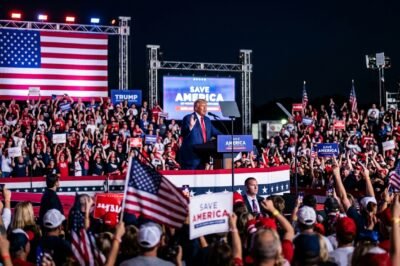
The atmosphere in Vandalia, Ohio, on the eve of the 2022 midterm elections was nothing short of electric, serving as a microcosm of the intense political polarization currently gripping the United States. As Donald Trump took to the stage, the air was thick with the scent of popcorn and the roar of a crowd that has remained steadfastly loyal to his brand of populism. The former president, appearing in support of Senate candidate JD Vance, did not just deliver a stump speech; he delivered a manifesto of defiance. This rally, meticulously covered by Al Jazeera and other international outlets, highlighted a leader who remains convinced of his political invincibility despite a mountain of legal challenges and the inherent volatility of the American electorate. For Trump, Ohio was more than a campaign stop; it was a proving ground for his continued grip on the Republican Party and a billboard for his potential 2024 aspirations. The defiance he projected was a calculated message to both his supporters and his detractors: the movement he started in 2016 is not fading into the sunset, but rather gearing up for a renewed assault on the Washington establishment.
As the sun dipped below the horizon at the Dayton International Airport, Trump used the platform to frame the upcoming elections as a final stand for the American middle class. His rhetoric was punctuated by frequent jabs at the Biden administration, focusing heavily on inflation, border security, and the perceived decline of American prestige on the world stage. To an audience deeply concerned about the rising cost of living, Trump’s message of economic restoration resonated with a visceral intensity. This introduction to the rally set a tone of urgency, suggesting that the midterms were not merely a choice between two parties, but a choice between national survival and systemic collapse. By positioning himself as the primary defender of the forgotten man, Trump effectively galvanized the base, ensuring that the turnout in traditional Republican strongholds would be high enough to counter Democratic gains in urban centers. This opening salvo in Ohio serves as a perfect lens through which to view the broader national struggle for control of the US Congress.
The Strategic Importance of the Buckeye State
Ohio has long been regarded as the ultimate bellwether in American politics, a state whose diverse demographic makeup often reflects the national mood. In recent years, however, the state has undergone a significant shift, moving from a competitive swing state to a more reliable Republican stronghold. Trump’s presence in Ohio was a recognition of this shift and an attempt to solidify it. The Senate race between JD Vance and Tim Ryan was one of the most closely watched contests in the country, representing a clash of two very different visions for the Rust Belt. Vance, a former critic of Trump turned staunch ally, embodied the ‘New Right’—a movement focused on cultural conservatism and economic protectionism. Trump’s endorsement was the catalyst that propelled Vance through a crowded primary, and the Ohio rally was designed to ensure that the MAGA base remained energized for the general election.
Beyond the Vance campaign, the Ohio rally served as a strategic signal to the rest of the country. By focusing on a state that he won twice by significant margins, Trump was asserting his role as the party’s kingmaker. He was also testing the efficacy of his messaging in an area that has been hard-hit by deindustrialization and the opioid crisis. The political geography of Ohio, with its mix of declining manufacturing hubs and growing suburban developments, provided the perfect backdrop for Trump’s narrative of national decline and promised rebirth. For the Republican Party, winning big in Ohio was not just about securing a Senate seat; it was about demonstrating that the Trumpian coalition of working-class voters could be sustained and expanded, even in the absence of Trump himself on the ballot.
Dissecting the Rhetoric of Defiance
The core of Trump’s speech in Vandalia was a relentless critique of the current administration, delivered with the signature bravado that has defined his political career. He characterized the Biden presidency as a period of ‘unmitigated disaster,’ citing the withdrawal from Afghanistan, the spike in fuel prices, and the increase in illegal border crossings as evidence of a failed leadership. This rhetoric of defiance is aimed at delegitimizing his opponents and framing the Republican Party as the only viable alternative. Trump’s ability to condense complex geopolitical and economic issues into punchy, relatable soundbites remains one of his most potent political tools. He spoke of ‘the deep state’ and ‘the fake news media’ with a fervor that suggested he was not just fighting for a political victory, but for the truth itself.
Moreover, Trump’s defiance extended to the numerous investigations into his own conduct. Rather than shying away from his legal troubles, he integrated them into his campaign narrative, presenting himself as a martyr for his followers. He argued that the legal actions against him were not based on justice, but were instead a form of ‘political persecution’ designed to prevent him from returning to power. This strategy has proven remarkably effective among his base, who view the investigations as an attack on their own values and political agency. By framing himself as a victim of a corrupt system, Trump transforms his personal legal battles into a collective struggle for his supporters, thereby deepening their loyalty and commitment to his cause.
The JD Vance Factor and the New GOP Coalition
The relationship between Donald Trump and JD Vance is one of the most fascinating dynamics in modern American politics. Vance, the author of ‘Hillbilly Elegy,’ initially rose to prominence as an intellectual voice explaining the white working class to the coastal elite. His transition from a ‘Never Trump’ conservative to a MAGA loyalist is emblematic of the broader transformation of the Republican Party. At the Ohio rally, Trump highlighted this evolution, praising Vance for his courage and his commitment to the ‘America First’ agenda. This endorsement was crucial for Vance, who needed to overcome skepticism from some segments of the base who remembered his earlier criticisms of the former president.
The Vance campaign in Ohio also illustrates the emergence of a new GOP coalition that prioritizes populist economic policies over traditional fiscal conservatism. This new movement is more comfortable with government intervention in the economy if it benefits domestic workers and is staunchly opposed to globalist trade agreements and foreign military interventions. At the rally, the rhetoric centered on protecting American jobs and ensuring that the interests of Ohioans were prioritized over those of international corporations. This shift represents a significant departure from the Reagan-era consensus and suggests that the Republican Party is becoming a more worker-centric party, at least in its public-facing messaging. The success of this strategy in Ohio could provide a blueprint for Republican candidates in other Rust Belt states like Pennsylvania, Michigan, and Wisconsin.
Economic Anxiety and the Midterm Mandate
Economic issues are almost always the primary driver of midterm election results, and 2022 was no exception. During the Ohio rally, Trump capitalized on the palpable economic anxiety felt by many attendees. He pointed to the highest inflation rates in forty years as a direct consequence of Democratic spending policies. For many families in the Midwest, the rising cost of groceries and utilities is not an abstract political talking point; it is a daily struggle that impacts their quality of life. Trump’s focus on ‘kitchen table’ issues allowed him to connect with voters on a personal level, bypassing the more esoteric debates about democratic norms and institutional integrity.
The Republican strategy in the midterms was built on the premise that voters would treat the election as a referendum on the incumbent president’s handling of the economy. Historically, the party in power almost always loses seats in the midterm elections, and Trump’s defiance was bolstered by polling data that showed widespread dissatisfaction with the country’s direction. In Ohio, this dissatisfaction was channeled into support for candidates who promised to rein in government spending and unleash American energy production. By framing the Democratic platform as ‘radical’ and ‘out of touch’ with the needs of ordinary Americans, Trump and his allies sought to create a mandate for a Republican-controlled Congress that would act as a check on the Biden administration’s legislative agenda.
The Democratic Response and the Polarization of the Electorate
While Trump was rallying his supporters in Ohio, the Democratic Party was engaged in a high-stakes effort to preserve its thin majorities in the House and Senate. President Joe Biden and other top Democrats shifted their strategy in the final weeks of the campaign, moving away from a purely economic focus to emphasize the threat they believed Trump and his followers posed to democracy. Biden’s ‘Battle for the Soul of the Nation’ speech served as the thematic counterpoint to Trump’s Ohio rally. Democrats argued that the ‘MAGA Republicans’ were a threat to the rule of law, voting rights, and the peaceful transfer of power. This messaging was intended to mobilize the Democratic base and appeal to moderate independent voters who were weary of the chaos and division associated with the Trump era.
The result of these competing narratives was a deeply polarized electorate. In Ohio, this polarization was visible in the stark divide between the rural counties that supported Trump and the urban centers like Cleveland and Columbus that leaned heavily Democratic. The rally in Vandalia was a celebration of one side of this divide, a place where the MAGA worldview was not just accepted but celebrated. However, the aggressive rhetoric used by both sides served to further entrench political identities, making bipartisan cooperation in the future seem even more unlikely. The midterms were not just about who would control Congress; they were a test of which narrative—the economic grievance of the right or the democratic defense of the left—would prove more compelling to the American people.
Conclusion: The Path to 2024 and Beyond
As the Ohio rally concluded and the crowds dispersed, the broader implications of Donald Trump’s defiance became clear. Regardless of the final vote counts, Trump has succeeded in reshaping the Republican Party in his image. The candidates he endorsed, like JD Vance, are the new faces of the GOP, carrying forward a populist and nationalist agenda that shows no signs of waning. Trump’s performance in Ohio was a clear indication that he intends to remain the central figure in American politics for the foreseeable future. The defiance he displayed is not just a personal affectation but a strategic tool used to keep his base energized and his opponents off balance. As the country looks toward the 2024 presidential election, the themes established in the Ohio rally will likely dominate the political discourse for years to come.
Ultimately, the Ohio rally was a reminder of the enduring power of political movements that tap into the deep-seated anxieties and identities of the electorate. Trump’s ability to command a crowd and dictate the national conversation remains unparalleled. While his critics point to his legal challenges and the controversies of his presidency as reasons for his political demise, the scene in Vandalia suggested otherwise. The ‘Make America Great Again’ movement is a potent force that continues to challenge the established order. Whether this movement leads to a Republican resurgence or further national fragmentation remains to be seen, but one thing is certain: Donald Trump is not going anywhere, and his defiance will continue to be a defining feature of the American political landscape.




































Leave a Reply