
The Dramatic Standoff in the Heart of the Capital
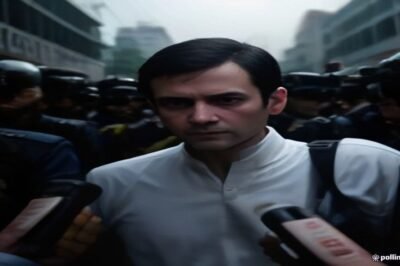
The political landscape of New Delhi witnessed a high-stakes confrontation today as senior Congress leader Rahul Gandhi was removed from a protest site and taken away in a police bus. The incident, which unfolded amidst a backdrop of rising tensions over the proposed changes to the appointment process of the Chief Election Commissioner (CEC), signifies a hardening of positions between the ruling dispensation and the opposition. As the sun beat down on the protest site, the atmosphere was thick with the scent of dissent and the rhythmic chanting of slogans that echoed through the corridors of power. This was not merely a localized demonstration; it was a symbolic battle for the perceived integrity of India’s democratic institutions. The spectacle of a prominent leader being physically handled and detained serves as a visceral reminder of the deepening polarization that characterizes contemporary Indian politics. The visual of Gandhi peering through the windows of a moving police vehicle has already begun to circulate globally, framing a narrative of a government increasingly intolerant of vocal opposition and a resistance that is willing to take its grievances to the streets.
For the Congress party and its allies in the I.N.D.I.A. bloc, the protest was the culmination of weeks of legislative maneuvering and public outcry. The focus of their ire is the Chief Election Commissioner and other Election Commissioners (Appointment, Conditions of Service and Term of Office) Bill. The opposition argues that the bill, which seeks to replace the Chief Justice of India on the selection committee with a cabinet minister, effectively gives the executive unilateral control over the watchdog of the world’s largest democracy. The stakes could not be higher, as the Election Commission of India (ECI) is the sole arbiter of electoral fairness, and any perceived bias in its leadership could have cascading effects on the legitimacy of future mandates. The scenes of Rahul Gandhi being whisked away are thus being portrayed by his supporters as a direct assault on the democratic process itself, while the administration maintains that the police action was a necessary measure to maintain public order in a high-security zone.
Legislative Context: The Core of the CEC Appointment Dispute
To understand the intensity of today’s protests, one must look at the legal history of the CEC appointment process. In early 2023, the Supreme Court of India, in a landmark judgment (Anoop Baranwal v. Union of India), ruled that the appointment of the CEC and Election Commissioners should be made by a committee comprising the Prime Minister, the Leader of the Opposition, and the Chief Justice of India. The court’s intent was to ensure a level of neutrality that would prevent any single party from packing the commission with loyalists. This ruling was hailed as a victory for judicial oversight and institutional independence. However, the subsequent introduction of a new bill by the central government aimed to modify this committee, replacing the Chief Justice with a cabinet minister nominated by the Prime Minister. This change would shift the balance of the selection committee to a 2-1 majority in favor of the ruling executive, a move that critics argue renders the presence of the Leader of the Opposition redundant.
The government justifies this legislative move by asserting the primacy of Parliament in creating laws and arguing that the Supreme Court’s ruling was a temporary measure intended to fill a legislative vacuum. From the government’s perspective, the new bill provides a structured and transparent framework for appointments that respects the executive’s role in governance. However, the opposition views this as a calculated attempt to bypass the judiciary and capture the very institution responsible for conducting free and fair elections. This legislative tug-of-war has transformed from a dry legal debate into a full-blown political crisis, with today’s street protests marking a significant escalation. The removal of Rahul Gandhi from the protest site is seen by many analysts as an attempt to stifle the most visible face of this opposition, though it may inadvertently provide him with a more potent platform for his narrative of democratic backsliding.
Tactical Maneuvers: The Police Response and Public Order
The logistics of today’s police operation were intricate and swift. As hundreds of Congress workers and senior leaders converged on the protest site, the Delhi Police deployed multiple layers of security. Using a combination of barricades, water cannons on standby, and a heavy presence of personnel in riot gear, the authorities sought to contain the crowd within a designated perimeter. When the leaders, led by Rahul Gandhi, attempted to march toward the Parliament or other restricted zones, the situation turned from a peaceful sit-in to a series of skirmishes. The decision to detain Gandhi was reportedly taken when it became clear that the crowd’s momentum was threatening to breach the security cordons. The process of removing a high-profile Special Protection Group (SPG) protectee is never simple, requiring a high degree of coordination between various security wings to ensure safety while executing the detention.
The use of police buses to transport detained protesters is a standard operating procedure in the national capital, but the optics of such an act are always politically charged. For the police, it is a tool of crowd management intended to de-escalate a volatile situation by removing its focal point. For the political actors involved, it is an opportunity to showcase their resolve. The images of Rahul Gandhi sitting inside the bus, surrounded by his colleagues and flanked by uniformed officers, serve as powerful propaganda tools for both sides. The government can point to the enforcement of law and order, while the opposition can highlight the ‘victimization’ of its leadership. This tactical dance between protesters and law enforcement has become a recurring feature of the Delhi landscape, yet each iteration brings with it a higher degree of urgency as the national elections draw closer.
The Broader Implications for the I.N.D.I.A. Alliance
The detention of Rahul Gandhi has acted as a catalyst for greater unity within the fragmented opposition alliance. Leaders from various regional parties, who have often had differences with the Congress, were quick to condemn the police action. This incident provides a common grievance around which the I.N.D.I.A. bloc can coalesce, moving beyond seat-sharing disputes to a more fundamental defense of constitutional values. By positioning themselves as the guardians of the Election Commission’s independence, the opposition is attempting to craft a narrative that resonates with the urban middle class and civil society, groups that are traditionally sensitive to institutional integrity. The CEC row is no longer just a technical disagreement over a bill; it has become a litmus test for the opposition’s ability to mount a collective challenge to the ruling party’s hegemony.
Furthermore, the protest highlights a shift in the opposition’s strategy. There is a clear move away from merely debating within the halls of Parliament—where they are often outnumbered and outmaneuvered—to taking the fight to the ‘Jan Adalat’ or the court of the people. By choosing to be detained, leaders like Gandhi are signaling a willingness to undergo personal hardship for their cause. This ‘politics of the street’ is designed to create a sense of crisis and urgency among the electorate. Whether this translates into actual votes remains to be seen, but it certainly changes the media cycle and forces the government to defend its actions on grounds other than pure policy. The coming weeks will likely see more such coordinated efforts as the opposition seeks to keep the momentum of the CEC row alive through various symbolic and direct actions across the country.
Institutional Integrity and the 2024 Election Horizon
As India approaches the 2024 General Elections, the shadow of the CEC row looms large over the entire electoral process. The Election Commission is the backbone of Indian democracy, and its perceived impartiality is essential for the peaceful transfer of power. If a significant portion of the political spectrum loses faith in the ECI’s neutrality, the very foundations of the democratic contract are at risk. This is why the protest by Rahul Gandhi and the subsequent police response are being watched so closely by international observers and constitutional experts. The concern is that if the appointment process is seen as a partisan affair, every decision made by the commission—from the scheduling of polls to the adjudication of the Model Code of Conduct—will be viewed through a lens of suspicion. This could lead to a post-election scenario where the results are contested not just on the ground, but in the minds of the public, potentially leading to social unrest.
Statistics and historical data show that trust in institutions is a key predictor of a stable democracy. In previous decades, the ECI had built up a massive reservoir of public trust through the efforts of commissioners like T.N. Seshan, who asserted the body’s independence against all political pressures. The current controversy threatens to deplete that reservoir. The government’s argument that the new law simply codifies the process is met with the counter-argument that the ‘spirit’ of the constitution demands a bipartisan approach to such critical appointments. As the legislative process for the bill moves toward its conclusion, the focus will shift to how the new selection committee operates in practice. The first few appointments under the new system will be scrutinized with unprecedented intensity, and any hint of favoritism will likely trigger a new wave of protests and legal challenges in the higher courts.
Conclusion: The Future of Democratic Dissent
The events surrounding the detention of Rahul Gandhi in the CEC row mark a pivotal moment in the lead-up to the next national election. It is a moment that encapsulates the tension between executive power and legislative oversight, between the enforcement of order and the right to protest. While the immediate physical confrontation has subsided with the clearing of the protest site, the underlying issues remain unresolved and more potent than ever. The government appears determined to push through its legislative agenda, viewing it as a mandate of the people, while the opposition is equally committed to portraying these moves as an existential threat to the Republic. This collision course suggests that the 2024 elections will be fought not just on issues of development and welfare, but on the very nature of India’s democratic framework.
In the long run, the legacy of today’s protest will be determined by whether it succeeds in sparking a broader national conversation about institutional independence. If the public perceives the detention of opposition leaders as an overreach, it could galvanize a segment of the electorate that was previously indifferent. Conversely, if the government successfully frames the protests as a disruption of governance by ‘sore losers,’ it may solidify its base of support. One thing is certain: the removal of Rahul Gandhi from the protest site was not an end, but a beginning. It has set the stage for a prolonged period of political volatility where every administrative decision and every act of dissent will be magnified. As the buses drove away from the protest site, they carried more than just detained politicians; they carried the weight of a nation’s evolving democratic struggle into an uncertain future.




































Leave a Reply