
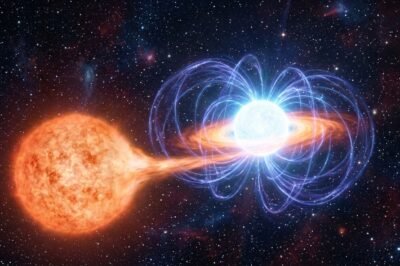
For nearly a century, the Chandrasekhar limit has stood as an unyielding sentinel in the field of astrophysics, defining the maximum mass a white dwarf can attain before succumbing to gravitational collapse. Named after the legendary Nobel laureate Subrahmanyan Chandrasekhar, who calculated this threshold at approximately 1.44 times the mass of our Sun, this limit has provided a crucial framework for understanding stellar evolution and the cataclysmic deaths of stars. However, groundbreaking research emerging from the Indian Institute of Science (IISc) in Bengaluru is now challenging this foundational principle. By incorporating the complex influences of intense magnetic fields into their mathematical models, researchers have demonstrated that white dwarfs may, under specific conditions, grow significantly beyond this historical mass limit. This revelation does not merely append a footnote to existing textbooks; it potentially upends our understanding of ‘standard candles’ in the universe and forces a recalibration of how we measure cosmic distances and the expansion of the universe itself.
The study, led by Professor Banibrata Mukhopadhyay and his team at the Department of Physics, IISc, dives deep into the high-energy environments of magnetized stars. While the original Chandrasekhar limit assumed a non-magnetized, non-rotating sphere of electron-degenerate matter, the IISc researchers recognized that the presence of extremely strong magnetic fields changes the internal physics of the star. These magnetic fields, which can reach strengths of trillions of Gauss, provide an additional source of outward pressure that counteracts the inward pull of gravity. As we explore this analysis, we find that the implications of this study reach far beyond the life cycles of individual stars, touching upon the very nature of dark energy and the structural evolution of the cosmos.
The Foundation: Understanding the Chandrasekhar Limit and Electron Degeneracy
To understand the magnitude of the IISc study, one must first grasp the significance of the Chandrasekhar limit. When a star like our Sun exhausts its nuclear fuel, it sheds its outer layers and leaves behind a dense, hot core known as a white dwarf. This core does not collapse further because of a quantum mechanical effect known as electron degeneracy pressure. According to the Pauli Exclusion Principle, no two electrons can occupy the same quantum state. In the incredibly dense environment of a white dwarf, electrons are packed so tightly that they are forced into higher energy states, creating an outward pressure that balances the inward force of gravity.
In 1930, Subrahmanyan Chandrasekhar realized that there was a limit to this pressure. As the mass of the white dwarf increases, the electrons must move faster and faster to provide the necessary pressure. Eventually, their speeds approach the speed of light. At this relativistic limit, the pressure can no longer increase fast enough to keep up with the increasing gravity. This critical mass point was calculated to be 1.44 solar masses. If a white dwarf exceeds this limit, usually by pulling matter from a companion star in a binary system, it undergoes a runaway thermonuclear explosion known as a Type Ia supernova. This predictability is why Type Ia supernovae are called ‘standard candles’; because they were thought to always explode at the same mass, they were assumed to always have the same intrinsic brightness.
The Role of Extreme Magnetic Fields in Stellar Stability
The IISc study introduces a vital variable that was largely omitted from the classical calculations: the magnetic field. In the vicinity of highly magnetized white dwarfs, the magnetic field energy becomes comparable to the gravitational energy. The researchers found that these intense magnetic fields significantly alter the ‘equation of state’ of the stellar matter. The equation of state is the mathematical relationship between pressure, density, and temperature. In a magnetized environment, the behavior of electrons is modified by Landau quantization, where the motion of electrons perpendicular to the magnetic field is restricted to discrete energy levels.
This quantization changes the way pressure is distributed within the star. Furthermore, the magnetic field itself exerts a ‘Lorentz force’ and provides a magnetic pressure that acts in tandem with the electron degeneracy pressure. This combined outward force allows the star to support a much greater mass than the 1.44 solar mass limit previously allowed. According to the IISc findings, some highly magnetized white dwarfs could potentially reach masses as high as 2.5 or even 3 solar masses without collapsing. This ‘super-Chandrasekhar’ mass limit suggests that the population of white dwarfs in the universe is far more diverse and capable of growth than we ever imagined.
IISc Research: Methodology and Challenging the 1.44 Solar Mass Rule
The researchers at IISc employed sophisticated numerical simulations and general relativistic calculations to reach their conclusions. They modeled the white dwarf not as a simple sphere, but as a complex system where the magnetic field varies from the core to the surface. By solving the Einstein-Maxwell equations, which describe the interaction between gravity and electromagnetism, they were able to map out the stability regions for these massive stars. Their work shows that as the magnetic field strength increases, the star becomes more robust against gravitational collapse.
One of the key breakthroughs of the IISc study was demonstrating that these massive white dwarfs are not just theoretical curiosities but are physically stable. Previous attempts to model super-Chandrasekhar stars often resulted in objects that were unstable or would collapse under the slightest perturbation. However, the IISc team showed that the internal structure created by the magnetic field provides a stable equilibrium. This adds a level of credibility to the theory, suggesting that astronomers should actively look for these massive white dwarfs in our galaxy and beyond. The research also explains why some observed Type Ia supernovae are significantly brighter than others, a phenomenon that has puzzled scientists for over a decade.
Implications for Cosmological Distance Ladders and Dark Energy
The discovery that white dwarfs can exceed the Chandrasekhar limit has profound implications for cosmology. Because Type Ia supernovae were believed to have a fixed mass and brightness, they have been used as the primary tool for measuring the distance to far-off galaxies. By comparing the observed brightness of a supernova with its expected intrinsic brightness, astronomers can calculate how far away it is. This ‘distance ladder’ was instrumental in the discovery that the expansion of the universe is accelerating, a discovery that led to the hypothesis of ‘dark energy’.
However, if some white dwarfs are more massive than 1.44 solar masses when they explode, they will produce much brighter supernovae. If astronomers unknowingly use these ‘super-Chandrasekhar’ supernovae as standard candles without adjusting for their higher mass, their distance calculations will be incorrect. This could mean that our current estimates for the rate of cosmic expansion—the Hubble constant—and the density of dark energy in the universe need to be re-evaluated. The IISc study suggests that the universe might be expanding at a different rate than we currently believe, potentially resolving some of the existing tensions in modern cosmological data.
Observation Evidence: Super-Chandrasekhar Candidates in the Sky
While the IISc study is theoretical, it is strongly supported by astronomical observations. Over the last twenty years, several Type Ia supernovae have been observed that are far too luminous to have come from a 1.44 solar mass white dwarf. For example, SN 2003fg and SN 2006gz exhibited properties that suggested their progenitor stars were well above the traditional limit, with some estimates placing their masses near 2.2 solar masses. At the time, these were considered anomalies or the result of rare stellar mergers.
The IISc research provides a more elegant and perhaps more common explanation: these were simply highly magnetized white dwarfs that had naturally grown to those sizes. This shifts the focus from ‘rare events’ to a fundamental property of magnetized stellar matter. Furthermore, modern telescopes have identified white dwarfs with surface magnetic fields as high as 10^9 Gauss. While these surface fields are high, the IISc model predicts that the internal fields could be orders of magnitude stronger, hidden from direct view but providing the structural support needed for super-massiveness. As more sensitive surveys like the Vera C. Rubin Observatory come online, we expect to find a larger population of these magnetic giants.
Conclusion: A New Chapter in Stellar Evolution and Future Research
The IISc study marks a pivotal moment in astrophysics, reminding us that even the most ‘settled’ laws of science are subject to revision as our understanding of extreme physics deepens. By proving that strong magnetic fields can push white dwarfs beyond the Chandrasekhar limit, the researchers have opened a new door into the study of compact objects. This work challenges us to look closer at the role of magnetism in all stages of stellar life, from the birth of stars in magnetic molecular clouds to their final states as white dwarfs, neutron stars, or black holes.
In the coming years, the focus will likely shift to observational confirmation. Astronomers will use gravitational wave detectors and X-ray observatories to probe the internal structures of massive white dwarfs. If the IISc models are correct, we may need to develop new ‘standard candles’ or find ways to determine the magnetic strength of a white dwarf before it explodes. Ultimately, this research doesn’t just change how we see a single type of star; it refines our vision of the entire universe, ensuring that our map of the cosmos is as accurate as possible as we continue our journey into the unknown depths of space and time.







































Leave a Reply