
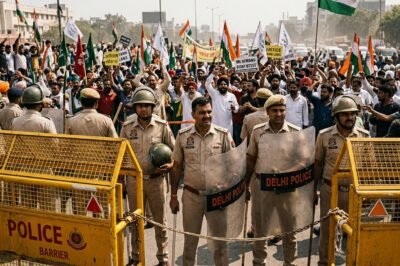
In the heart of the world’s largest democracy, the streets of New Delhi have once again become the epicenter of a fierce ideological battleground, sparking a national debate that transcends the physical barricades erected by the administration. As the sweltering heat of the capital mirrors the rising political temperature, Rahul Gandhi, a prominent figure in the Indian National Congress, has launched a scathing critique against the central government, specifically targeting Prime Minister Narendra Modi and Home Minister Amit Shah. His assertion that the current state of affairs represents “not the India we want” serves as a rallying cry for the opposition and a stark indictment of the state’s handling of civil dissent. The recent crackdown on protesters in Delhi, characterized by heavy police presence, the deployment of water cannons, and the detention of activists, has become the latest flashpoint in a long-standing struggle between the ruling Bharatiya Janata Party (BJP) and its critics. This confrontation is not merely about a single protest or policy; it is about the very soul of the Indian Republic and the democratic norms that have defined it for over seven decades. The intensity of Gandhi’s rhetoric underscores a deepening polarization within the country, where every administrative action is scrutinized through the lens of constitutional integrity and individual liberty.
The Delhi Crackdown: A Chronology of Escalation
The events leading up to Rahul Gandhi’s impassioned statement began with a series of demonstrations organized by various civil society groups and political factions. These protesters, representing a diverse array of interests ranging from agrarian rights to employment reforms, sought to march toward the heart of the capital to voice their grievances. However, they were met with an unprecedented level of security. The Delhi Police, which falls under the direct jurisdiction of the Union Home Ministry led by Amit Shah, implemented a multi-layered security apparatus. This included the installation of massive concrete blocks, iron spikes on roads, and high-tensile wire fencing, effectively turning the city’s borders into fortified zones. The visual of these barriers sparked immediate outrage, drawing comparisons to international conflict zones rather than the administrative center of a democratic nation.
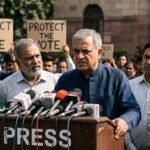
As the standoff progressed, the use of force became more pronounced. Reports of tear gas shells being fired from drones and the use of sonic weapons to disperse crowds began to circulate on social media, creating a narrative of state-led repression. Rahul Gandhi, visiting the site of the detentions and meeting with the families of those held by the authorities, articulated a sense of betrayal. He argued that the use of such heavy-handed tactics against unarmed citizens is a sign of weakness, not strength. According to Gandhi, a government that fears its own people to the extent of barricading itself behind iron and concrete has lost the moral authority to lead. This sentiment resonated with many who feel that the space for peaceful protest is shrinking in India, replaced by a culture of surveillance and preemptive suppression.
Rahul Gandhi’s Ideological Rebuttal: The Two Indias
At the core of Gandhi’s critique is the concept of “two Indias.” In his detailed analysis provided to the press and via his social media channels, he paints a picture of a nation divided by the current administration’s policies. One India, he suggests, is the India of the elite and the powerful, protected by the state machinery and shielded from the consequences of economic hardship. The other India consists of the laborers, farmers, and youth who find themselves at the receiving end of what he calls “dictatorial” policies. By invoking the phrase “Not the India we want,” Gandhi is tapping into a nostalgic yet progressive vision of a pluralistic, inclusive, and tolerant society—a vision he claims is being systematically dismantled by the Modi-Shah duo.
Gandhi’s strategy involves framing the Delhi crackdown not as an isolated incident of maintaining law and order, but as a symptom of a broader systemic failure. He argues that the “Gujarat Model” of governance, characterized by a strong centralized executive and a perceived intolerance for dissent, is being forcefully applied at the national level. By naming Prime Minister Modi and Amit Shah directly, Gandhi is personalizing the conflict, holding the highest echelons of power accountable for the actions of the ground-level police force. This direct approach aims to puncture the aura of invincibility surrounding the BJP leadership and to project the Congress party as the true custodian of India’s constitutional values, specifically the right to freedom of speech and assembly as enshrined in Article 19.
The Role of PM Modi and Amit Shah: A Centralized Response
The involvement of the Prime Minister and the Home Minister in the narrative of the Delhi protests is significant due to the unique administrative structure of the National Capital Territory. Unlike other states where the police report to the local government, the Delhi Police is an arm of the central government. Therefore, any major security operation or crackdown is viewed as a direct reflection of the Union government’s policy. Critics argue that the heavy-handedness seen in recent weeks is a deliberate strategy to discourage future protests and to project an image of a “tough” state. From the perspective of the BJP, however, these measures are necessary to prevent chaos and to ensure that the functioning of the capital is not held hostage by political agitators.
Amit Shah, as the Home Minister, has been at the forefront of defending the security measures. The government’s stance is that the protesters often include elements that seek to incite violence or destabilize the state, thereby necessitating a firm response. They point to past incidents where protests turned into riots as a justification for the preemptive use of barricades and detentions. However, the opposition, led by Gandhi, dismisses these claims as a pretext for silencing legitimate criticism. The struggle here is over the definition of “public order”—is it the absence of dissent, or is it the management of dissent within a democratic framework? The Modi government’s preference for the former has become a central theme in Gandhi’s political messaging, as he seeks to build a coalition of the discontented ahead of major electoral cycles.
Public Perception and the Erosion of Democratic Rights
Beyond the political rhetoric, the crackdown has had a profound impact on public perception. Statistics regarding the number of detentions and the duration of internet shutdowns in specific pockets of the capital suggest a tightening grip on the flow of information. Human rights organizations have noted with concern the increasing use of the Unlawful Activities (Prevention) Act (UAPA) and other stringent laws against activists. While the government maintains that these laws are used only against those who threaten national security, the perception among the youth and the academic community is one of intimidation. Rahul Gandhi has been quick to capitalize on this, positioning himself as a defender of the marginalized who are afraid to speak out.
The impact of these crackdowns also extends to the international community. As India seeks to position itself as a global leader and a “Vishwa Guru” (World Teacher), the imagery of police clashing with protesters and the use of iron spikes on roads creates a contradictory narrative. International media outlets have frequently covered these events, often highlighting the friction between the government’s democratic claims and its ground-level actions. Gandhi’s statement, “Not the India we want,” is also intended for this international audience, signaling that there is a significant portion of the Indian populace that does not subscribe to the current government’s methods. This internal friction, if left unaddressed, could potentially affect India’s soft power and its standing in global democratic indices, which have already seen a decline in recent years.
Conclusion: Future Implications for Indian Democracy
The confrontation over the Delhi protest crackdown marks a critical juncture in Indian politics. As Rahul Gandhi continues to lash out at the Modi-Shah leadership, the political discourse is likely to become even more abrasive. The immediate implication is a further hardening of stances on both sides, making parliamentary consensus on key issues nearly impossible. For the Congress party, this is an opportunity to reclaim its lost ground by becoming the face of the anti-establishment sentiment. For the BJP, the challenge lies in balancing its image as a strong, security-conscious party with the need to appear responsive to the grievances of the citizenry. The “India we want” remains a contested vision, and the path chosen to resolve these protests will dictate the health of India’s democratic institutions for years to come.
Ultimately, the resolution of such conflicts requires a return to dialogue rather than a reliance on force. If the government continues to view every protest as a security threat and the opposition continues to view every administrative action as a step toward autocracy, the democratic fabric of the nation will continue to fray. The words of Rahul Gandhi serve as a reminder that democracy is not just about elections, but about the day-to-day interactions between the state and its people. As India moves forward, the world will be watching to see if the nation can bridge this divide and reclaim a version of itself that is inclusive, peaceful, and truly reflective of its constitutional ideals. The struggle on the streets of Delhi is, in many ways, a struggle for the definition of India itself.































Leave a Reply