
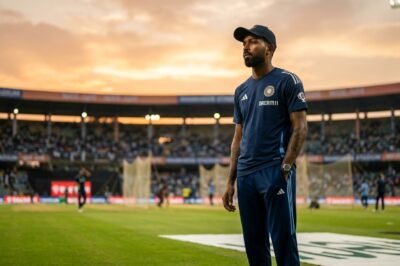
In a move that has sent ripples through the Indian cricketing community, the announcement of Baroda’s squad for the upcoming Syed Mushtaq Ali Trophy (SMAT) notably lacked one of the biggest names in the sport: Hardik Pandya. As India’s premier fast-bowling all-rounder and a linchpin in the national T20 setup, Hardik’s absence from domestic duties frequently sparks intense debate regarding player availability, workload management, and the prioritization of international commitments over the domestic grind. While his brother, Krunal Pandya, continues to lead the side with a mix of seasoned experience and tactical acumen, the void left by Hardik is palpable, both in terms of on-field balance and the star power he brings to the regional tournament. This development comes at a crucial juncture in the Indian cricket calendar, with the Champions Trophy on the horizon and the national team navigating a period of transition in its leadership and core structure. Understanding the nuance behind this exclusion requires a deep dive into the physical demands placed on modern all-rounders, the specific instructions from the Board of Control for Cricket in India (BCCI) medical team, and the broader strategic roadmap for Hardik Pandya’s career as he approaches his thirties.
The Fitness Conundrum and Workload Management
The primary narrative surrounding Hardik Pandya for the last several years has been his physical durability. Since his back surgery, Hardik has transitioned into a player whose overs must be managed with surgical precision. The decision for him to skip the Syed Mushtaq Ali Trophy is likely rooted in a sophisticated workload management program designed by the National Cricket Academy (NCA). For an all-rounder who generates significant pace and possesses an explosive batting style, the risk of injury in a high-intensity domestic tournament often outweighs the benefits of match practice, especially when he is already a regular fixture in the national T20I squad.
Furthermore, the BCCI has recently been vocal about senior players participating in domestic cricket to prove their fitness and form. However, Hardik seems to occupy a unique niche. Unlike players who are fighting for their spots across formats, Hardik’s role as a specialist white-ball finisher and change-up bowler is well-defined. His absence suggests a tactical preservation, ensuring he remains ‘match-ready’ for the high-stakes international assignments rather than grinding through the league stages of domestic T20s. This approach, while controversial among traditionalists who believe in the sanctity of the Ranji and SMAT trophies, reflects the modern reality of ‘format specialization’ where elite athletes are preserved for the grandest stages.
Impact on Baroda’s Team Dynamics and SMAT Prospects
Baroda has historically been a powerhouse in domestic white-ball cricket, and much of that success in recent years has been built around the Pandya brothers. Without Hardik, the team loses a genuine three-dimensional player who can single-handedly change the course of a game. His absence forces the Baroda selection committee and coach to look toward younger talent to fill the ‘finisher’ role—a task that is easier said than done. The middle-order now carries a heavier burden, and the bowling unit lacks that extra bit of ‘X-factor’ pace that Hardik provides during the middle and death overs.
Key challenges for the Baroda squad in this tournament include:
- Loss of a premier death-overs bowling option who can clock 140kph.
- Reduced depth in the lower-middle order batting, requiring others to step up.
- Absence of a high-pressure match-winner who has succeeded at the highest level.
- A shift in leadership dynamics where the tactical focus moves away from all-round versatility.
However, Baroda’s squad remains robust under the captaincy of Krunal Pandya. The team has cultivated a culture of resilience, often performing well even when their star international players are unavailable. The inclusion of other domestic stalwarts and promising youngsters provides an opportunity for the next generation of Baroda cricketers to step out of the shadow of the Pandya brothers.
The Krunal Pandya Leadership and Tactical Stability
Krunal Pandya’s role as the captain of Baroda cannot be overstated. He has been the bedrock of the state side, providing a sense of continuity that is often missing in teams that lose players to the national squad. Under his leadership, Baroda has focused on a spin-heavy attack and a calculated batting approach. Krunal himself has evolved into a reliable anchor and an intelligent left-arm spinner who understands the nuances of Indian pitches. His familiarity with the domestic circuit allows Baroda to punch above their weight, even in the absence of a superstar like Hardik.
The tactical stability Krunal brings ensures that the team doesn’t panic. He understands the strengths and weaknesses of every player in the squad, and his partnership with the coaching staff has created a system where roles are clearly defined. While Hardik’s explosive nature is a luxury, Krunal’s steady hand is a necessity. The SMAT campaign will be a test of Krunal’s ability to marshal his resources and find innovative ways to compensate for the missing firepower in the lower-middle order.
Strategic Roadmaps: Champions Trophy and the Road to 2026
From a national perspective, the management of Hardik Pandya is geared toward the 2025 Champions Trophy and the 2026 T20 World Cup. The Indian team management, led by the head coach and the selection committee, views Hardik as an indispensable asset for these ICC events. His absence from the SMAT could be interpreted as a directive to focus on specific conditioning drills rather than competitive match-play, which carries a higher risk of freak injuries. There is a clear strategy to ensure that Hardik is at his peak physical condition when he dons the blue jersey.
This long-term planning is essential for a player of Hardik’s caliber. By skipping certain domestic windows, he can focus on enhancing his bowling workload in a controlled environment. The goal is to have him bowling ten overs in ODIs and four high-intensity overs in T20Is without his body breaking down. The roadmap for 2025 involves several white-ball series where Hardik will be expected to play a leading role, and the current hiatus from domestic cricket is a calculated step in that journey.
T20 Specialist vs. All-Format Readiness
The exclusion also brings to light the ongoing discussion about Hardik Pandya’s future in Test cricket. While he has expressed a desire to return to the longest format, his consistent absence from red-ball domestic cricket (and now even some white-ball domestic cricket) suggests that the transition back to Tests is not an immediate priority. Hardik has effectively become a white-ball specialist, a role that allows him to maximize his impact while minimizing the toll on his body. This specialization is a growing trend in global cricket, where players choose to excel in specific niches rather than burning out across all three formats.
Being a specialist requires a different kind of preparation. The intensity of T20 cricket is high, but the volume of play is lower than in Test matches. By not playing the Syed Mushtaq Ali Trophy, Hardik might be focusing on explosive power training and specific skill sets required for the death overs. This specialization ensures that when he does play, he is the most impactful player on the field. However, it also means that the window for him to ever return to the Indian Test side is rapidly closing, as the selectors prefer players who are battle-hardened in the Ranji Trophy.
Market and Brand Implications for Hardik Pandya
Beyond the boundary ropes, Hardik Pandya is a massive brand. His presence in any tournament significantly boosts viewership, sponsorship interest, and social media engagement. His absence from the SMAT is a minor blow to the tournament’s commercial appeal but does little to dim his personal brand. As the captain of the Mumbai Indians and a high-profile international star, Hardik’s marketability is tied more to his performance in the IPL and for India than in domestic state cricket.
Advertisers and sponsors look for consistency and ‘big stage’ presence. Hardik’s strategic rest periods are often seen by brand managers as a way to ensure he remains the face of the sport for years to come. In the ecosystem of Indian sports marketing, a healthy and fit Hardik Pandya playing in the IPL and World Cups is far more valuable than a fatigued or injured Hardik playing every domestic game. His management team likely supports these breaks, as they prolong his career and maintain his status as one of the most sought-after athletes in the country.
Conclusion on Future Implications
The news that Hardik Pandya will not feature in the Baroda squad for the Syed Mushtaq Ali Trophy is a multifaceted story. It reflects the complexities of modern athlete management, where the physical limits of a high-performance all-rounder are weighed against the traditional expectations of domestic participation. For Baroda, it is a challenge to their depth and resilience; for Hardik, it is a period of focused preparation; and for the Indian selectors, it is a move to protect a vital national asset. As the tournament progresses, the focus will remain on how Baroda fares under Krunal and how quickly Hardik returns to the international fold. Ultimately, the success of this strategy will be measured by Hardik’s performance in the next major ICC tournament. If he leads India to glory, this period of absence will be hailed as a masterclass in workload management. If not, the debates regarding the importance of domestic cricket will only grow louder. For now, the cricketing world waits to see the next chapter in the career of India’s most enigmatic all-rounder.




































Leave a Reply