
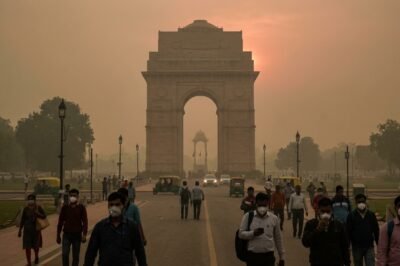
As the sun dipped below the horizon on the eve of Diwali, the festive spirit in India’s capital was met with a familiar, suffocating embrace. According to the latest data from IQAir, a prominent Swiss air quality technology group, Delhi has once again claimed the dubious distinction of being the most polluted major city on the planet. This annual recurrence, timed perfectly with the Festival of Lights, serves as a grim reminder of the structural environmental failures that plague the National Capital Region (NCR). While the city prepares for celebrations, the air quality index (AQI) has surged into the ‘hazardous’ territory, prompting urgent health warnings and reigniting a fierce debate over policy efficacy. The narrative surrounding Delhi’s pollution is no longer just an environmental concern; it has transformed into a complex socio-economic crisis that threatens the health of millions and the financial stability of the region. As the world watches, the ‘Gas Chamber’ moniker for Delhi feels less like hyperbole and more like a permanent geographic reality, casting a long shadow over India’s aspirations of becoming a global superpower with world-class urban infrastructure.
The Swiss Group’s Verdict: Quantifying the Air Crisis
The report released by IQAir provides a chilling quantitative breakdown of the atmospheric conditions in Delhi. On the eve of Diwali, the city’s Air Quality Index (AQI) breached the 400 mark in several monitoring stations, a level categorized as ‘Severe.’ To put this in perspective, the World Health Organization (WHO) recommends an annual mean concentration of PM2.5 not exceeding 5 micrograms per cubic meter. Delhi’s levels were frequently recorded at 20 to 30 times this limit. The data points to a systemic failure in curbing the sources of particulate matter that thicken the air during the transition from autumn to winter.
IQAir’s live rankings often show Delhi competing with cities like Lahore and Beijing, but the intensity and duration of Delhi’s pollution spikes are increasingly unique. The Swiss group’s methodology utilizes a vast network of ground-based sensors combined with satellite data, ensuring a high degree of accuracy. Their findings suggest that the current spike is not merely a result of festive firecrackers—which are largely banned but still prevalent—but a culmination of unfavorable meteorological conditions and stagnant pollutants from industry and transport. The ‘most polluted’ tag is more than a headline; it is a statistical indictment of the current environmental management strategies implemented within the NCR.
The Economic Toll: Analyzing Market and Productivity Impacts
From a financial perspective, the pollution crisis in Delhi is a massive drain on the national economy. Estimates from various economic think tanks suggest that air pollution costs India approximately $95 billion annually in lost productivity and healthcare expenses. In Delhi specifically, the ‘pollution season’ leads to a significant decrease in footfall for retail businesses, excluding the e-commerce sector which sees a minor bump. However, the broader service sector, which relies on the physical presence of employees, suffers as respiratory illnesses lead to a surge in sick leave and decreased cognitive performance among workers.
Furthermore, the real estate market in Delhi-NCR is witnessing a subtle but steady shift. High-net-worth individuals and corporate offices are increasingly looking at ‘greener’ alternatives in Southern India or the outskirts of the NCR, fearing the long-term health implications of staying in the capital. This ‘environmental migration’ could eventually lead to a stagnation of property values in the most affected zones. Additionally, the foreign direct investment (FDI) climate is sensitive to quality-of-life metrics. International corporations often struggle to convince top-tier global talent to relocate to Delhi during the winter months, citing the air quality as a primary deterrent. This talent drain poses a hidden but significant cost to India’s burgeoning tech and financial sectors.
Meteorological Factors and the Stubble Burning Conundrum
The timing of this pollution peak is inextricably linked to the agricultural cycles of neighboring states like Punjab and Haryana. As farmers clear their fields for the winter crop, the practice of stubble burning releases massive plumes of smoke that are carried by north-westerly winds directly into the Indo-Gangetic plain. While the government has introduced subsidies for crop-residue management machinery, the adoption rate remains insufficient to prevent the seasonal crisis. The political friction between the Delhi government and neighboring state administrations often stalls meaningful cross-border cooperation.
Adding to the human-made factors is the geographical ‘trap’ of Delhi’s winter. During this period, a phenomenon known as temperature inversion occurs, where a layer of warm air traps cooler air—and all the pollutants it contains—close to the ground. Low wind speeds mean that the smoke from vehicles, construction dust, and industrial emissions cannot be dispersed. This creates a stagnant pool of toxic air that lingers over the city for weeks. Without a fundamental shift in agricultural practices and a drastic reduction in local emission sources, the city remains at the mercy of the wind and weather.
Public Health Emergency: The Human Cost of Toxic Air
The health implications of breathing Delhi’s air are catastrophic. Medical professionals in the capital report a 25-30% increase in patients with respiratory complaints during the Diwali season. PM2.5 particles are small enough to enter the bloodstream, leading not only to lung diseases like asthma and COPD but also increasing the risk of heart attacks, strokes, and even cognitive decline. For the most vulnerable populations—children and the elderly—the current AQI levels are equivalent to smoking multiple packs of cigarettes a day.
The long-term societal impact is equally concerning. Schools are frequently forced to shut down or move to online modules to protect students, disrupting the educational cycle. The reliance on expensive air purifiers and N95 masks has created a ‘pollution divide,’ where the wealthy can afford to filter their indoor environments while the poor, who often work outdoors in construction or delivery services, are left completely exposed. This disparity highlights a burgeoning human rights issue centered around the right to clean air, a right that remains elusive for the millions residing in the capital region.
Policy Failures and the Graded Response Action Plan (GRAP)
The Indian government has not been idle, but the effectiveness of its interventions is under intense scrutiny. The Graded Response Action Plan (GRAP) is the primary framework used to tackle pollution, involving stages of restrictions ranging from banning coal-fired tandoors to halting construction activities and implementing the ‘odd-even’ vehicle rationing scheme. However, critics argue that these measures are reactive rather than proactive. By the time GRAP Stage III or IV is triggered, the health damage to the population has already been done.
There is also the issue of enforcement. While firecracker bans are announced every year, enforcement remains patchy due to cultural sensitivities and the sheer scale of the city. Industrial compliance with emission norms is another area where the gap between policy and practice is wide. The Supreme Court of India has frequently intervened, pulling up authorities for their ‘lackadaisical’ approach, yet the needle has barely moved on the annual AQI averages. A more integrated approach, involving a transition to 100% electric public transport and a permanent solution to stubble burning, is required to move beyond these temporary, emergency fixes.
Future Implications: Can Delhi Breathe Again?
The long-term outlook for Delhi depends on a radical transformation of its energy and transport infrastructure. The current trajectory is unsustainable, both for the health of its citizens and the vitality of its economy. We are likely to see a continued push toward green energy, with the Delhi government aiming to significantly increase the share of renewable energy in the city’s grid. Furthermore, the expansion of the Delhi Metro and the introduction of thousands of electric buses are steps in the right direction, but they must be matched by a total overhaul of waste management to prevent landfill fires, which are another major source of toxic fumes.
Ultimately, the Swiss group’s ranking should serve as a wake-up call for a national-level intervention. As India positions itself as a leader in the global climate change conversation through initiatives like the International Solar Alliance, it must address the smog in its own backyard. The transition to a circular economy, where agricultural waste is turned into biofuel and industrial emissions are strictly sequestered, is no longer a luxury but a necessity. Until then, the eve of Diwali will continue to be a time of anxiety rather than just celebration, as the city waits for the wind to clear the air that its own progress has fouled.



































Leave a Reply