
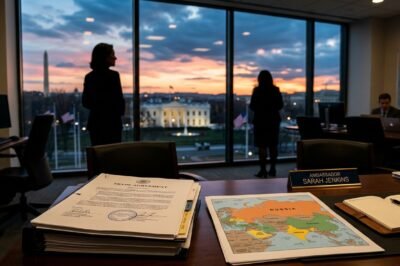
As the dust settles on the 2024 United States presidential election, the global community is scrutinizing every appointment made by President-elect Donald Trump for his second term. Among the most pivotal roles is that of the White House Chief of Staff, a position often described as the gatekeeper to the President. The recent appointment has sent ripples through the diplomatic corridors of New Delhi, particularly following reports from NDTV highlighting past criticisms directed at India by the incoming Chief of Staff. These criticisms specifically targeted India’s burgeoning trade relationship with Russia and its refusal to align fully with Western-led sanctions following the invasion of Ukraine. For India, a nation that has historically balanced its strategic autonomy with a growing partnership with the US, these past comments serve as a sobering reminder of the transactional nature of the ‘America First’ doctrine. The intersection of domestic American politics and international trade security is now more complex than ever, as the Trump administration prepares to reconcile its desire for a strong Indo-Pacific ally with its demand for total economic loyalty from its partners.
The appointment of Susie Wiles as Chief of Staff marks a historic first, but for international observers, the focus remains on the policy implications. While Wiles is known as a behind-the-scenes strategist, the broader ecosystem of the Trump transition team—and the sentiments expressed by those now ascending to power—reflects a skepticism toward India’s ‘double-dealing’ in energy markets. Since 2022, India has significantly ramped up its imports of discounted Russian crude oil, effectively becoming one of Moscow’s largest customers and providing a vital lifeline to the Kremlin’s economy. This has been a point of contention in Washington, where both Republican and Democratic hawks have expressed frustration. However, the specific tone of the Trump camp suggests a more confrontational approach to trade deficits and energy bypasses. This analysis delves deep into the friction points between the incoming administration and the world’s most populous democracy, exploring whether these past criticisms will manifest as formal policy shifts or remain as mere rhetorical pressure points.
The Core of the Criticism: Russian Oil and Strategic Autonomy
The primary bone of contention highlighted in recent reports is India’s refusal to abandon its energy ties with Russia. Since the onset of the Russia-Ukraine war, India’s imports of Russian oil have surged by over 400%, a move New Delhi defends as a necessary measure to ensure its own energy security and control domestic inflation. For the incoming Trump administration, however, this is often viewed through the lens of trade fairness. The sentiment expressed by key Trump advisors, including the newly appointed Chief of Staff, suggests that India cannot expect a ‘privileged’ relationship with the United States while simultaneously undermining U.S. geopolitical objectives by funding a strategic adversary.
Furthermore, the criticism extends to the mechanisms used to bypass Western sanctions. India’s use of alternative payment systems and its role as a refiner of Russian crude—which is then sold as petroleum products to Europe and the US—has been labeled by some in the Trump circle as a ‘backdoor’ that weakens American influence. The rhetoric suggests that the second Trump term will be less inclined to grant the ‘CAATSA’ (Countering America’s Adversaries Through Sanctions Act) waivers that India has previously enjoyed. If the Chief of Staff’s past views are any indication, the ‘free pass’ India has received for its S-400 missile deal and its oil imports may be reaching its expiration date.
Trade Imbalances and the ‘Tariff King’ Rhetoric
Donald Trump has famously referred to India as the ‘Tariff King,’ a label that reflects his long-standing grievance with India’s high import duties on American goods, ranging from Harley-Davidson motorcycles to agricultural products. The Chief of Staff is expected to be a primary architect in implementing the ‘universal baseline tariff’ that Trump proposed during his campaign. This policy aims to penalize countries that maintain trade surpluses with the United States, and India, which has a significant trade surplus in goods, is directly in the crosshairs.
The criticism regarding trade isn’t just about tariffs; it is about market access. The incoming administration is likely to push for a complete overhaul of the Generalised System of Preferences (GSP), which was revoked during Trump’s first term and remained a point of friction during the Biden era. With a Chief of Staff who has historically prioritized American manufacturing over international diplomacy, India may find itself forced to choose between maintaining its protectionist domestic policies and securing a favorable trade deal with Washington. The ‘America First’ agenda does not view India’s ‘Atmanirbhar Bharat’ (Self-Reliant India) initiative as a complementary goal, but rather as a competitive barrier that must be dismantled.
The Geopolitical Calculus: China vs. Russia
A significant factor in the relationship is the ‘China threat.’ Both Washington and New Delhi agree that containing China’s influence in the Indo-Pacific is a top priority. This shared interest has often acted as a buffer, preventing trade disagreements from derailing the entire partnership. However, the Trump administration’s perspective on Russia differs significantly from the previous administration. While Trump has expressed a desire to de-escalate the conflict in Ukraine, his advisors remain wary of India’s role in a ‘new multipolar world’ where Russia and India grow closer.
The challenge for the Chief of Staff will be to balance the need for India as a military counterweight to China with the demand that India reduces its reliance on Russian defense technology. Over 60% of India’s military hardware is of Russian origin. The criticism from the Trump camp often emphasizes that India’s military dependency on Moscow makes it a ‘compromised’ partner in high-tech defense sharing. As the US moves to share critical technologies under the iCET (Initiative on Critical and Emerging Technology) framework, the incoming Chief of Staff will likely demand stricter ‘firewalls’ against Russian influence, potentially stalling key defense projects if New Delhi does not comply.
Market Implications for Energy and Defense
The financial markets are already pricing in the volatility that a Trump 2.0 administration brings to Indo-US relations. Specifically, the energy sector is on high alert. If the US decides to strictly enforce the $60-per-barrel oil price cap on Russian crude or introduces secondary sanctions on Indian entities involved in the trade, the cost of energy in India could spike, leading to inflationary pressures. This would affect everything from the Indian Rupee’s exchange rate to the profitability of major Indian refiners like Reliance Industries and Indian Oil Corporation.
In the defense sector, the implications are equally stark. Major American firms like General Electric (GE), which has a deal to manufacture jet engines in India, and General Atomics, which is selling Predator drones to the Indian Navy, could see their contracts weaponized as leverage in trade negotiations. The Chief of Staff’s office will play a decisive role in determining whether these deals are fast-tracked or held hostage to gain concessions on Indian tariffs or Russian oil purchases. Investors are currently cautious, looking for signs of whether the ‘transactional’ nature of Trump’s first term will return with even greater intensity.
Human Rights and the Diaspora Factor
Unlike the Biden administration, which occasionally raised concerns regarding human rights and democratic backsliding in India, the Trump administration is expected to be largely indifferent to these domestic issues. This ‘non-interference’ policy is generally welcomed by the Indian government. However, the Chief of Staff’s focus on ‘merit-based immigration’ and the potential tightening of H-1B visa programs could create a new front of tension. The Indian diaspora, which was a significant supporter of Trump in 2024, may find itself caught between its loyalty to the President and the restrictive immigration policies spearheaded by his inner circle.
The past criticisms of India by the incoming staff often touched upon the ‘unreliability’ of partners who do not align with American labor and immigration standards. If the Chief of Staff pushes for a more restrictive labor market to ‘protect’ American jobs, it could lead to a ‘brain drain’ reversal or a cooling of the tech partnership that currently defines the bilateral relationship. The irony remains that while the political leadership may share a personal rapport, the administrative machinery under the Chief of Staff will be focused on numbers, deficits, and ‘winning’ the trade war.
Conclusion: Navigating a Transactional Future
The transition to a new Trump administration, guided by a Chief of Staff who has already voiced concerns over India’s strategic choices, signals a period of ‘tough love’ in Indo-US relations. The era of diplomatic niceties is likely over, replaced by a raw, transactional approach where every concession from Washington will require a reciprocal gesture from New Delhi. India’s challenge will be to maintain its ‘strategic autonomy’—a cornerstone of its foreign policy—while satisfying a US administration that demands loyalty in its economic and energy crusades.
Ultimately, the criticism of India’s Russian oil trade serves as a harbinger of the pressures to come. If India can successfully pivot and offer the Trump administration a ‘win’ on trade or investment in American manufacturing, the friction may be manageable. However, if New Delhi remains steadfast in its neutrality regarding Russia, the gatekeeper of the White House may ensure that the path to the Oval Office for Indian interests remains fraught with hurdles. The coming months will reveal whether these past criticisms were a warning shot or the foundation of a new, more contentious chapter in the world’s most consequential democratic partnership.




































Leave a Reply