
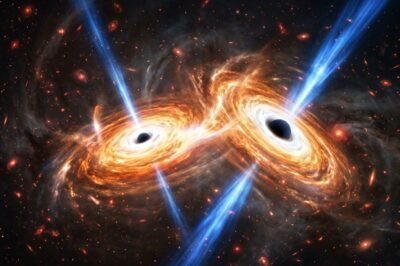
The universe has always been a repository of profound mysteries, but every so often, a discovery emerges that fundamentally alters our understanding of the cosmic timeline. In a groundbreaking revelation that has sent shockwaves through the global scientific community, the James Webb Space Telescope (JWST) has identified the earliest pair of black hole-powered quasars ever recorded. These celestial phenomena, residing in the distant reaches of the ‘Cosmic Dawn,’ date back to an era when the universe was less than 900 million years old. For years, astronomers hypothesized that such massive, energetic systems existed in the early universe, but the sheer scale and proximity of this duo have left experts reeling. This discovery is not merely a visual triumph; it is a direct challenge to existing cosmological models that dictate how quickly supermassive black holes can grow and how galaxies evolve in their infancy. By peering through the thick curtains of primordial dust, Webb’s infrared eyes have captured a moment of cosmic transition that was previously invisible to human technology. The discovery of these twin titans suggests that the early universe was a far more violent and crowded environment than we ever dared to imagine, forcing a massive re-evaluation of the first billion years of existence. This event marks a pivotal moment in astronomy, where the theoretical meets the observable in a spectacular display of light and gravity.
The Cosmic Dawn Unveiled: Identifying the Twin Beacons
The identification of these two quasars represents a technical feat that would have been impossible just five years ago. Quasars are the extremely bright cores of galaxies, powered by supermassive black holes that are actively devouring matter. As this matter spirals into the black hole, it heats up to millions of degrees, releasing jets of radiation that can outshine entire galaxies. Finding a single quasar at this distance is rare, but finding a pair in such close proximity is virtually unheard of in the context of the early universe. This specific pair was located at a redshift that indicates they existed approximately 900 million years after the Big Bang, a period known as the epoch of reionization. During this time, the first stars and galaxies were beginning to clear the neutral hydrogen fog that filled the cosmos.
Astronomers utilized the Near-Infrared Camera (NIRCam) and the Mid-Infrared Instrument (MIRI) on board the James Webb Space Telescope to pierce through the cosmic dust that usually obscures such distant objects. The data revealed two distinct sources of intense light, which subsequent analysis confirmed to be two separate, massive black holes. The proximity of these two quasars suggests that they are in the process of a galactic merger, a titanic event where two massive galaxies collide to form an even larger structure. This discovery provides the first empirical evidence of early-stage galaxy mergers involving supermassive black holes, offering a direct look at the hierarchical growth of structures in the young universe.
Deciphering Quasar Mechanics: Engines of the Early Universe
To understand why this discovery is so stunning, one must appreciate the sheer power of a quasar. These are not static objects; they are dynamic, high-energy engines. The black holes at the center of these quasars are estimated to be hundreds of millions of times the mass of our sun. The rate at which they are consuming surrounding gas and dust is staggering, a process known as accretion. As this material falls inward, it forms an accretion disk, where friction and gravitational forces generate intense heat and light across the electromagnetic spectrum. The energy output of a single quasar can be a thousand times greater than that of the entire Milky Way galaxy.
The existence of two such powerful engines so close together implies a massive concentration of dark matter and gas in that region of space. In the early universe, these ‘overdense’ regions served as the nurseries for the largest clusters of galaxies we see today. By studying the light from these quasars, scientists can also learn about the intergalactic medium—the space between galaxies. The light acts as a flashlight, illuminating the gas it passes through on its multi-billion-year journey to Earth. This allows researchers to measure the chemical composition and ionization state of the early universe, providing a roadmap of how the cosmos evolved from a hot, dense plasma into the structured web of stars and galaxies we inhabit.
The James Webb Advantage: Engineering a Glimpse into the Past
The success of this mission highlights the extraordinary engineering behind the James Webb Space Telescope. Unlike the Hubble Space Telescope, which primarily views the universe in visible and ultraviolet light, Webb is optimized for the infrared. This is crucial because light from the distant universe is ‘redshifted.’ As the universe expands, the light traveling through space is stretched to longer, redder wavelengths. Light that started as ultraviolet or visible billions of years ago arrives at our sensors as infrared radiation. Without the sensitivity of Webb’s 6.5-meter golden mirror, these twin quasars would have remained hidden forever.
Furthermore, the telescope’s ability to conduct spectroscopy—breaking light down into its component colors—allows astronomers to determine the exact chemical signatures of the elements surrounding these black holes. The data from the JWST has shown traces of carbon, oxygen, and neon in the vicinity of these early quasars. The presence of these ‘heavy’ elements is surprising because they are only forged in the hearts of stars. This indicates that even by 900 million years post-Big Bang, several generations of stars had already lived and died, enriching the cosmos with the building blocks of life and planetary systems. This level of detail is providing a much more complex and ‘mature’ picture of the early universe than previously thought.
Rewriting the Rulebook: The Challenge to Modern Cosmological Theories
Perhaps the most significant aspect of this discovery is the challenge it poses to the ‘Standard Model’ of cosmology. Current theories suggest that supermassive black holes take billions of years to reach the masses observed in these two quasars. However, Webb has found them existing in a fully realized state much earlier. This leads to the ‘seed’ problem: how did these black holes get so big so fast? There are two primary theories being debated: the ‘light seed’ theory, where black holes grow from the remnants of the first stars, and the ‘heavy seed’ theory, where massive clouds of gas collapse directly into large black holes without forming stars first.
The discovery of a pair of quasars suggests that mergers play a more critical role in early growth than previously estimated. If two massive black holes can find each other and merge early on, it would drastically accelerate their growth trajectory. This finding pushes theorists to reconsider the rate of accretion and the frequency of galactic interactions in the first billion years. The data suggests that the early universe was a high-speed assembly line of cosmic structures, far exceeding the pace predicted by computer simulations. Astronomers are now scrambling to adjust their models to account for this accelerated growth, which could have implications for our understanding of dark matter’s role in pulling the first structures together.
The Ripple Effect: Economic and Industrial Impacts of Space Exploration
While the scientific implications are clear, the discovery also has significant ‘down-to-earth’ impacts, particularly in the realms of technology and the global economy. The development of the James Webb Space Telescope involved thousands of private contractors, leading to innovations in cryogenic cooling, mirror fabrication, and high-speed data processing. These technologies often find their way into commercial sectors, such as medical imaging and telecommunications. The continued success of JWST reinforces the value of public-private partnerships in the space sector, encouraging further investment from both governments and private equity firms in aerospace technology.
From a market perspective, the data generated by Webb is a form of high-value intellectual capital. The software developed to process these massive datasets is being adapted for use in big data analytics and artificial intelligence. Furthermore, the global interest in these discoveries fuels a growing ‘space economy,’ which encompasses everything from satellite launches to space tourism. As we push the boundaries of the observable universe, we are simultaneously building the industrial infrastructure for the next century of human achievement. The discovery of these quasars serves as a powerful reminder that the search for knowledge is also a primary driver of economic and technological progress.
Conclusion: A New Era of Discovery and Future Implications
The discovery of the earliest pair of black hole-powered quasars is a watershed moment for 21st-century science. It has provided the first definitive evidence of how the most massive structures in our universe began to take shape during the Cosmic Dawn. As the James Webb Space Telescope continues its mission, we can expect more discoveries that challenge our preconceptions and expand our horizons. These twin quasars are just the beginning; they are the signposts pointing toward a deeper understanding of the laws of physics and the history of our existence. Future observations will focus on finding even earlier pairs and investigating the host galaxies in which these monsters reside. We are witnessing the dawn of a new era in astronomy, where the invisible is made visible and the ancient secrets of the stars are finally within our reach.
Ultimately, this discovery reminds us of our place in the cosmos. We are a species capable of building a machine and sending it a million miles from Earth to look back at the beginning of time. The data returned by Webb does more than satisfy scientific curiosity; it inspires a sense of wonder and a drive for exploration that is fundamental to the human spirit. As we continue to analyze the light from these distant beacons, we are not just looking at black holes; we are looking at the origins of everything we have ever known.





































Leave a Reply