
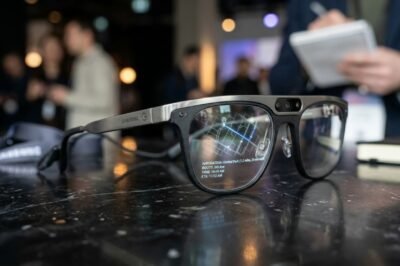
The landscape of personal technology is currently teetering on the edge of a monumental transition, one that marks the potential decline of the smartphone as our primary interface and the rise of ambient, wearable computing. For years, the industry has whispered about the ‘next big thing,’ and according to a recent bombshell report from Bloomberg, that moment is set to arrive this December. The collaboration between Google and Samsung, two titans that have shaped the digital era, is finally coming to fruition with the release of their long-awaited AI-powered smart glasses. This partnership represents more than just a new gadget; it is a defensive and offensive masterstroke aimed at reclaiming the narrative from Meta and Apple. As we stand in late 2024, the anticipation is palpable, driven by the promise of seamless Gemini AI integration and Samsung hardware engineering. This introduction into the consumer market signals a paradigm shift where information is no longer a pocket-bound resource but a visual overlay on our reality, fundamentally changing how we interact with the physical and digital worlds simultaneously. This release is expected to challenge our definitions of privacy, productivity, and social interaction, setting a new benchmark for the tech industry.
The Strategic Alliance: Why Google and Samsung Need Each Other
The alliance between Google and Samsung is not a matter of convenience but of survival in the rapidly evolving artificial intelligence landscape. Google, despite its dominance in search and cloud services, has historically struggled with consumer hardware, as seen in the limited market share of Pixel devices compared to industry leaders. Conversely, Samsung is a manufacturing powerhouse with a global supply chain and brand loyalty that rivals Apple, yet it lacks the sophisticated large language models (LLMs) necessary to power the next generation of smart devices. By combining Google software ecosystem, specifically the Gemini AI suite, with Samsung precision hardware and optics, the two companies are creating a synergy that neither could achieve alone. This partnership mirrors their successful collaboration on Android and Wear OS, but the stakes are significantly higher this time. The goal is to create a seamless user experience that integrates Google services like Maps, Translate, and Workspace directly into the wearer field of vision, powered by Samsung specialized micro-OLED displays.
According to industry insiders, this collaboration also serves as a critical buffer against the rising influence of Meta and its Ray-Ban smart glasses. Meta has proven that there is a genuine appetite for stylish, camera-equipped eyewear that does not look like a science fiction prop. Google and Samsung must now prove they can offer more than just a camera and speakers; they must offer a ‘cognitive assistant’ that understands the world in real-time. This requires immense processing power and cloud integration, areas where Google infrastructure is unparalleled. From a business perspective, this launch is a calculated move to secure a foothold in the ‘spatial computing’ market before Apple second-generation Vision products or Meta orion project can dominate the mid-tier consumer segment.
Technical Specifications and the Gemini AI Integration
At the heart of these new smart glasses is a custom-built processor, likely a derivative of Qualcomm Snapdragon AR platforms, optimized specifically for low-power AI tasks. However, the true selling point is the software layer. Bloomberg reports indicate that these glasses will be the first wearable to feature ‘Gemini Live’ natively, allowing users to have fluid, spoken conversations with an AI that can see what they see. Imagine walking through a foreign city and asking the glasses to translate a menu or provide historical context for a building in real-time. This level of multimodal AI integration is what separates this upcoming release from previous attempts like Google Glass or early North Focals. The glasses are rumored to feature high-resolution cameras that act as the ‘eyes’ for the AI, enabling advanced object recognition and situational awareness without requiring the user to look down at a phone screen.
The display technology is another area where Samsung expertise will shine. Unlike the bulky headsets of the past, these smart glasses are expected to utilize thin-film waveguides and micro-LED technology to project crisp, readable text and simple graphics onto the lenses. This ensures that the glasses remain lightweight and socially acceptable for all-day wear. Battery life remains the ‘holy grail’ of wearables, and reports suggest that Samsung has developed a high-density battery that can provide a full day of intermittent use. The integration with the broader Android ecosystem means that notifications, health data from Galaxy Watches, and smart home controls will all be accessible via voice or subtle gestures, making the glasses a centralized hub for the user digital life.
Market Competitive Landscape: A Battle for the Face
The timing of the December release is no coincidence. By launching just before the holiday season and ahead of major 2025 tech conferences, Google and Samsung are looking to disrupt Meta growing dominance. Meta Ray-Ban smart glasses have been a surprise hit, proving that consumers are willing to wear cameras on their faces if the design is right. However, Meta lacks a robust productivity ecosystem compared to Google. While Meta glasses are great for social media and basic tasks, the Google-Samsung glasses are being positioned as tools for ‘enhanced living’ and professional productivity. The competition is not just about hardware; it is about which AI assistant people want to live with. Google Gemini vs. Meta AI is the new battlefront, and the face is the most valuable real-estate in tech.
Furthermore, Apple looms large in the background. While the Vision Pro is a high-end, niche product, rumors of a lighter, more consumer-friendly ‘Apple Glass’ continue to circulate. By moving now, Google and Samsung are establishing a first-mover advantage in the high-end, non-VR smart glasses category. They are betting that consumers want an augmented reality (AR) experience that enhances the real world, rather than a virtual reality (VR) experience that replaces it. The market for AR glasses is projected to grow exponentially over the next five years, with some analysts suggesting it could become a 100 billion dollar industry by 2030. For Samsung and Google, this is a race to define the interface that will eventually succeed the smartphone.
Financial Implications and Stock Market Reaction
The announcement of a December release has already sent ripples through the financial markets. Investors in Alphabet (Google parent company) and Samsung Electronics are closely monitoring the potential for a new revenue stream. For Google, the glasses represent a way to diversify away from search advertising revenue by creating a new platform for ‘visual search’ and premium AI subscriptions. If Gemini becomes the primary way users interact with the physical world, the data gathered will be incredibly valuable for refining AI models and targeting services. Samsung, on the other hand, stands to benefit from its position as the primary hardware manufacturer and component supplier, potentially selling its display and battery technology to other AR competitors in the future.
- Revenue Diversification: Both companies are seeking to reduce reliance on the stagnating smartphone market.
- Component Sales: Samsung semi-conductor and display divisions could see a massive boost if the glasses are a hit.
- AI Subscription Growth: Google likely will bundle advanced glass features with its Google One AI Premium plans.
- Market Cap Impact: Successful execution could add billions to the market valuations of both tech giants.
However, there are risks. High price points have killed many promising wearables in the past. If the Google-Samsung glasses are priced too high—comparable to a flagship smartphone or more—they may struggle to find a mass audience. Financial analysts are looking for a ‘sweet spot’ pricing strategy that balances the high cost of components with the need for rapid adoption. The success of this launch will also depend on the developer ecosystem; if third-party developers do not build useful ‘apps’ or ‘skills’ for the glasses, they risk becoming an expensive novelty.
Privacy and Societal Considerations in the AI Era
One cannot discuss smart glasses without addressing the massive privacy implications. The ‘Glasshole’ era of 2013 taught Google a harsh lesson about social etiquette and the public fear of being constantly recorded. To avoid a repeat of this PR disaster, the new glasses are expected to feature very prominent ‘recording’ indicators and privacy-first features. Bloomberg reports that Google has spent significant time developing ‘on-device’ AI processing, meaning that much of the visual and auditory data captured by the glasses is processed locally and never sent to the cloud. This ‘Privacy by Design’ approach is crucial for gaining consumer trust in an era of heightened data sensitivity.
Beyond individual privacy, there is the broader question of how these devices will change social dynamics. Will we become even more distracted? Or will these glasses help us put our phones down and look up, with information appearing only when needed? There is a fine line between an ‘augmented’ reality and a ‘distracted’ one. Google and Samsung are reportedly working on ‘Digital Wellbeing’ features that limit notifications and prioritize real-world interactions. The success of these features will determine whether the glasses are seen as a tool for empowerment or another tether to the digital world. The social acceptance of seeing people wearing tech-augmented eyewear in restaurants, boardrooms, and parks will be the ultimate test for this product.
Future Implications: The Dawn of Ambient Computing
Looking ahead, the December release of the Google-Samsung AI glasses marks the beginning of the ‘Ambient Computing’ era. This is a future where technology fades into the background, becoming a subtle layer of our daily lives rather than a device we must actively hold and look at. As AI continues to evolve, the glasses will become more intuitive, eventually anticipating our needs before we even ask. We are moving toward a world where ‘Search’ is not something you do on a computer, but something you experience as you move through the world. The implications for education, healthcare, and remote work are profound. Surgeons could have vital stats projected in their field of vision; students could see historical figures ‘re-enacted’ at historical sites; and office workers could have virtual monitors anywhere they go.
In conclusion, the Google and Samsung collaboration is a high-stakes bet on the future of human-computer interaction. While challenges remain in battery life, social etiquette, and pricing, the technological foundation being laid this December is undeniable. If they succeed, we may look back at 2024 as the year the smartphone began its long goodbye, replaced by a pair of glasses that promised to make us smarter, more connected, and more present in the world around us. The world will be watching closely this December to see if these two giants can finally deliver on the promise of true augmented reality.







































Leave a Reply